
Table of Contents
Introduction to AI in Medical Writing
What do medical writers do?
If you’ve ever wondered what do medical writers do, here’s the simplest way to think about it: they act as translators between complex medical science and real-world understanding. Medical writers create clinical study reports, research papers, regulatory documents, blog content, patient education material, and even pharmaceutical marketing content. Their job is not just writing—it’s about accuracy, clarity, compliance, and storytelling backed by science.
From my personal experience as a PharmD, I initially thought medical writing was just about summarizing research papers. But once I stepped into it, I realized it’s far more nuanced. You’re constantly balancing scientific precision with readability, which is honestly harder than it sounds. One mistake in terminology can change the meaning of an entire document. That’s exactly why AI tools are now becoming indispensable—they help reduce human error while speeding up workflows.
Medical writers today also collaborate with regulatory teams, clinicians, and researchers. This includes preparing documents aligned with guidelines from organizations like the American Medical Writers Association, European Medical Writers Association, and Indian Medical Writers Association. These bodies ensure quality and standardization in the field. To increase virality I present with Free AI Tools for Medical Writing.
Rise of AI in medical writing
AI is no longer just a “nice-to-have” tool—it’s becoming the backbone of medical writing workflows. In fact, studies show a growing presence of AI-generated content in medical literature, increasing from 0% in 2022 to over 11% in 2025 . That’s a massive shift in just a few years.
What’s driving this change? Speed and scalability. AI tools can analyze thousands of research papers in seconds, generate structured drafts, and even suggest citations. Tools like AI-powered scribes are saving doctors 2–3 hours daily on documentation —imagine what that means for medical writers handling multiple projects.
Even more interesting, newer platforms like OpenAI’s Prism are designed specifically for scientific writing and collaboration, making research workflows smoother than ever . The future is clear: AI isn’t replacing medical writers—it’s redefining how they work.
Why AI Tools Are Essential for Medical Writers
Efficiency and productivity benefits
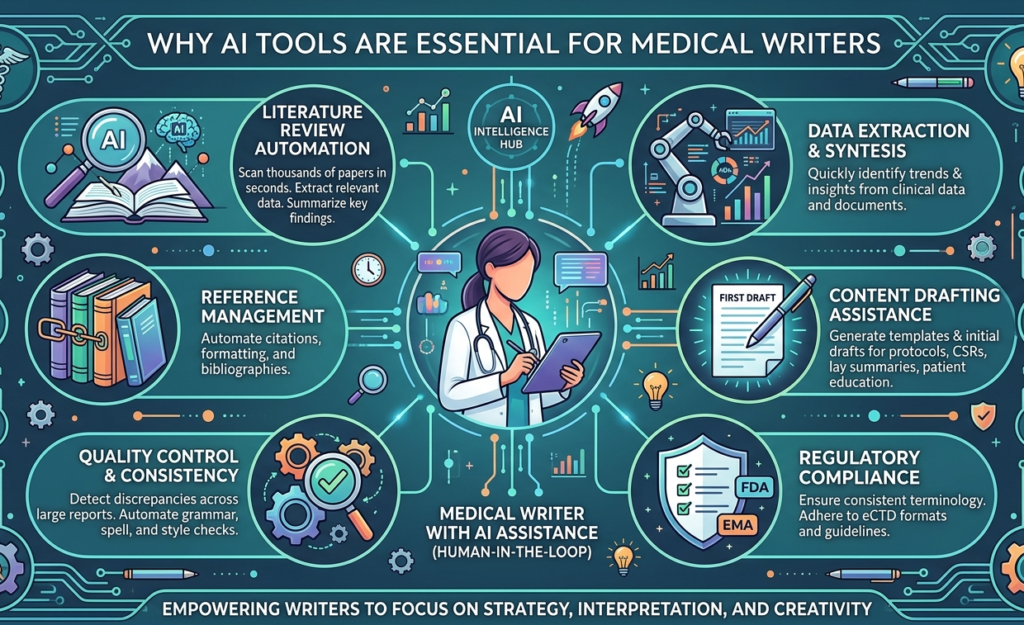
Let’s be honest—medical writing can be time-consuming. Literature reviews alone can take days or even weeks. Free AI tools for medical writing cut that down drastically. Instead of manually scanning PubMed or journals, AI can summarize key findings instantly.
For example, modern AI tools can automate:
- Literature review summaries
- Draft creation
- Reference formatting
- Data extraction
This doesn’t just save time—it allows writers to focus on critical thinking and analysis, which is where real value lies.
Accuracy and compliance advantages
Accuracy is everything in medical writing. One incorrect statement can lead to regulatory issues. AI tools trained on medical datasets can help ensure terminology consistency, grammar precision, and structured formatting.
Some enterprise tools even achieve over 99% drafting accuracy in regulated environments . That’s huge for clinical and regulatory writing where compliance is non-negotiable.
Types of AI Tools Used in Medical Writing
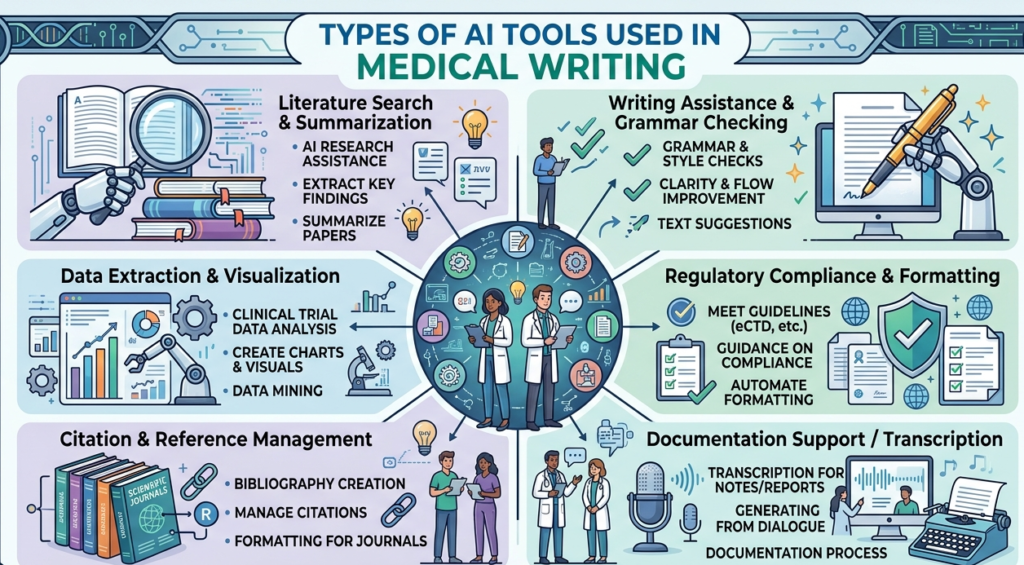
Writing and content generation tools
These are your everyday tools for drafting blogs, articles, and reports. They help generate structured content quickly while maintaining readability.
Research and literature review tools
These tools scan databases, extract relevant studies, and provide summaries. They are especially useful for systematic reviews and meta-analyses.
Editing and proofreading tools
Grammar checkers and AI editors ensure your content is polished and publication-ready. They improve tone, clarity, and readability.
Clinical documentation tools
AI scribes and documentation tools convert spoken or raw data into structured medical notes. These tools are widely used in hospitals and clinics.
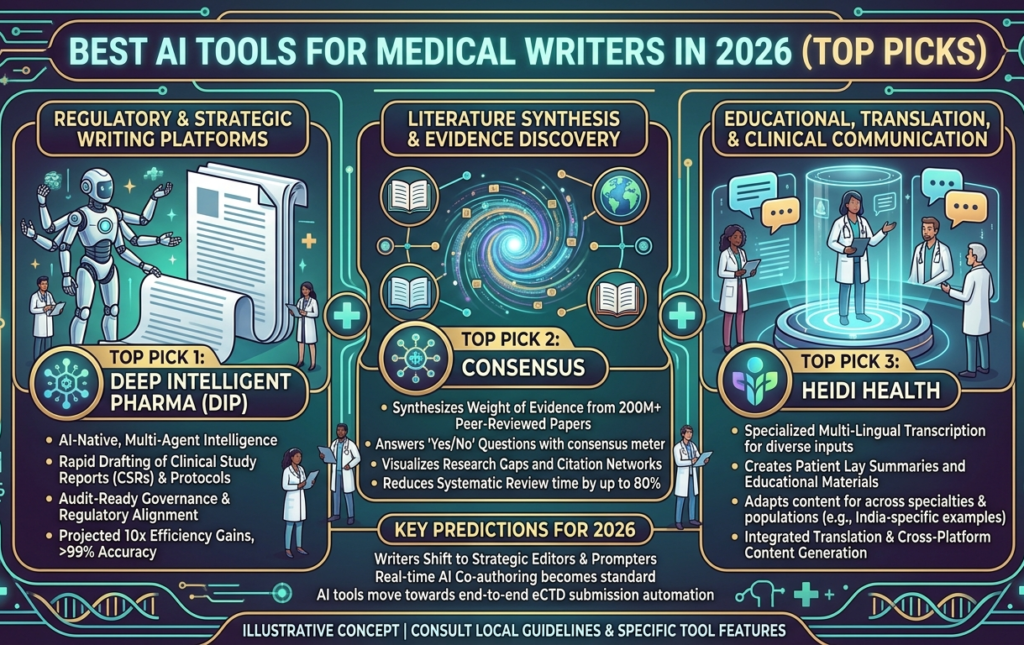
Best AI Tools for Medical Writers in 2026 (Top Picks)
AI writing assistants
Some of the recommended AI tools for medical writers include:
- Jasper AI – Ideal for blog writing and long-form medical content
- ChatGPT – Best for drafting, brainstorming, and explaining complex concepts
- Claude & Gemini – Strong for structured academic writing
These tools help generate drafts quickly but still require human validation.
AI research tools
- Perplexity AI – Real-time research with citations
- Elicit – Academic paper analysis
- NotebookLM – Works well with uploaded research PDFs
These tools are essential for AI academic writing and research.
AI clinical documentation tools
- Abridge – Leading AI medical scribe
- Nuance DAX Copilot – Reduces documentation time by 50%
- DeepScribe – Converts conversations into structured notes
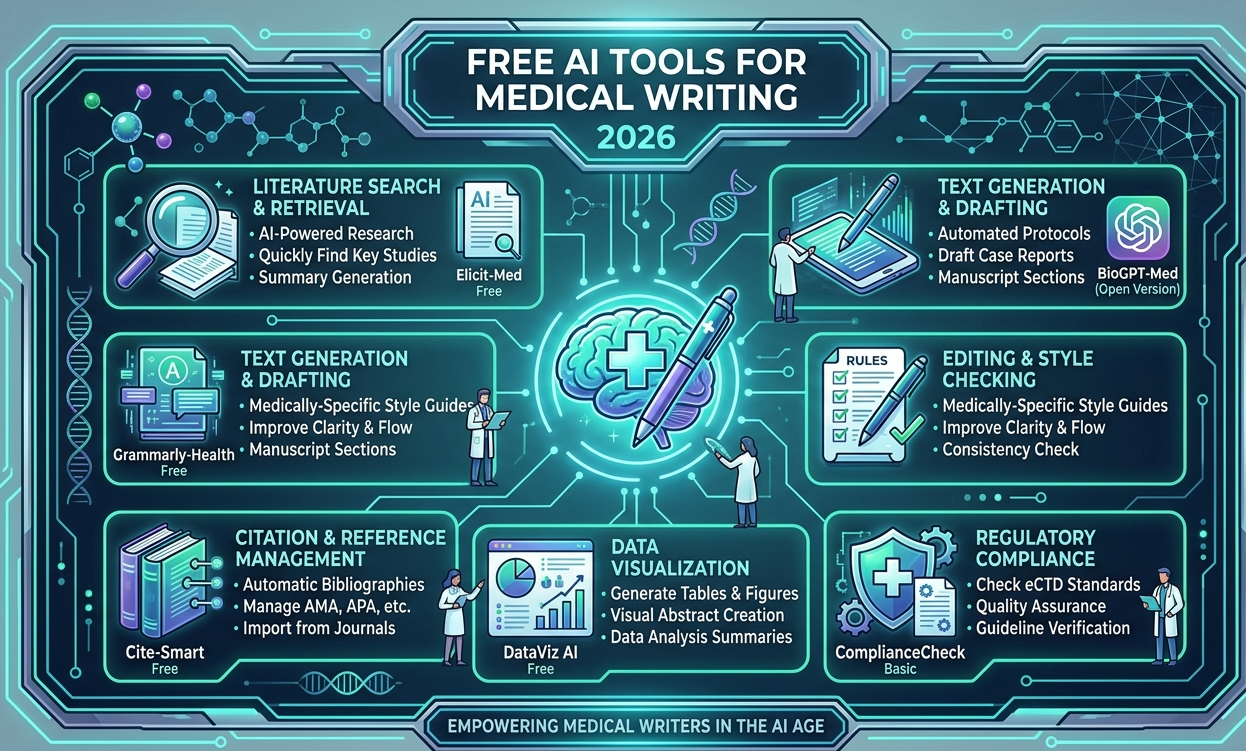
Free AI tools for medical writing
If you’re just starting out, here are some free AI tools for Medical Writing :
- ChatGPT (free tier)
- Grammarly (basic plan)
- OpenAI Prism (for research workflows)
These are great free AI tools for research paper writing and beginner-level projects.
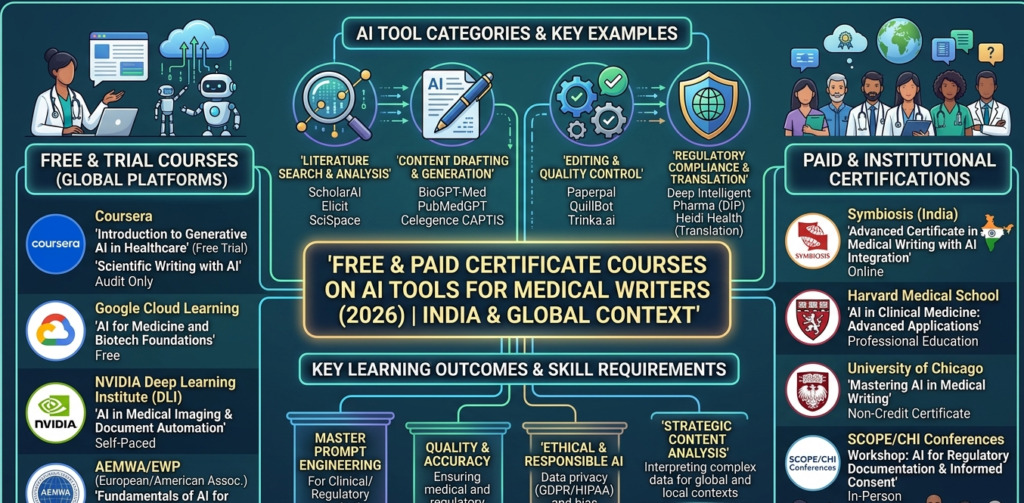
Paid Certificate Courses for Medical Writers and Free AI Tools for Medical Writing Certificate Courses (2026)
| Course Name | Platform | Type | Price | Certificate | Key Focus |
| Introduction to Medical Writing | Alison | Free | Free (certificate paid optional) | Yes | Basics of medical writing, research, documentation |
| AI in Medical Writing (Mini Course) | AIMWE | Free | Free | Yes (completion-based) | AI tools, prompt usage, workflow automation |
| Responsible AI for Health Writers | Health Writer Hub | Free | Free | Yes | Ethical AI use in medical writing |
| AI in Healthcare | Great Learning Academy | Free | Free | Yes | AI fundamentals, healthcare applications |
| NBEMS AI in Medicine Course | NBEMS (India) | Free | Free | Yes | AI in clinical & academic healthcare |
| Medical Writing Course | Elevify | Free | Free | Yes | Clinical writing, patient communication |
| Online Medical Writing Diploma | Reed (Learner Ground) | Paid | ~£21 | Yes | Advanced medical writing skills |
| Medical Writing + Terminology | Reed (Learning Route) | Paid | ~£21 | Yes | Medical transcription + writing |
What Makes These Courses Valuable for Medical Writers?
- AI-focused learning: Courses like AIMWE and Health Writer Hub teach real-world AI usage—prompting, automation, and ethical writing.
- Beginner-friendly: Platforms like Alison and Great Learning require no prior coding or AI knowledge.
- India-relevant options: NBEMS offers a government-backed AI course for healthcare professionals with certification.
- Career-ready skills: Paid courses (Reed) focus on practical writing, terminology, and documentation, which are directly applicable in jobs.
Best Picks (Quick Recommendations)
- Best FREE AI course: AIMWE Mini Course (focused on AI tools for medical writers)
- Best FREE beginner course: Alison Medical Writing
- Best India-specific AI course: NBEMS AI in Medicine
- Best PAID budget course: Reed Medical Writing Diploma
Pro Tip
When I started exploring free AI tools for medical writing, I made one mistake—jumping directly into tools without understanding how to use them responsibly. Courses like Health Writer Hub’s AI course actually teach something most people skip: ethical AI use in healthcare writing, which is critical if you’re dealing with patient or clinical data.

Case Study: Using Free AI Tools for Medical Writing as a PharmD Medical Writer
Let me share a real-world workflow from my experience.
During my PharmD internship, I had to prepare a drug utilization review report. Traditionally, this would take around 2–3 days. But using AI tools:
- I used ChatGPT to summarize research papers
- Used Grammarly for editing
- Used AI tools to structure headings
Result? The report was completed in less than 8 hours.
But here’s the key takeaway: AI didn’t replace my thinking—it amplified it. I still had to verify data, interpret results, and ensure accuracy.
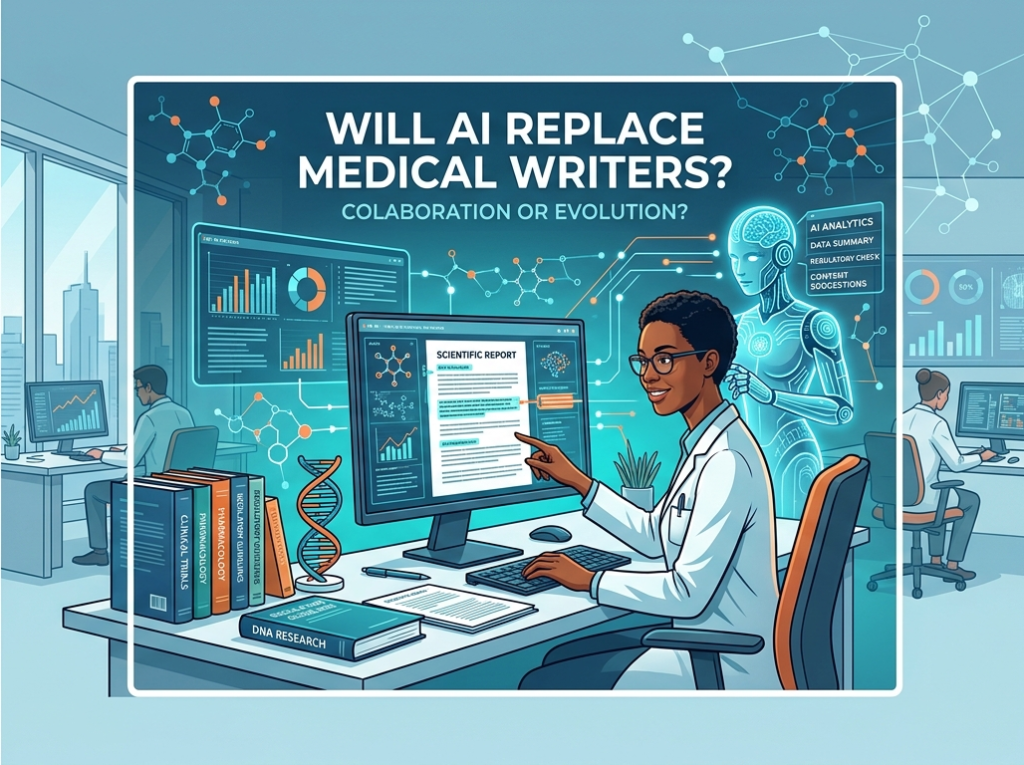
Will AI Replace Medical Writers?
This is the biggest question: will AI replace medical writers?
Short answer: No.
AI can generate content, but it lacks:
- Clinical judgment
- Contextual understanding
- Ethical decision-making
Even experts say AI will support, not replace healthcare professionals by handling repetitive tasks .Therefore explore Free AI Tools for Medical Writing.
Medical Writing Associations & Career Growth
If you’re serious about this field, consider joining:
- American Medical Writers Association
- European Medical Writers Association
- Australasian Medical Writers Association
- Indian Medical Writers Association
These organizations offer certifications, networking, and career growth opportunities.

Salary Insights: How Much Do Medical Writers Get Paid
India vs Global
| Location | Average Salary |
|---|---|
| India | ₹3–10 LPA |
| USA | $70,000–$120,000 |
| Europe | €50,000–€90,000 |
Freelancers can earn even more depending on experience and niche.
How to Start Medical Writing in 2026
- Learn basics of medical writing
- Take certification courses
- Build a portfolio
- Start freelancing
- Use AI tools to scale work
Best Free AI Tools for Medical Research & Academic Writing
Some of the best AI tools for research paper writing free include:
- Elicit
- Perplexity
- ChatGPT
These tools are ideal for free AI for research paper writing.
Free AI for research paper writing pdf
Free AI Tools for Medical Writing Courses & Certifications
Look for:
- Free medical writing courses online in India with certificate
- AI in medical writing course
- AMWA certification programs
Ethical Considerations of Free AI Tools for Medical Writing
AI must be used responsibly. Issues include:
- Data privacy
- Bias in AI models
- Lack of transparency
Future of Free AI Tools for Medical Writing in Medical Communications
AI is moving toward automation + human collaboration. Tools will become more specialized, especially in regulatory writing and pharmacovigilance.

Conclusion
Free AI Tools for Medical Writing are transforming how medical writers work in 2026. From drafting to research, these tools are improving efficiency, accuracy, and scalability. But the human element remains irreplaceable. As a PharmD, I’ve seen firsthand how AI can boost productivity—but only when used correctly. The future belongs to medical writers who can combine clinical knowledge with AI skills.
FAQs (People Also Ask)
Which is the Free AI tools for medical writing?
Tools like Jasper AI, ChatGPT, and Deep Intelligent Pharma are widely used.
Do medical writers use AI?
Yes, AI is increasingly used for drafting, editing, and research.
Can you use AI to write medical notes?
Yes, AI scribes like Abridge can generate clinical notes.
What are 7 types of AI?
Reactive machines, limited memory, theory of mind, self-aware AI, narrow AI, general AI, and superintelligence.
Which type of AI is ChatGPT?
ChatGPT is a form of narrow AI (ANI) focused on language processing.