
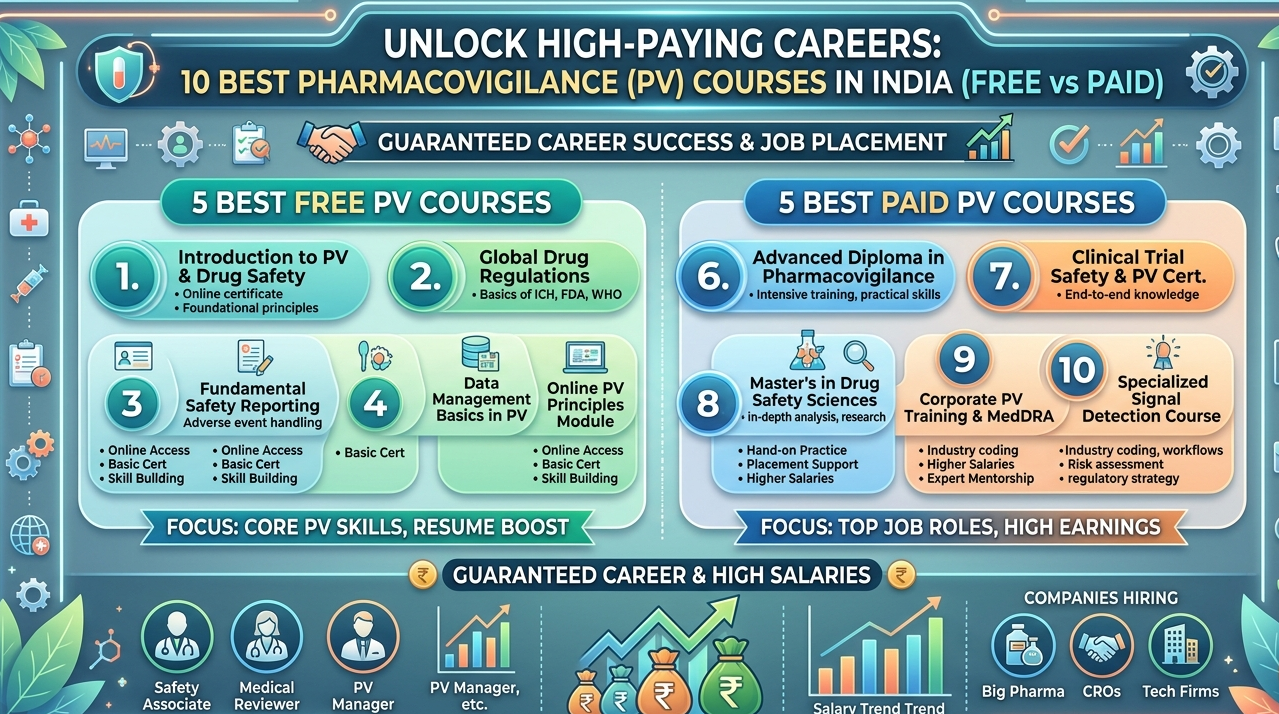
Table of Contents
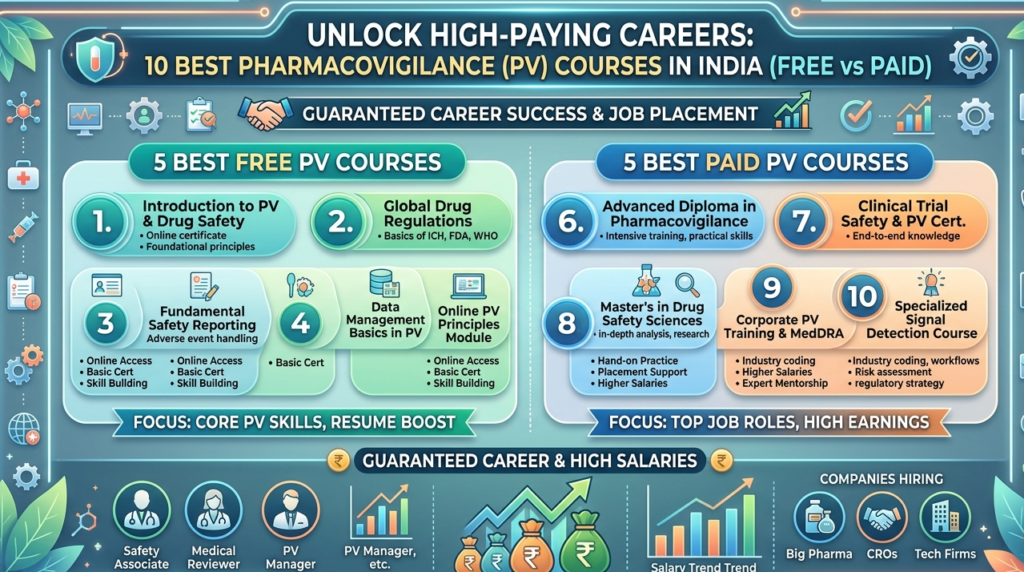
Introduction to Pharmacovigilance in 2026
Why Pharmacovigilance is Booming
If you’ve been exploring healthcare careers lately, you’ve probably noticed how pharmacovigilance is suddenly everywhere. And no, it’s not just hype. The global drug safety market is expanding rapidly due to increasing clinical trials, stricter regulatory requirements, and rising awareness about adverse drug reactions (ADRs). Governments and organizations are investing heavily in monitoring drug safety, especially after global health crises highlighted the importance of real-time drug surveillance.
Think of pharmacovigilance as the “watchdog” of the pharmaceutical industry. Every medicine you take has gone through layers of safety monitoring, and professionals in this field ensure that even after approval, drugs remain safe for public use. This growing responsibility means more demand for trained professionals, which is why online pharmacovigilance courses are gaining popularity like never before.
In 2026, students and professionals are faced with a dilemma: should they choose free pharmacovigilance courses with certificate or invest in paid programs? The answer isn’t one-size-fits-all, and that’s exactly what we’ll break down in this article.
Role of AI and Automation in Drug Safety
Artificial Intelligence is quietly reshaping pharmacovigilance. Tools now help automate case processing, signal detection, and data mining. But here’s the twist—AI isn’t replacing professionals; it’s transforming their roles. Instead of repetitive tasks, professionals now focus on decision-making, interpretation, and compliance.
This shift makes best pharmacovigilance courses online more relevant, as they now include modules on AI tools and regulatory software. If you’re planning to enter this field, choosing the right course type becomes even more critical.
What Are Pharmacovigilance Courses in India?
Core Skills You Learn
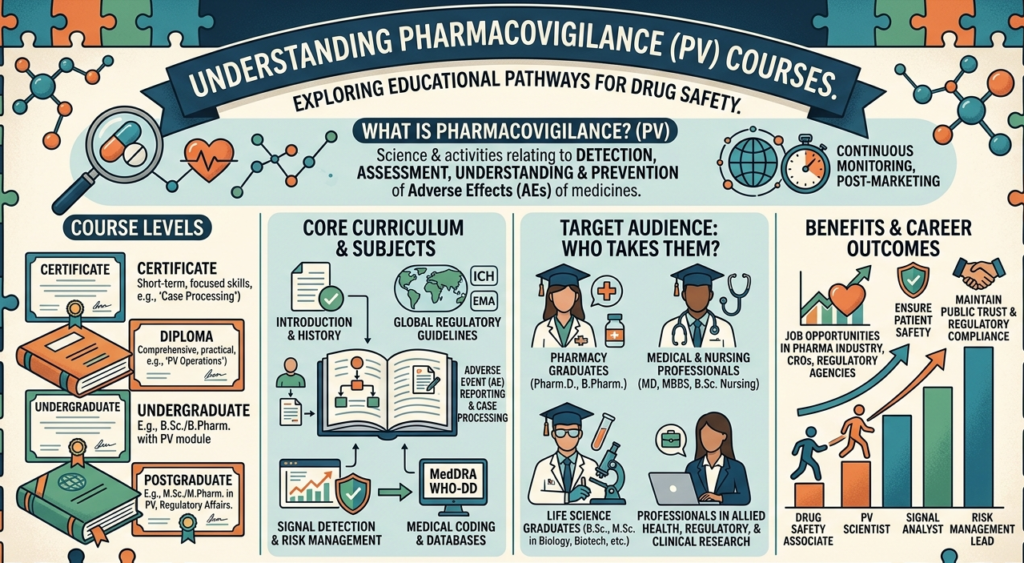
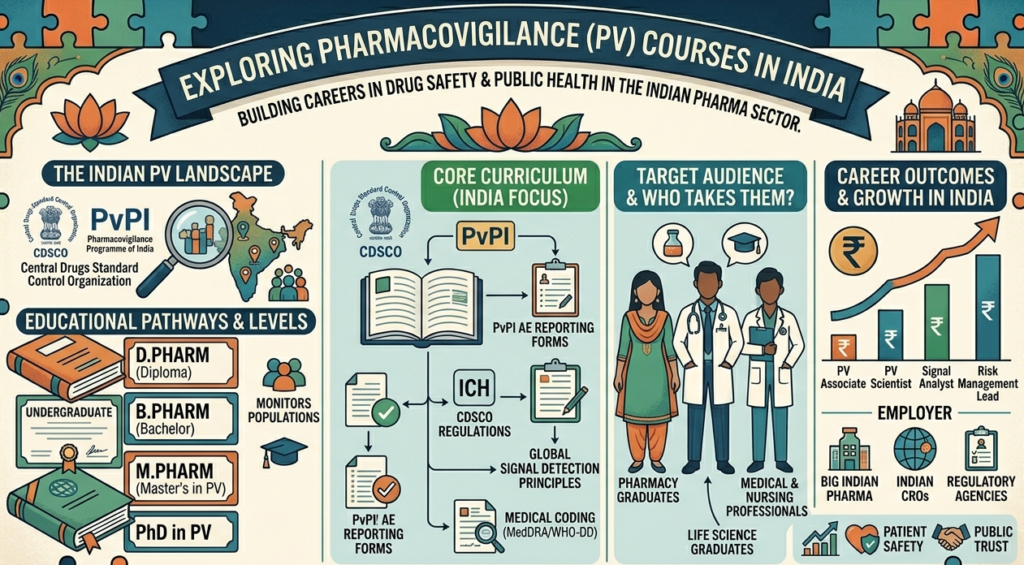
Pharmacovigilance courses are designed to teach you how to detect, assess, and prevent adverse effects of drugs. Whether you choose a pharmacovigilance course free with certificate or a paid one, the fundamentals usually include:
- Case processing and reporting
- Drug safety regulations (FDA, EMA, CDSCO)
- Signal detection and risk management
- Medical coding (MedDRA, WHO-ART)
- Clinical data analysis
These skills are essential for roles like Drug Safety Associate, PV Scientist, and Medical Reviewer.
Pharmacovigilance Courses in India Duration
The pharmacovigilance courses duration varies widely. Free courses typically last from a few hours to 4 weeks, while paid programs can extend from 3 months to 1 year. Longer courses usually include internships or placement assistance, which can be a game-changer for freshers.
Free Pharmacovigilance Courses with Certificate
Benefits of Free Courses
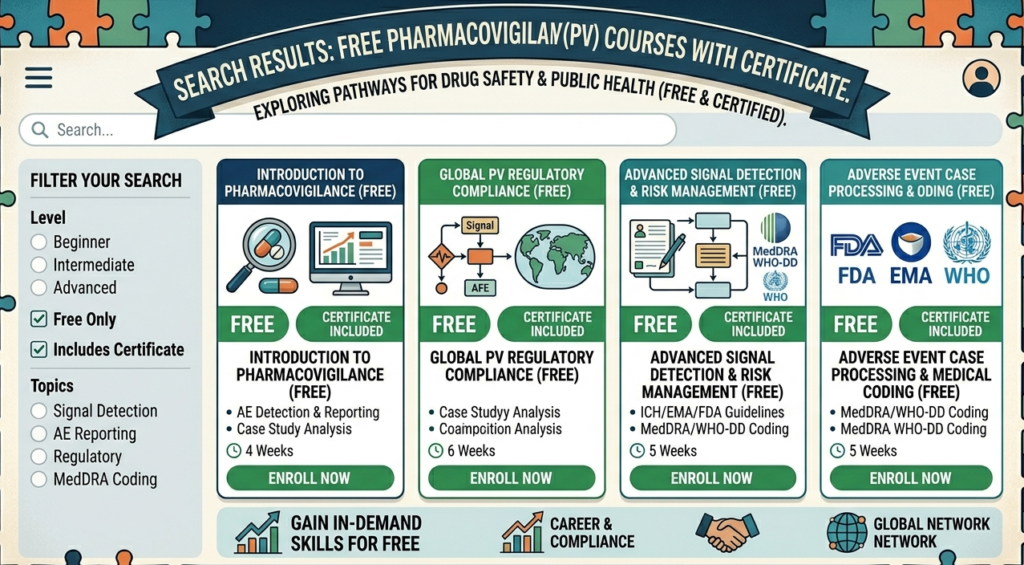
Let’s be honest—free always sounds tempting. And in many cases, it’s actually a great starting point. Free pharmacovigilance courses with certificate online are perfect for beginners who want to explore the field without financial risk.
One major advantage is accessibility. Anyone can enroll, regardless of background or location. Platforms offering pharmacovigilance free online courses with certificate in India make it easy for students to gain foundational knowledge. These courses often cover basic concepts, terminology, and introductory case studies.
Another benefit is flexibility. You can learn at your own pace, which is ideal if you’re juggling college or a job. For Pharm D students especially, these courses act as a stepping stone before diving deeper into advanced training.
Limitations of Free Pharmacovigilance Courses in India
Here’s where reality kicks in. Free courses often lack depth. They may not cover advanced topics like signal detection or real-world case processing. Also, most free certificates don’t carry strong industry recognition.
You might also miss out on practical exposure. No internships, no live projects, and definitely no placement support. So while free pharmacovigilance courses are great for learning, they might not be enough to land a job on their own.
Free Pharmacovigilance Courses in India (With Valid Links)
| Course Name | Platform | Key Features | Certificate |
| Good Pharmacovigilance Practice (GVP) Training | Pharmalessons | Covers GVP guidelines, ADR detection, regulatory basics | Yes |
| Pharmacovigilance & CDM Course | Jopir Courses | Free access, industry-relevant modules, QR verified certificate (₹60 optional) | Yes |
| Pharmacovigilance Training | Pharmalessons (via Shiksha) | Self-paced, intermediate level, certificate included | Yes |
| Basic Good Pharmacovigilance Practices | Pharma Digests | Beginner-friendly, 10–12 hrs training, ADR & signal detection basics | No |
| Pharmacovigilance Course | Elevify | Flexible duration (4–360 hrs), practical case-based learning | Yes |
Paid Pharmacovigilance Courses in India
Benefits of Paid Courses
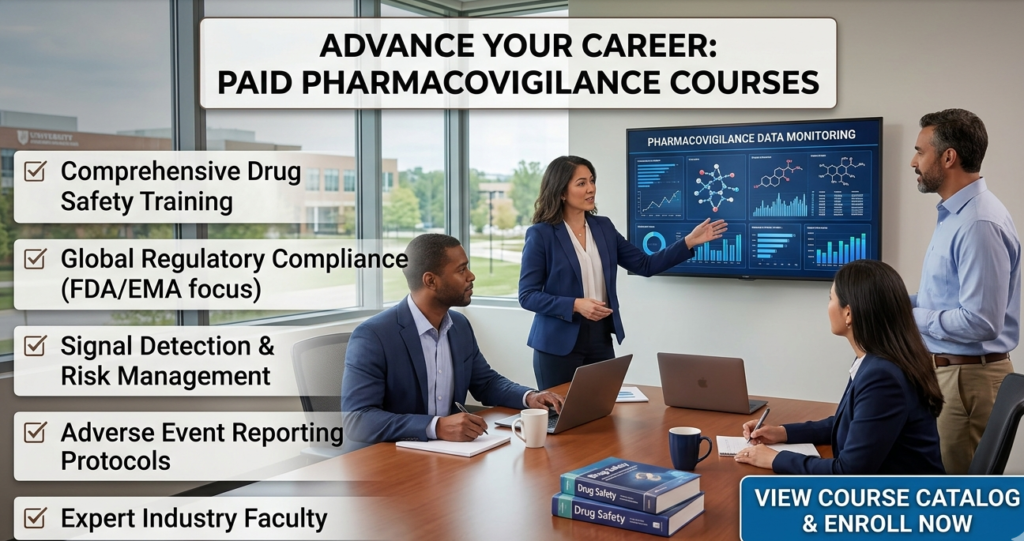
Paid courses are like a complete package. They go beyond theory and focus on real-world applications. If you’re serious about building a career, investing in a pharmacovigilance course online with placement can significantly boost your chances.
These courses often include:
- Hands-on training with real case studies
- Access to industry tools
- Internship opportunities
- Placement assistance
The biggest advantage? Credibility. Recruiters tend to trust candidates who have completed structured training programs from recognized institutes.
Drawbacks of Paid Courses
Of course, nothing is perfect. Paid courses can be expensive, ranging from ₹20,000 to ₹1,50,000 in India. Not all institutes deliver what they promise, so choosing the right one is crucial.
Also, some courses may focus too much on theory despite being paid. That’s why research is essential before enrolling.
Paid Pharmacovigilance Courses in India (With Valid Links)
| Course Name | Platform | Price | Key Features |
| Certificate Course in Pharmacovigilance | Udemy | Paid (varies ₹499–₹3,499) | Bestseller, 7+ hours content, MedDRA, ICSR, PV audits |
| Certificate Course in Pharmacovigilance | VigiServe Foundation | Paid | Covers ADR, causality, coding, industry fundamentals |
| Pharmacovigilance Online Certification | Pharmuni | Subscription (~€40/month) | ISO-certified, EU-GVP, signal detection, database training |
| Certificate Course in Pharmacovigilance | Pharmscape | ₹49–₹89 | 5-week beginner course, ADR classification, causality assessment |
Free vs Paid Pharmacovigilance Courses in India (Comparison Table)
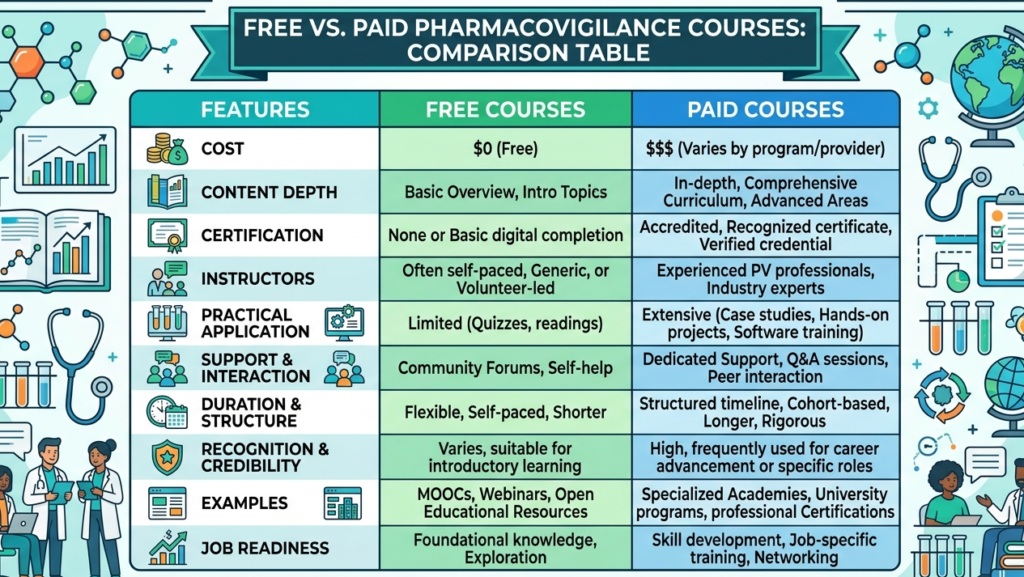
| Feature | Free Courses | Paid Courses |
|---|---|---|
| Cost | Free | ₹20,000–₹1,50,000 |
| Depth of Content | Basic | Advanced |
| Certification Value | Limited | High |
| Practical Training | Rare | Extensive |
| Placement Support | No | Yes |
| Duration | Short | Medium to Long |
Best Pharmacovigilance Courses Online in 2026
WHO Pharmacovigilance Course
The WHO pharmacovigilance course is one of the most recognized free programs globally. It provides foundational knowledge and is ideal for beginners. The certification adds credibility, especially for those starting out.
Online Pharmacovigilance Courses with Placement
Several institutes now offer pharmacovigilance course online with placement, combining theory with real-world exposure. These programs are particularly beneficial for fresh graduates looking to enter the industry quickly.
Pharmacovigilance Courses in India
Top Institutes Offering Courses
India has become a hub for pharmacovigilance training. Cities like Hyderabad, Pune, and Bangalore offer some of the best programs. Institutes focus on industry-relevant skills, making pharmacovigilance courses in India highly competitive.
Key Takeaways (Quick Decision Guide)
- ✅ Choose free pharmacovigilance courses with certificate if:
- You are a beginner
- You want basic knowledge without investment
- You are exploring career options
- 💼 Choose paid pharmacovigilance courses online if:
- You want job-ready skills
- You need placement support or internships
- You aim for career entry in drug safety
Pro Tip (From Industry Trend)
- Many successful candidates start with free courses → then upgrade to paid training
- Courses with ICSR processing + MedDRA + case studies have better job outcomes
- Certifications alone are not enough—practical exposure matters most
Personal Experience as a Pharm D Student
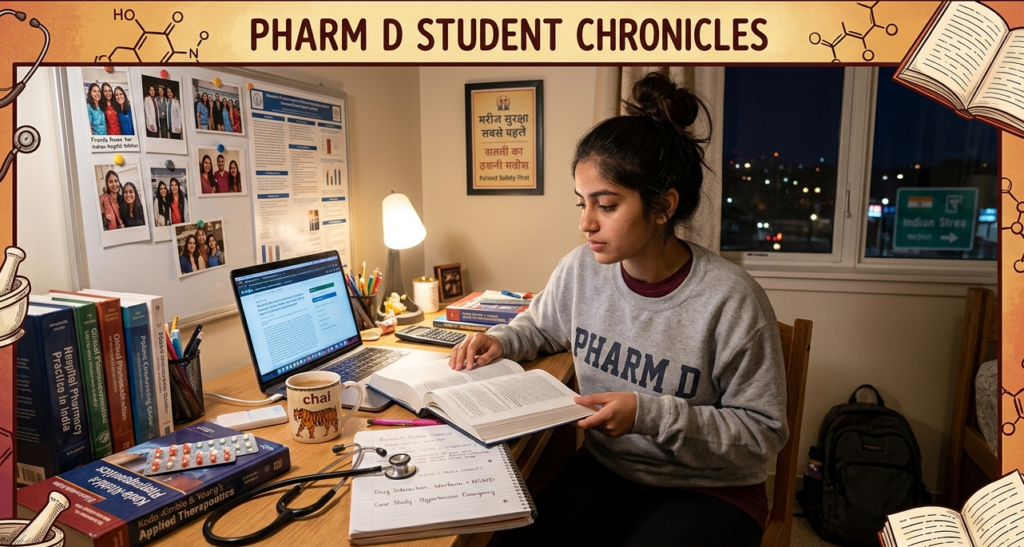
As a Pharm D student, I remember feeling overwhelmed by career choices. Clinical pharmacy, research, hospital roles—everything seemed confusing. That’s when I stumbled upon free pharmacovigilance courses with certificate online.
Initially, I took a free course just to understand the basics. It was eye-opening. I learned how ADRs are reported and how drug safety works behind the scenes. But when I tried applying for jobs, I realized something was missing—practical experience.
So I enrolled in a paid course. The difference was huge. I worked on real case studies, learned medical coding, and even attended mock interviews. That’s when things started clicking. Within months, I felt confident enough to apply for roles.
This journey taught me one thing: free courses are great for starting, but paid courses help you finish strong.

Case Study: From Free Course to Job Placement
Let’s take an example. A pharmacy graduate started with a pharmacovigilance course free with certificate. After gaining basic knowledge, they enrolled in a paid program with internship support.
During the internship, they worked on real ADR cases and learned industry tools. Within six months, they secured a job as a Drug Safety Associate.
This shows how combining both approaches can be powerful.
Career Scope & Salary in Pharmacovigilance
Pharmacovigilance offers promising career growth. Entry-level salaries in India range from ₹3–6 LPA, while experienced professionals can earn ₹10–20 LPA or more.
Globally, demand is even higher, making it a lucrative option for healthcare professionals.
Will AI Replace Pharmacovigilance Jobs?
Short answer? No. AI will assist, not replace. While automation handles repetitive tasks, human expertise is still needed for decision-making and regulatory compliance.

People Also Ask (FAQs)
Which certification is best for pharmacovigilance?
The WHO course and recognized paid certifications are considered highly valuable.
Will AI replace pharmacovigilance jobs?
No, it will enhance roles rather than replace them.
Which institute is best for pharmacovigilance?
Top institutes in India include those offering placement-based training programs.
What is pharmacovigilance salary?
Entry-level: ₹3–6 LPA; Experienced: ₹10–20 LPA.
Is Pharmacovigilance a good career?
Yes, due to high demand and global opportunities.

Conclusion
Choosing between free pharmacovigilance courses with certificate and paid programs depends on your goals. If you’re exploring, start free. If you’re serious about a career, invest in a paid course with placement support. The smartest approach? Combine both.