
Table of Contents
Pharmacovigilance and Clinical Research, whether you choose either continuous learning and practical exposure will play the biggest role in your success.
Understanding Pharmacovigilance
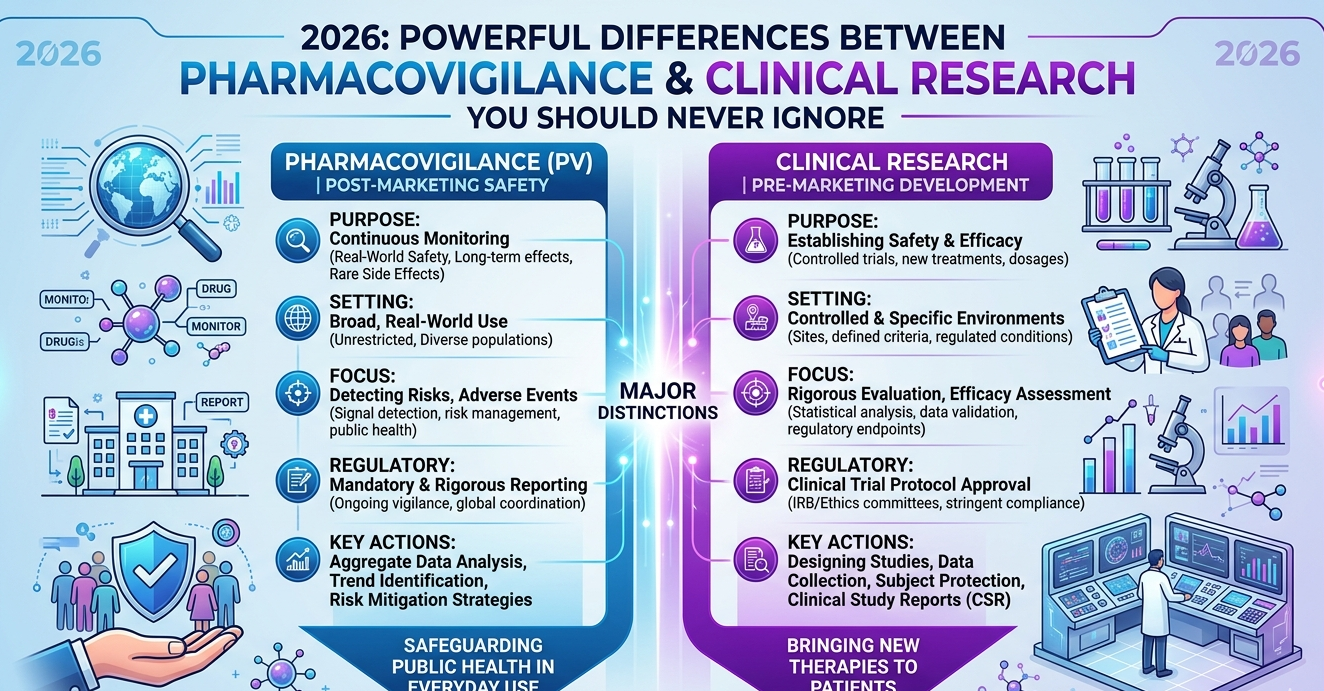
Pharmacovigilance is the science of detecting, assessing, understanding, and preventing adverse effects or drug-related problems. In simple words, it focuses on ensuring that medicines remain safe after they reach the market. Imagine a medicine as a newly launched car. Even after extensive testing, unexpected issues may appear once thousands or millions of people start using it. Pharmacovigilance works like the safety monitoring system that identifies those hidden problems before they become dangerous.
The importance of pharmacovigilance has increased dramatically after several drug-related disasters in history. Medicines that once seemed completely safe later caused serious adverse effects when used by large populations. Because of this, regulatory authorities such as the World Health Organization and the U.S. Food and Drug Administration now require strict drug safety monitoring systems.
In pharmacovigilance, professionals analyze ICSRs (Individual Case Safety Reports), monitor adverse drug reactions, perform signal detection, and prepare safety reports for regulatory submissions. The field combines healthcare knowledge, analytical thinking, medical terminology, and regulatory compliance.
One interesting thing I noticed during my Pharm D hospital internship was how frequently adverse drug reactions go unnoticed. Many patients experience side effects but never report them. That made me realize why pharmacovigilance professionals are so valuable. They connect real-world patient experiences with pharmaceutical safety systems.
What Does a Pharmacovigilance Professional Do?
A pharmacovigilance professional handles activities related to drug safety monitoring. Their daily responsibilities can include:
| Role | Responsibilities |
|---|---|
| Drug Safety Associate | Processing adverse event reports |
| PV Scientist | Signal detection and risk assessment |
| Medical Reviewer | Reviewing case narratives |
| Aggregate Report Writer | Preparing PSURs and DSURs |
| Signal Detection Analyst | Identifying emerging safety trends |
These professionals work with global databases, regulatory guidelines, and patient safety information. Precision is extremely important because a small documentation error can impact patient safety outcomes.
Importance of Drug Safety Monitoring
Drug safety monitoring has become essential because medicines are now used by diverse populations including elderly patients, children, pregnant women, and patients with multiple diseases. Clinical trials cannot predict every possible adverse reaction. Real-world evidence often reveals rare side effects years later.
A good example is how post-marketing surveillance helped identify cardiovascular risks associated with certain painkillers in the past. Without pharmacovigilance systems, these risks could have remained unnoticed for much longer.
Understanding Clinical Research
While pharmacovigilance focuses on drug safety after or during usage, clinical research primarily deals with testing medicines, devices, and therapies in human subjects before regulatory approval. Clinical research acts as the bridge between laboratory discoveries and real-world medical treatments.
Think of it like constructing a building. Laboratory research designs the blueprint, but clinical research tests whether the structure is actually safe and effective in real life. Without clinical research, pharmaceutical companies would never know if a new medicine truly works.
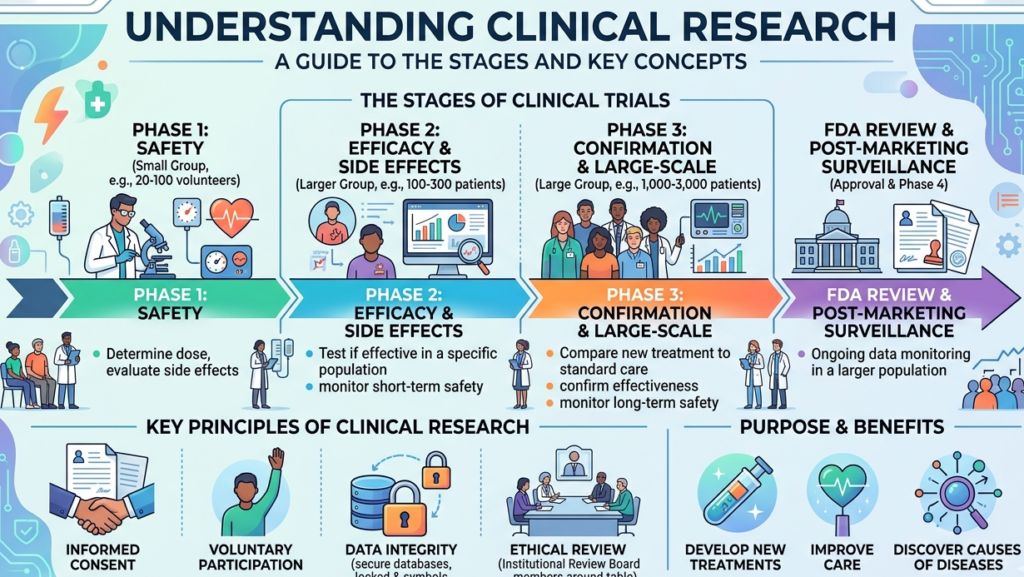
Clinical research involves multiple phases:
| Clinical Trial Phase | Purpose |
|---|---|
| Phase I | Safety testing in healthy volunteers |
| Phase II | Effectiveness testing |
| Phase III | Large-scale confirmation |
| Phase IV | Post-marketing studies |
As a Pharm D student, I found clinical research incredibly fascinating because it combines science, patient interaction, ethics, documentation, and regulatory systems. During one seminar, a CRA explained how even a single protocol deviation could affect trial integrity. That showed me how detail-oriented this field really is.
What Happens During Clinical Trials?
Clinical trials follow strict protocols approved by ethics committees and regulatory authorities. Researchers recruit participants, collect data, monitor safety, and evaluate drug performance.
Every step must comply with ICH-GCP (International Council for Harmonisation – Good Clinical Practice) guidelines. Clinical research professionals ensure participant rights, data integrity, and study accuracy.
A clinical trial may involve:
- Patient recruitment
- Informed consent
- Monitoring visits
- Data management
- Statistical analysis
- Regulatory documentation
The environment is fast-paced and highly process-driven. Unlike pharmacovigilance, clinical research often involves direct interaction with hospitals, investigators, and study participants.
Key Roles in Clinical Research
Clinical research offers diverse career paths across CROs, pharmaceutical companies, and hospitals.
| Job Role | Main Responsibility |
|---|---|
| Clinical Research Coordinator (CRC) | Site coordination |
| Clinical Research Associate (CRA) | Site monitoring |
| Clinical Data Manager | Managing trial databases |
| Regulatory Affairs Associate | Regulatory submissions |
| Clinical Trial Assistant | Trial documentation support |
Each role contributes to the success of clinical trials and regulatory approvals.
Difference Between Pharmacovigilance and Clinical Research
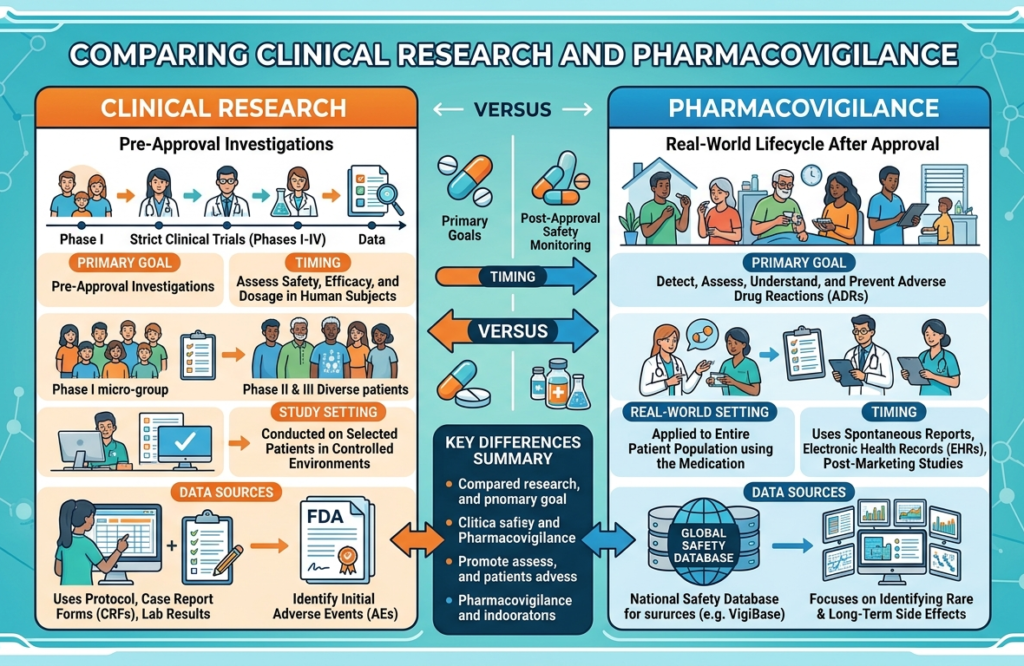
This is the section most students search for online because choosing the wrong field can impact long-term career satisfaction. Although both fields belong to the pharmaceutical industry, their goals and daily responsibilities differ significantly.
Comparison Table
| Parameter | Pharmacovigilance | Clinical Research |
|---|---|---|
| Main Focus | Drug safety | Drug effectiveness and safety |
| Stage | Post-marketing and ongoing monitoring | Pre-marketing clinical trials |
| Patient Interaction | Minimal | Moderate to high |
| Core Activity | Adverse event reporting | Conducting clinical trials |
| Documentation | Safety reports | Trial documentation |
| Regulatory Guidelines | PV regulations | ICH-GCP |
| Work Style | Desk-oriented | Site visits and coordination |
| Common Employers | Pharma companies, KPOs | CROs, hospitals, pharma companies |
| Stress Level | Moderate | High during monitoring timelines |
| Travel Requirement | Usually less | Often higher for CRAs |
Work Environment Comparison : Pharmacovigilance and Clinical Research
One major difference lies in the work environment. Pharmacovigilance professionals mostly work in office-based settings analyzing safety reports and maintaining databases. Clinical research professionals, especially CRAs, may travel frequently between hospitals and study sites.
From personal observation, students who enjoy patient interaction and fieldwork usually prefer clinical research. Those who enjoy documentation, analysis, medical coding, and safety assessment often feel more comfortable in pharmacovigilance.
Another practical difference is workload variability. Clinical research timelines can become extremely intense near database lock or regulatory inspections. Pharmacovigilance workloads are more continuous because adverse event reporting happens daily worldwide.
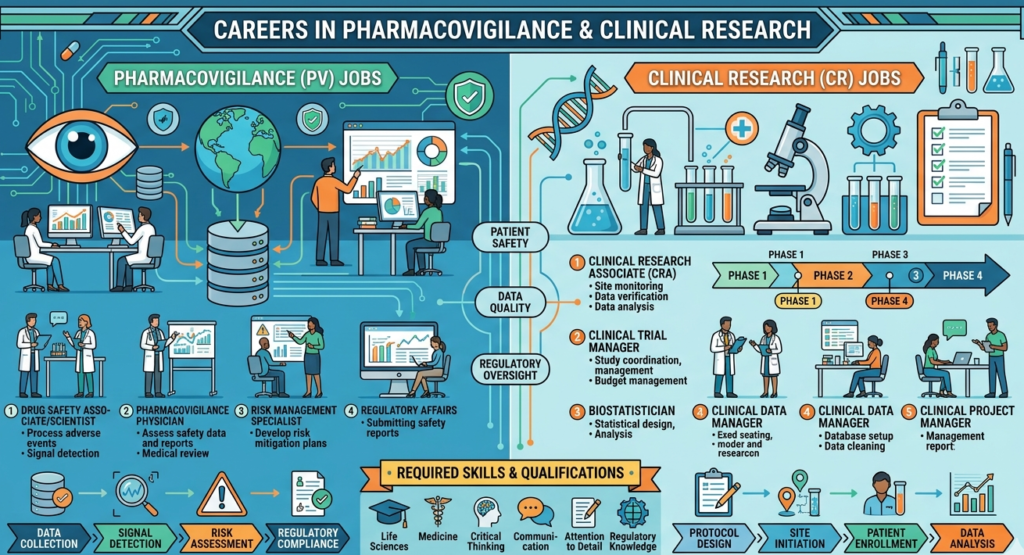
Pharmacovigilance and Clinical Research Jobs
The demand for pharmacovigilance and clinical research jobs has increased rapidly due to expanding pharmaceutical markets, global clinical trials, and stricter regulatory requirements.
India has emerged as a major hub for both industries because of cost-effective operations, skilled healthcare graduates, and increasing outsourcing by multinational companies.
Entry-Level Roles :Pharmacovigilance and Clinical Research
Freshers commonly start with roles such as:
- Drug Safety Associate
- Clinical Trial Coordinator
- Medical Reviewer Trainee
- Pharmacovigilance Associate
- Clinical Data Coordinator
- Safety Scientist Trainee
Many companies now prefer candidates with internships or certifications because competition has increased significantly.
Popular recruiters include:
- IQVIA
- Parexel
- ICON plc
- Accenture
- Cognizant
Career Growth Opportunities : Pharmacovigilance and Clinical Research
Career progression can be quite rewarding in both fields.
Pharmacovigilance Career Ladder
- Drug Safety Associate
- Senior PV Associate
- PV Scientist
- Signal Detection Specialist
- Safety Manager
- Global Safety Lead
Clinical Research Career Ladder
- Clinical Trial Assistant
- Clinical Research Coordinator
- Clinical Research Associate
- Senior CRA
- Clinical Project Manager
- Director of Clinical Operations
Clinical research often offers faster promotions initially, especially for CRAs. Pharmacovigilance may provide better long-term stability and work-life balance.
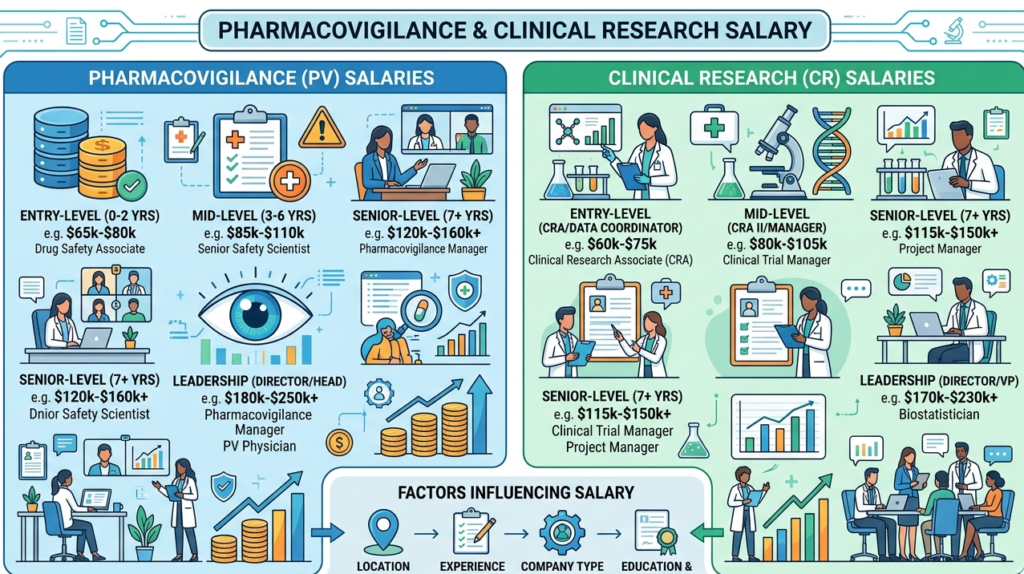
Pharmacovigilance and Clinical Research Salary
Salary is one of the biggest deciding factors for students choosing between these fields.
Salary in India
| Role | Average Fresher Salary |
|---|---|
| Drug Safety Associate | ₹3–5 LPA |
| Clinical Research Coordinator | ₹2.5–4 LPA |
| Clinical Research Associate | ₹4–7 LPA |
| PV Scientist | ₹6–12 LPA |
| Clinical Project Manager | ₹12–25 LPA |
Salaries depend heavily on skills, certifications, communication abilities, and company reputation.
Global Salary Trends : Pharmacovigilance and Clinical Research
Globally, pharmacovigilance and clinical research professionals earn significantly higher salaries in countries like the US, UK, Germany, and Canada.
Clinical research salaries tend to rise faster because of travel responsibilities and project management pressure. Pharmacovigilance salaries become highly competitive at senior levels involving global safety leadership.
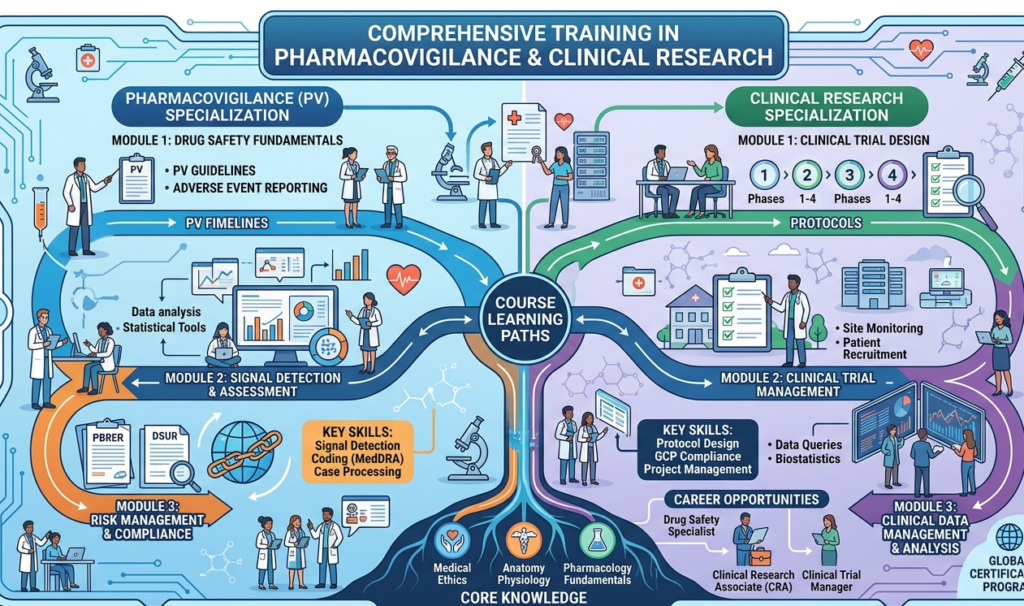
Pharmacovigilance and Clinical Research Courses
Choosing the right certification can dramatically improve job opportunities.
Best Offline Courses Pharmacovigilance and Clinical Research
Many institutes in India now offer industry-oriented training programs.
Popular course subjects include:
- ICH-GCP
- Medical coding
- Clinical trial management
- Signal detection
- Pharmacovigilance databases
- Regulatory affairs
Students should always verify placement records before enrolling.
Clinical Research and Pharmacovigilance Courses Online
Free Online Pharmacovigilance and Clinical Research Courses
| Course Name | Domain | Platform | Certificate | Level | Link |
|---|---|---|---|---|---|
| Essentials of Clinical Research | Clinical Research | Alison | Yes (Paid optional certificate) | Beginner | Essentials of Clinical Research Course |
| ICH E6 and Good Clinical Practice | Clinical Research | Alison | Yes | Intermediate | ICH E6 and GCP Course |
| Introduction to Biomedical Research | Clinical Research | Alison | Yes | Beginner | Introduction to Biomedical Research |
| Clinical Research Foundations | Clinical Research | FreeGCP | Free Certificate | Beginner | Clinical Research Foundations |
| Free GCP Certification Training | Clinical Research | FreeGCP | Free Certificate | Beginner to Advanced | Free GCP Training Courses |
| Free Pharmacovigilance Training (GVP) | Pharmacovigilance | PharmaLessons | Free Access | Beginner | Good Pharmacovigilance Practice Training |
| Free Pharma Courses & Resources | PV + CR + Regulatory | ClinPath | Mixed | Beginner | ClinPath Free Pharma Courses |
| Free Online Clinical Research Courses | Clinical Research | Alison | Yes | Beginner | Free Clinical Research Courses |
| Free Pharmacovigilance Course Video | Pharmacovigilance | YouTube | No | Beginner | Free Pharmacovigilance Course on YouTube |
| Free Clinical Research Course Video | Clinical Research | YouTube | No | Beginner | Free Clinical Research Course on YouTube |
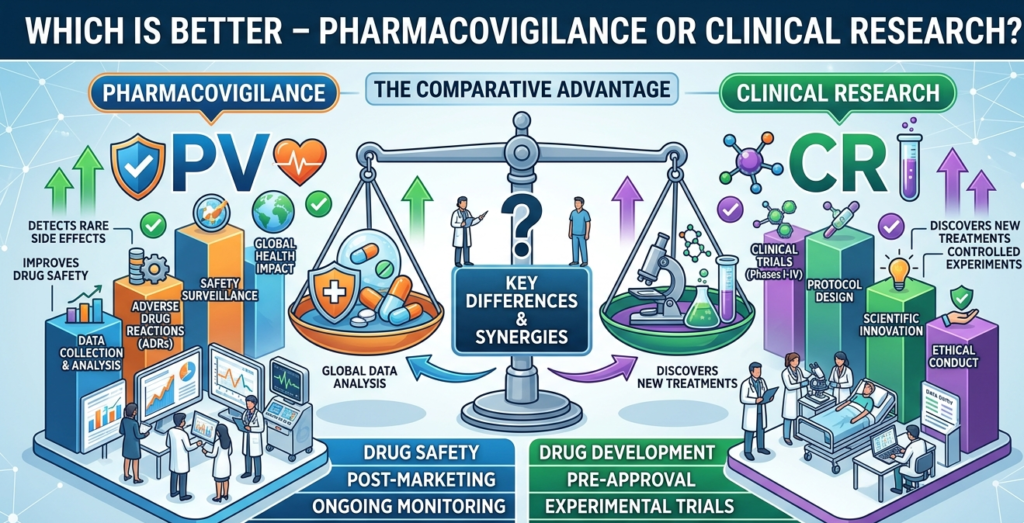
Which Is Better – Pharmacovigilance and Clinical Research?
This question does not have a universal answer because it depends on personality, interests, and career goals.
Skills Needed in Pharmacovigilance
You may enjoy pharmacovigilance if you like:
- Medical writing
- Drug safety analysis
- Regulatory documentation
- Stable desk-oriented work
- Database handling
Pharmacovigilance suits people who are detail-oriented and patient with repetitive analytical work.
Skills Needed in Clinical Research
Clinical research may suit you better if you enjoy:
- Communication
- Site coordination
- Travel
- Problem-solving
- Working under timelines
CRAs often need strong interpersonal skills because they coordinate with doctors, hospitals, sponsors, and ethics committees.
Personally, as a Pharm D student, I initially leaned toward clinical research because it sounded exciting and dynamic. But after observing the lifestyle of traveling CRAs and comparing it with pharmacovigilance professionals, I realized career satisfaction depends entirely on individual preferences.
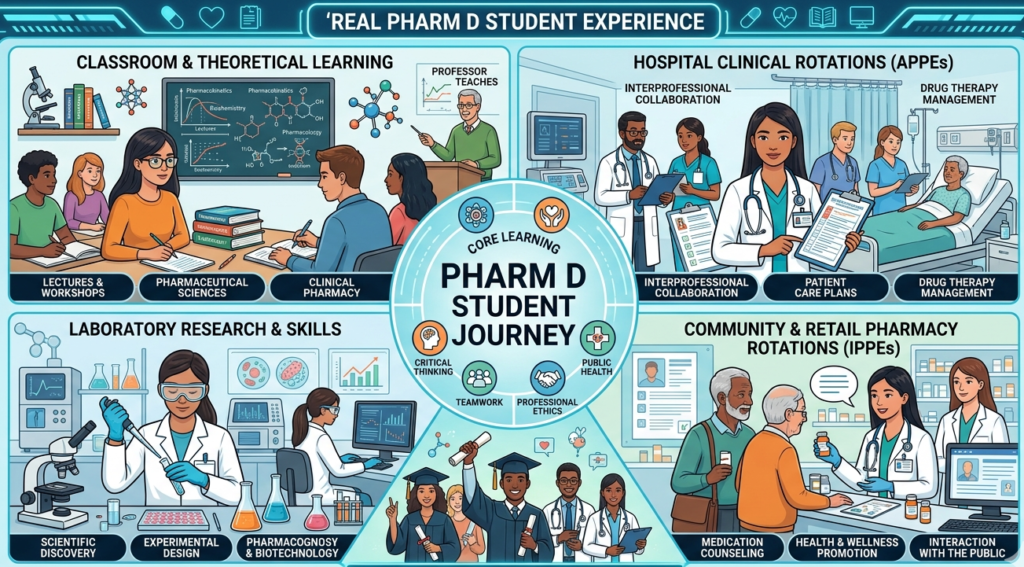
Real Pharm D Student Experience
During my hospital internship postings, I encountered a patient who developed severe skin rashes after starting antibiotic therapy. The physician suspected an adverse drug reaction and documented the case carefully. That was the first time I witnessed how drug safety reporting actually happens in real healthcare settings.
At the same time, I attended a clinical research workshop where professionals explained how participants are monitored during vaccine trials. Seeing both worlds together helped me understand the practical difference between pharmacovigilance and clinical research.
Clinical research felt like the “testing phase” of medicine development, while pharmacovigilance felt like the “long-term surveillance system” protecting patients after approval.
One senior working in pharmacovigilance told me something I still remember:
“A medicine’s journey does not end after approval. That’s where pharmacovigilance truly begins.”
That statement completely changed my understanding of the pharmaceutical industry.
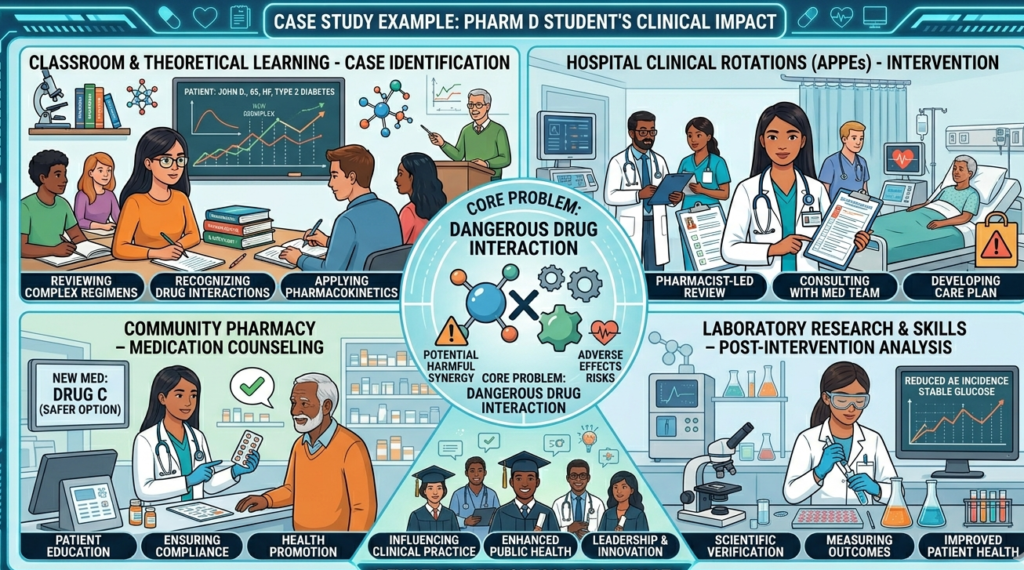
Case Study Example : Pharmacovigilance and Clinical Research
A classic example showing the importance of pharmacovigilance involves post-marketing adverse event reporting systems.
Case Scenario
A newly approved diabetes medication performed extremely well during clinical trials involving a few thousand participants. The drug received regulatory approval and entered the market.
After six months, pharmacovigilance teams began receiving reports of rare cardiac complications from different countries. Individually, the cases appeared isolated. But signal detection experts identified a pattern after analyzing multiple ICSRs.
Further investigations revealed that the adverse effect occurred mainly in elderly patients with pre-existing cardiovascular disease.
Outcome
Regulatory authorities responded by:
- Updating warning labels
- Restricting use in high-risk populations
- Increasing post-marketing surveillance
- Requiring additional studies
Without pharmacovigilance systems, this risk may have remained unnoticed for years.
This example perfectly highlights how clinical research and pharmacovigilance complement each other rather than compete against each other.
People Also Ask
What are the 4 elements of ICSR?
The four essential elements of an ICSR (Individual Case Safety Report) are:
- Identifiable patient
- Identifiable reporter
- Suspected drug
- Adverse event/reaction
Without these four components, a case may not qualify as a valid safety report.
Which is better, CRA or CRC?
A CRA (Clinical Research Associate) usually earns higher salaries and has faster career growth, but the role involves frequent travel and higher pressure. A CRC (Clinical Research Coordinator) works more closely with patients and investigators at study sites with relatively stable schedules.
If you enjoy travel and monitoring activities, CRA may suit you better. If you prefer hospital-based coordination and patient interaction, CRC can be an excellent choice.
Is IQVIA a CRO or CDMO?
IQVIA is primarily a CRO (Contract Research Organization). The company provides clinical research services, healthcare analytics, pharmacovigilance, and technology solutions for the pharmaceutical industry.
What is pharmacovigilance salary?
In India, freshers in pharmacovigilance typically earn between ₹3–5 LPA. Experienced professionals in global safety leadership roles can earn significantly higher salaries ranging from ₹15–40 LPA depending on expertise and company size.
Is pharmacovigilance a good career in India?
Yes, pharmacovigilance is considered a strong career option in India because of increasing global outsourcing, expanding pharmaceutical markets, and growing emphasis on drug safety regulations. The field offers stable growth, international opportunities, and multiple specialization paths.

Conclusion
The debate around pharmacovigilance and clinical research which is better ultimately depends on your personality, interests, and long-term goals. Both fields are crucial pillars of the pharmaceutical industry, and both offer rewarding career opportunities for pharmacy and life science graduates.
If you enjoy analytical work, safety monitoring, documentation, and structured office environments, pharmacovigilance may be the right fit. If you prefer dynamic environments, patient interaction, site coordination, and travel opportunities, clinical research might align better with your strengths.
As a Pharm D student, exploring both fields through internships, workshops, and networking helped me understand that career satisfaction comes from choosing the field that matches your working style rather than blindly following salary trends.
The healthcare industry will continue evolving, and professionals skilled in drug safety and clinical trials will remain in high demand globally. Whether you choose pharmacovigilance or clinical research, continuous learning and practical exposure will play the biggest role in your success.

FAQs
1. Can Pharm D students enter both pharmacovigilance and clinical research?
Yes, Pharm D graduates are eligible for both industries and are often preferred because of their clinical knowledge and understanding of therapeutics.
2. Is coding required in pharmacovigilance?
No advanced programming is usually required, but familiarity with databases and safety software can be beneficial.
3. Which field has better work-life balance?
Pharmacovigilance generally offers better work-life balance compared to clinical research roles involving extensive travel.
4. Can I switch from clinical research to pharmacovigilance later?
Yes, many professionals transition between both fields because they share overlapping pharmaceutical and regulatory knowledge.
5. Are online certifications enough to get a job?
Online certifications improve your resume, but internships, communication skills, and practical understanding significantly increase job chances.