
Table of Contents
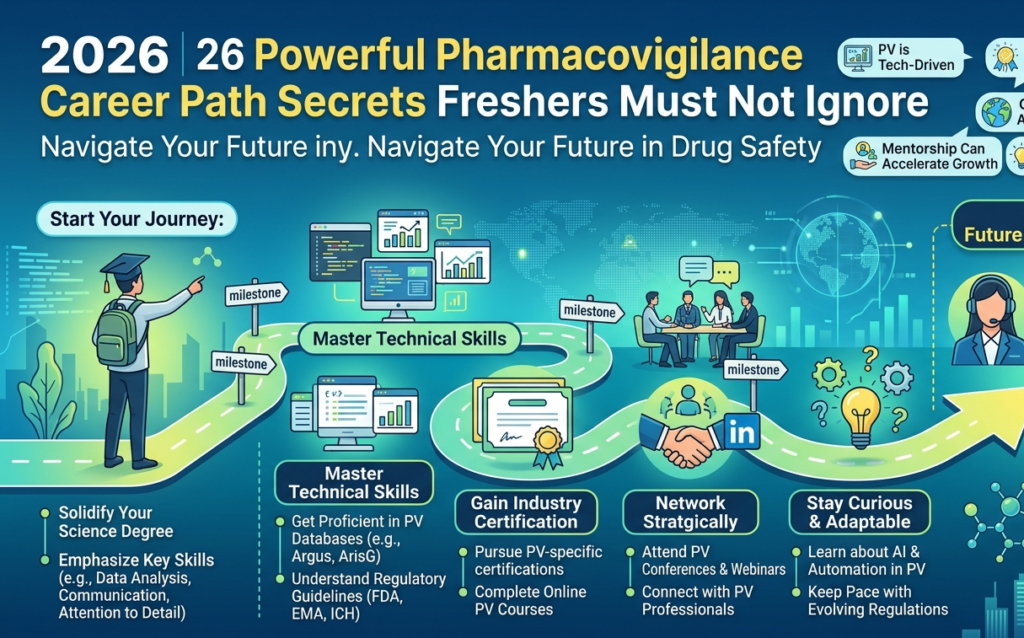
The pharmaceutical and healthcare industries are growing rapidly, and patient safety has become one of the most important priorities worldwide. Every medicine released into the market must be continuously monitored to ensure its safety, effectiveness, and quality. This is where Pharmacovigilance (PV) plays a major role.
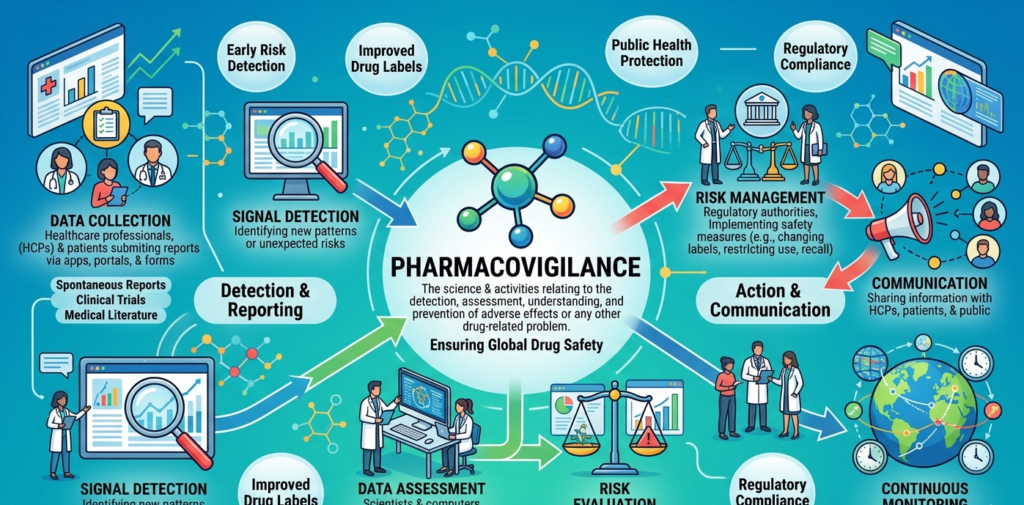
Pharmacovigilance is the science of detecting, assessing, understanding, and preventing adverse effects or any other drug-related problems. It helps healthcare professionals and pharmaceutical companies monitor the safety of medicines and protect patients from harmful side effects.
The importance of Pharmacovigilance increased globally after the thalidomide tragedy, which highlighted the need for strict drug safety monitoring systems. Since then, many regulatory authorities and healthcare organizations have strengthened drug safety guidelines and reporting systems to improve patient care.
Today, Pharmacovigilance Career Path has become one of the fastest-growing career opportunities for pharmacy and life science graduates. Many pharmaceutical companies, CROs (Contract Research Organizations), and healthcare organizations are actively hiring freshers for drug safety and case processing roles. This rapid expansion has significantly improved pharmacovigilance career opportunities, especially for fresh graduates exploring the pharmacovigilance career path.
For students and fresh graduates from B.Pharm, PharmD, M.Pharm, and other life science backgrounds, Pharmacovigilance offers excellent pharmacovigilance career path, global opportunities, and long-term stability. Many students now consider pharmacovigilance career in India as one of the most stable healthcare professions due to increasing demand and attractive pharmacovigilance career salary packages.
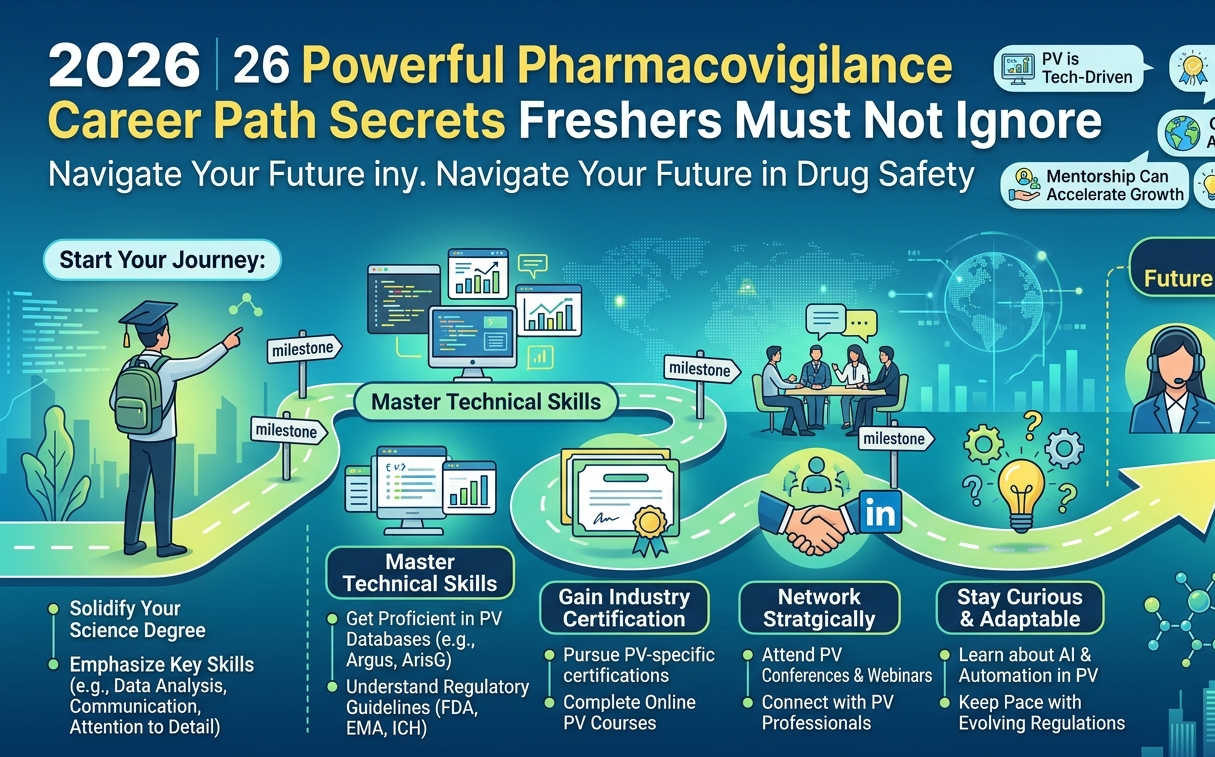
This article provides a beginner-friendly roadmap for freshers who want to start their pharmacovigilance career path in 2026. It covers eligibility, required skills, important tools, certifications, interview preparation, salary expectations, career growth, and practical tips to enter the industry successfully. It also explains the pharmacovigilance career path and requirements, available pharmacovigilance free certificate course options, and the growing demand for pharmacovigilance online courses with certificate programs.
What is Pharmacovigilance?
Pharmacovigilance (PV) is the science and process of monitoring the safety of medicines and identifying adverse effects associated with their use. The main objective of Pharmacovigilance is to protect patients by ensuring that medicines available in the market are safe, effective, and used appropriately.
According to the World Health Organization (WHO), Pharmacovigilance involves the detection, assessment, understanding, and prevention of adverse effects or any other medicine-related problems. It plays an important role throughout the lifecycle of a drug, from clinical trials to post-marketing surveillance.
No medicine is completely free from side effects. Even after a drug is approved and released into the market, unexpected adverse reactions may occur in different patients. Pharmacovigilance professionals help identify these reactions, analyze safety data, and support regulatory authorities in maintaining public health and patient safety.
One of the major responsibilities of Pharmacovigilance professionals is monitoring Adverse Drug Reactions (ADRs). ADRs are harmful or unintended reactions caused by medicines at normal doses. Identifying and reporting ADRs helps healthcare organizations improve drug safety and reduce risks associated with medicines.
For example, if a patient develops a severe allergic reaction after taking a medicine, the case may be reported and evaluated by Pharmacovigilance professionals. If multiple similar cases are identified, regulatory authorities may update the safety information, issue warnings, or take necessary actions to protect patients.
Pharmacovigilance activities are performed by pharmaceutical companies, CROs, hospitals, healthcare professionals, and regulatory authorities worldwide. Many organizations work together to monitor medicine safety and maintain proper reporting systems for adverse events.
Today, Pharmacovigilance has become an essential part of the pharmaceutical industry because patient safety and regulatory compliance are becoming increasingly important across the world. This increasing importance has also improved Pharmacovigilance Career Path and pharmacovigilance career opportunities in India and globally.
Why Pharmacovigilance is Growing in 2026 as a Pharmacovigilance Career Path
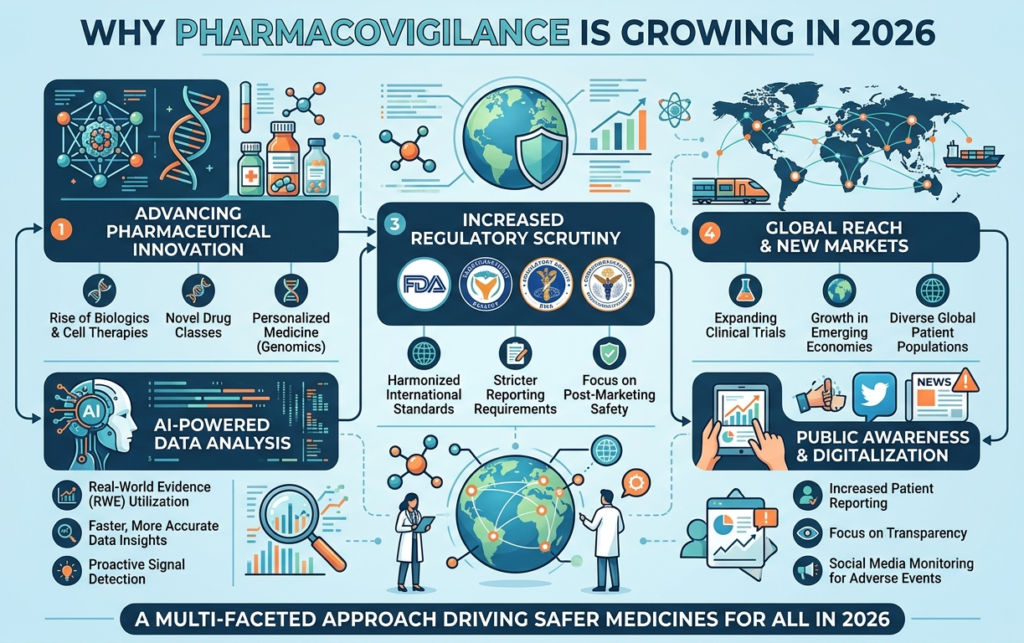
In recent years, the pharmaceutical and healthcare industries have experienced significant growth across the world. As new medicines, vaccines, and biological products are continuously being developed, the importance of drug safety monitoring has also increased rapidly. This has created a growing demand for Pharmacovigilance professionals in the healthcare sector.
One of the major reasons for the growth of Pharmacovigilance is the increasing focus on patient safety. Regulatory authorities and healthcare organizations are paying more attention to monitoring adverse drug reactions and ensuring that medicines are safe for public use. Even after a medicine is approved and released into the market, continuous safety monitoring is necessary to identify rare or unexpected side effects.
The increase in clinical trials and global drug development activities has also contributed to the expansion of pharmacovigilance career opportunities. Pharmaceutical companies and Contract Research Organizations (CROs) require trained professionals to manage safety data, process adverse event reports, and maintain regulatory compliance.
In 2026, technology and digital healthcare systems are also playing an important role in the growth of Pharmacovigilance. Many companies are using advanced safety databases, automation tools, and artificial intelligence to improve drug safety monitoring and reporting processes. As a result, professionals with knowledge of Pharmacovigilance concepts and safety systems are becoming highly valuable in the industry.
Another important reason for the growth of this field is the increasing awareness about adverse drug reaction reporting among healthcare professionals and patients. Many countries have strengthened their Pharmacovigilance programs and reporting systems to improve public health and medicine safety.
Today, Pharmacovigilance offers excellent pharmacovigilance career growth for pharmacy and life science graduates. Many multinational companies, CROs, and pharmaceutical organizations are actively hiring freshers for entry-level drug safety and case processing roles. With continuous learning and practical experience, freshers can build a stable and rewarding long-term career in this field.
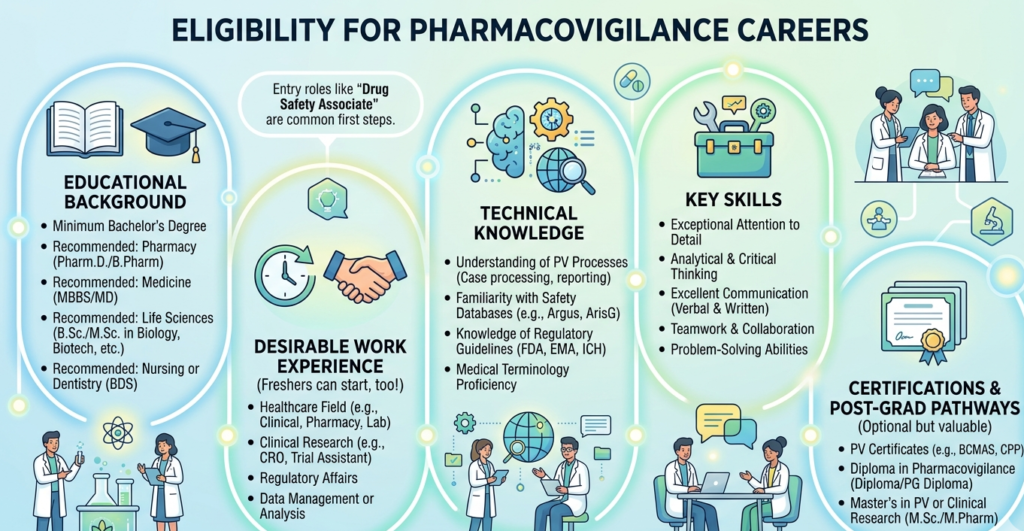
Eligibility for Pharmacovigilance Career Path
Pharmacovigilance is one of the most suitable career options for pharmacy, medical, and life science graduates who are interested in drug safety and healthcare. One of the biggest advantages of this field is that many companies also provide opportunities for freshers with basic Pharmacovigilance knowledge and good communication skills.
Candidates from different educational backgrounds can build a career in Pharmacovigilance. Some of the commonly eligible qualifications include:
- B.Pharm
- M.Pharm
- PharmD
- BSc Life Sciences
- MSc Life Sciences
- Biotechnology
- Microbiology
- Nursing and other healthcare-related courses
Among these, pharmacy graduates are highly preferred because they already have knowledge related to medicines, adverse effects, pharmacology, and patient safety.
Apart from educational qualifications, companies also look for candidates with good communication and analytical skills. Since Pharmacovigilance professionals work with medical data, safety reports, and regulatory documents, understanding medical terminology and scientific concepts is important.
Freshers who want to enter this field should also focus on improving their English communication skills, medical writing abilities, and basic computer knowledge. Familiarity with Microsoft Word, Excel, and safety-related terminology can be beneficial during interviews and training programs.
Understanding the technical skills required for pharmacovigilance is equally important for building a successful career. Skills such as case processing, narrative writing, MedDRA coding awareness, safety database understanding, and regulatory knowledge are becoming highly valuable in the industry.
Although certifications and online courses can help build basic knowledge, practical understanding and continuous learning are equally important in Pharmacovigilance careers. Many companies provide training for entry-level employees, so freshers should focus on building strong fundamentals and maintaining a positive learning attitude.
With the right skills, dedication, and consistent effort, freshers from pharmacy and life science backgrounds can successfully start and grow their careers in Pharmacovigilance.
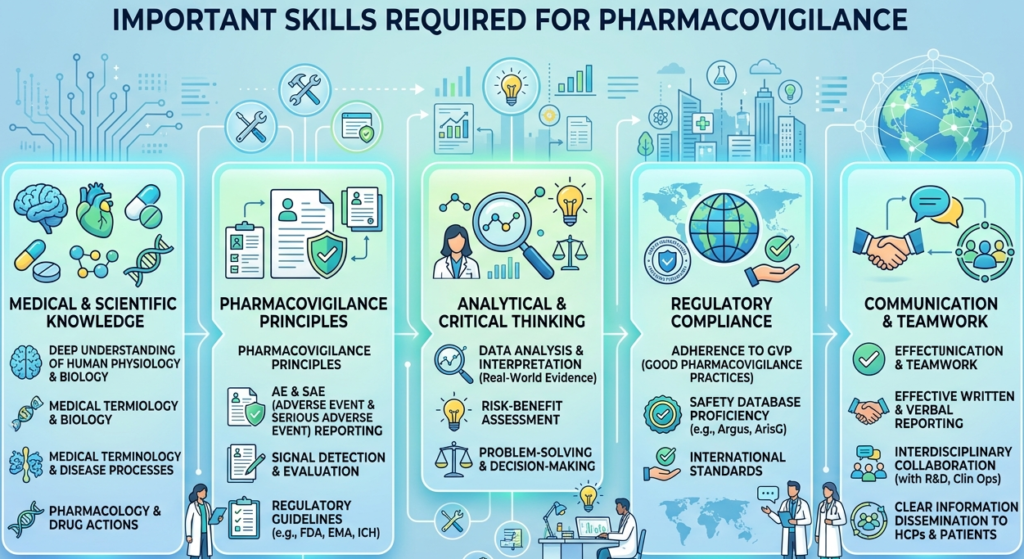
Important Skills Required for Pharmacovigilance Career Path
To build a successful pharmacovigilance career, freshers need both technical knowledge and soft skills. Since Pharmacovigilance professionals work with patient safety data and medical information, accuracy and clear communication are extremely important in this field.
One of the most important technical skills required for pharmacovigilance is knowledge of medical terminology. Professionals should understand common medical terms, disease conditions, drug names, adverse effects, and basic pharmacology concepts. This helps in understanding adverse event reports and safety-related information correctly.
Communication skills also play a major role in Pharmacovigilance careers. Professionals often prepare safety reports, write narratives, review medical information, and communicate with healthcare professionals or regulatory teams. Therefore, good written and verbal communication skills are highly valuable.
Another essential skill is attention to detail. Even a small mistake in patient information, drug details, or adverse event data can affect the quality of a safety report. Pharmacovigilance professionals must carefully review and verify information before submitting reports to regulatory authorities.
Basic understanding of case processing and adverse event reporting is also beneficial for freshers. Learning concepts such as Adverse Events (AE), Adverse Drug Reactions (ADR), Serious Adverse Events (SAE), and Individual Case Safety Reports (ICSR) can help candidates understand Pharmacovigilance workflows more effectively.
Narrative writing is another important skill in Pharmacovigilance. A narrative is a structured summary of patient case information, adverse events, medical history, laboratory findings, and treatment details. Writing clear and accurate narratives is an important part of safety data processing.
Time management and organizational skills are equally important because Pharmacovigilance professionals often work with multiple reports and strict regulatory timelines. Managing work efficiently while maintaining quality and accuracy is essential in this field.
Freshers should also develop basic computer skills and familiarity with Microsoft Word, Excel, and Pharmacovigilance databases. Although companies usually provide software training, having basic technical awareness can be an added advantage during interviews.
In addition to technical knowledge, having a positive attitude, willingness to learn, and continuous self-improvement are important for long-term pharmacovigilance career growth. Since the pharmaceutical industry continuously evolves with new regulations and technologies, professionals must stay updated with industry trends and guidelines.
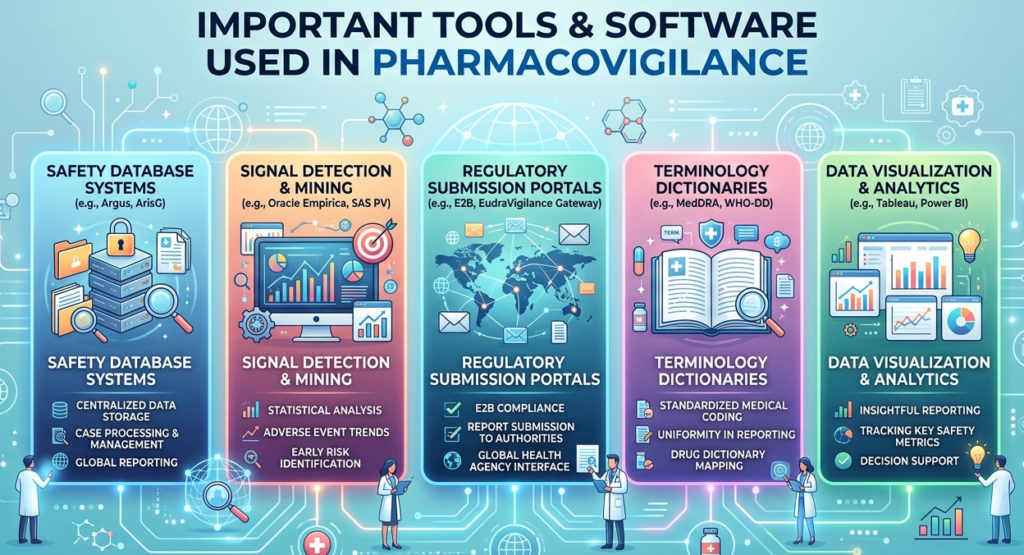
Important Tools and Software Used in Pharmacovigilance Career Path
Technology plays an important role in modern Pharmacovigilance activities. Pharmaceutical companies and Contract Research Organizations (CROs) use various safety databases and software systems to collect, process, review, and submit adverse event reports efficiently.
One of the most commonly used safety databases in Pharmacovigilance is Oracle Argus Safety, often referred to as Argus. It is widely used for case processing, adverse event management, and regulatory reporting.
Another important Pharmacovigilance software is ARISg. It is also used for safety data management and adverse event processing.
MedDRA (Medical Dictionary for Regulatory Activities) is an internationally accepted medical terminology used in Pharmacovigilance for coding adverse events, diseases, and medical conditions.
The WHO Drug Dictionary is another important reference system used for coding and identifying medicinal products during safety data processing.
Microsoft Excel is also widely used in Pharmacovigilance for maintaining trackers, managing safety data, reviewing reports, and organizing case-related information.
Understanding these systems can strengthen a candidate’s pharmacovigilance career path and requirements preparation and improve interview performance.
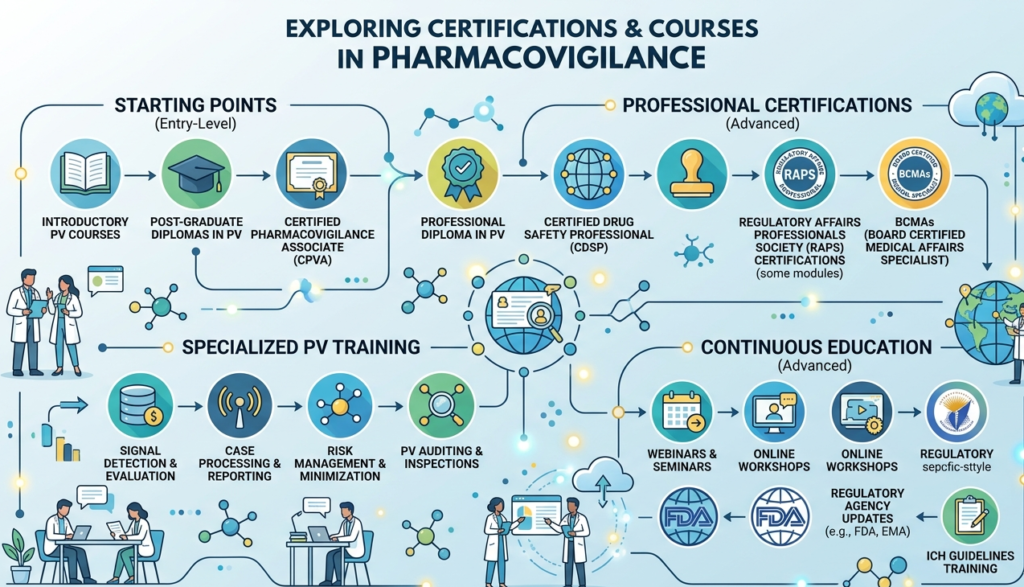
Certifications and Courses for Pharmacovigilance Career Path
Certifications and training programs can help freshers build basic knowledge and improve their understanding of Pharmacovigilance concepts.
Today, many online and offline platforms offer pharmacovigilance free certificate course programs, internships, workshops, and certification training for pharmacy and life science students. Many learners also prefer pharmacovigilance free online courses with certificate in India because they provide flexible learning opportunities at affordable or no cost.
Several institutes and educational platforms now provide pharmacovigilance online courses with certificate covering topics such as:
- Adverse Drug Reactions (ADR)
- Individual Case Safety Reports (ICSR)
- MedDRA coding
- Narrative writing
- Signal detection
- Pharmacovigilance regulations
Short-term certification programs can be useful for freshers because they provide industry exposure and help candidates understand the practical aspects of drug safety.
However, freshers should understand that certifications alone are not enough to build a successful career in Pharmacovigilance. Practical understanding, communication skills, continuous learning, and strong fundamentals are equally important.
Attending webinars, scientific workshops, and industry sessions can also help freshers stay updated with current trends and regulatory requirements in Pharmacovigilance.
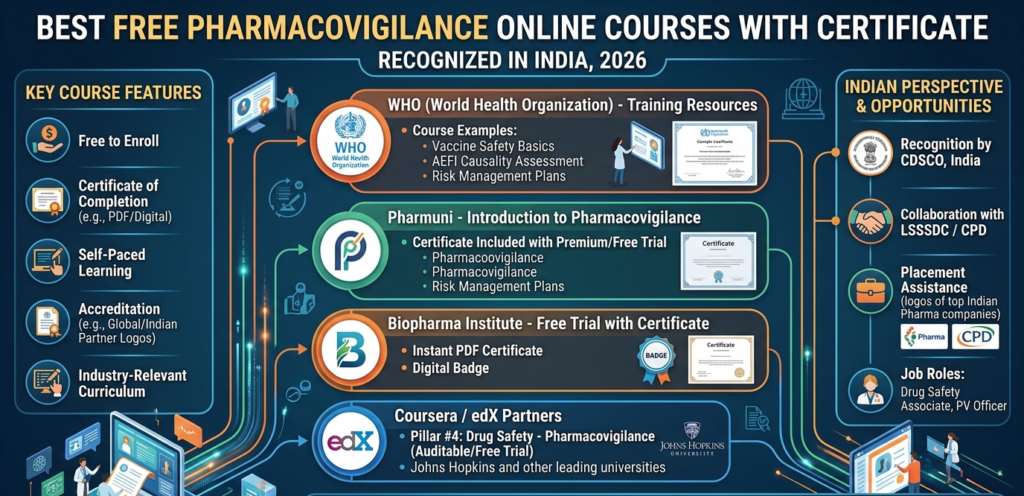
Best Free Pharmacovigilance Online Courses With Certificate in India (2026): Pharmacovigilance Career Path
| Course Name | Platform | What You Will Learn | Certificate | Course Link |
| Introduction to Pharmacovigilance | Pharmuni | ADR reporting, ICSR, EMA/FDA/ICH guidelines, drug safety basics | Yes | Pharmuni Pharmacovigilance Course |
| GVP (Good Pharmacovigilance Practice) Training | PharmaLessons | Good Pharmacovigilance Practices, safety monitoring, regulatory basics | Yes | Free GVP Training Course |
| Pharmacovigilance Learning Resources | ClinPath | PV basics, pharma career guidance, safety workflows | Some courses offer certificates | ClinPath Free Pharma Courses |
| UMC Pharmacovigilance Training | Uppsala Monitoring Centre (WHO-UMC) | WHO pharmacovigilance systems, signal detection, ADR monitoring | Available for selected modules | WHO-UMC Learning Platform |
| Good Pharmacovigilance Practices Course | Pharma Digests | Safety signals, risk minimization, pharmacovigilance quality systems | No official certificate | Pharma Digests GVP Course |
| Pharmacovigilance and CDM Course | JOPIR Courses | PV basics, clinical data management, drug safety concepts | Yes | JOPIR Pharmacovigilance Course |
| Free Pharmacovigilance Resources List | MyPharmaGuide | Collection of free PV learning resources and certification links | Varies | MyPharmaGuide Free PV Courses |
| Pharmacovigilance Course | Elevify | ICSRs, signal detection, regulatory reporting, risk evaluation | Yes | Elevify Pharmacovigilance Course |
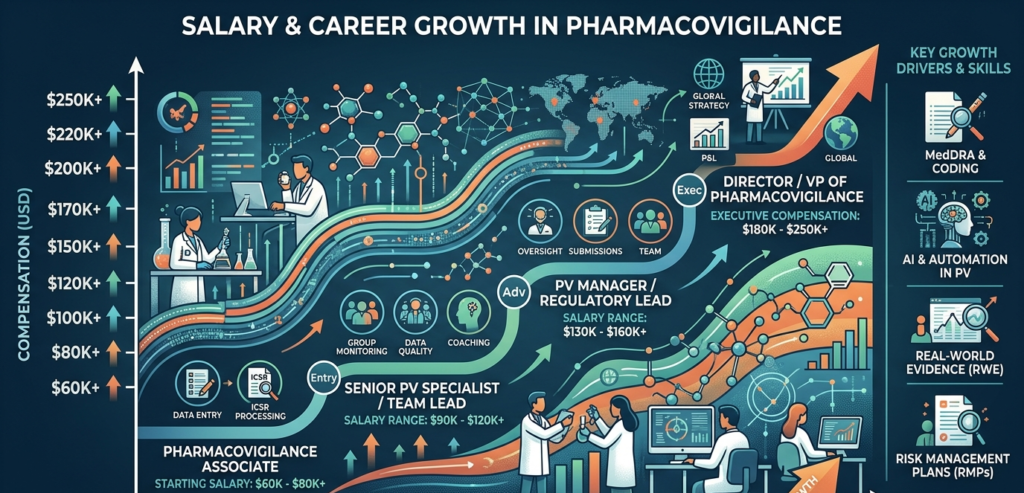
Salary and Career Growth in Pharmacovigilance : Pharmacovigilance Career Path
Pharmacovigilance offers stable pharmacovigilance career growth and long-term opportunities for pharmacy and life science graduates.
In India, entry-level Pharmacovigilance professionals generally receive salaries ranging from approximately ₹2.5 LPA to ₹5 LPA. Candidates with strong communication skills and practical understanding may receive better opportunities and improved pharmacovigilance career salary packages.
Many freshers begin their careers in roles such as:
- Drug Safety Associate
- Pharmacovigilance Associate
- Case Processing Associate
- Safety Data Associate
- Junior Drug Safety Executive
With experience and continuous learning, professionals can gradually move into higher-level positions such as:
- Senior Pharmacovigilance Associate
- Medical Reviewer
- Signal Detection Specialist
- Aggregate Reporting Specialist
- Safety Scientist
- Pharmacovigilance Team Lead
Many students often ask, “is pharmacovigilance a good career in India?” The answer is yes. Due to increasing pharmaceutical investments, global outsourcing, and growing regulatory requirements, pharmacovigilance career path, pharmacovigilance career opportunities in India are expanding rapidly.
The field also provides opportunities to work with multinational pharmaceutical companies, CROs, healthcare organizations, and global drug safety teams. Some professionals may also transition into related fields such as Regulatory Affairs, Medical Writing, Clinical Research, and Quality Assurance.
As automation and digital technologies continue to evolve, Pharmacovigilance professionals with strong analytical and technical skills are expected to remain in demand in the coming years.
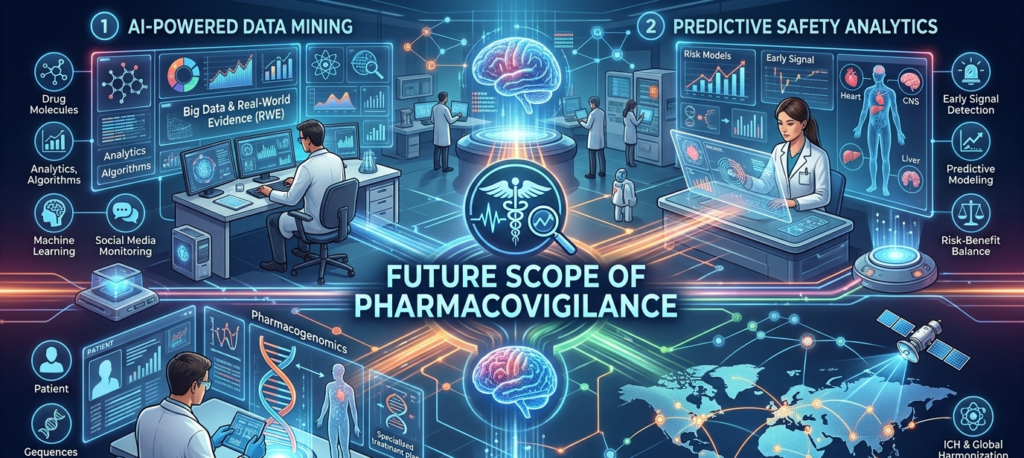
Future Scope of Pharmacovigilance Career Path
The future of Pharmacovigilance looks highly promising as the pharmaceutical and healthcare industries continue to expand globally.
Regulatory authorities across the world are strengthening safety guidelines and reporting systems to ensure patient safety and maintain the quality of healthcare products. As a result, pharmaceutical companies and Contract Research Organizations (CROs) are continuously increasing their Pharmacovigilance operations and hiring skilled professionals for various drug safety roles.
Technological advancements such as automation, artificial intelligence, and digital safety databases are also transforming the Pharmacovigilance industry.
In addition to traditional Pharmacovigilance roles, professionals can also explore career opportunities in related areas such as:
- Signal detection
- Aggregate reporting
- Risk management
- Medical review
- Regulatory Affairs
- Medical Writing
- Clinical Research
- Drug safety auditing
Remote and global job opportunities are also increasing in this field, especially in multinational pharmaceutical companies and global CROs.
For pharmacy and life science graduates who are interested in healthcare, patient safety, and continuous learning, Pharmacovigilance can provide a stable, meaningful, and future-oriented pharmacovigilance career path.

Personal Experience as a Pharmacy Student in Pharmacovigilance Career Path
As a pharmacy student, Pharmacovigilance initially felt very theoretical and difficult to understand. Terms like ADRs, ICSRs, narrative writing, MedDRA coding, and signal detection seemed confusing during the early learning phase.
The turning point came while exploring free online courses and LinkedIn learning resources. Watching beginner-friendly tutorials and practicing simple adverse event cases helped in understanding how drug safety works in real clinical settings.
One important realization during pharmacy studies was that Pharmacovigilance is not only about medicines — it is mainly about patient safety. Learning how a single adverse drug reaction report can contribute to global safety monitoring made the field much more meaningful and interesting.
Initially, many pharmacy students focus only on certificates. However, practical understanding becomes more important during interviews. Practicing narrative writing, reading case reports, and learning common interview questions helped improve confidence significantly.
Another useful learning method was following Pharmacovigilance professionals on LinkedIn and reading beginner discussions on Reddit communities. Many freshers openly share their learning journeys, interview experiences, and mistakes, which helps new learners understand industry expectations better.
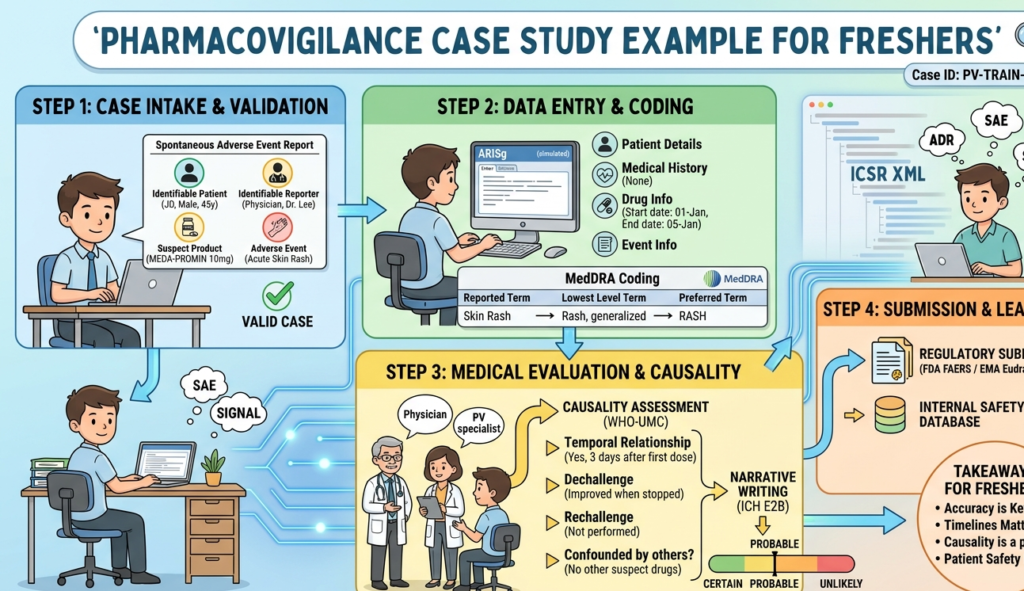
Pharmacovigilance Case Study Example for Freshers
Case Study: Adverse Drug Reaction Reporting
A 45-year-old male patient was prescribed Amoxicillin for a bacterial throat infection.
After taking the medicine for two days, the patient developed:
- Skin rashes
- Itching
- Mild swelling on the face
The physician suspected an adverse drug reaction and stopped the medication immediately. The patient was treated with antihistamines, and symptoms gradually improved within 48 hours.
How Pharmacovigilance Professionals Handle This Case
Step 1: Case Collection
The adverse event information is collected from:
- Physician notes
- Patient history
- Medication details
- Laboratory findings
Step 2: Minimum Criteria Verification
The case must contain:
- Identifiable patient
- Identifiable reporter
- Suspected drug
- Adverse event
Step 3: Data Entry and Coding
The event is entered into a safety database such as Oracle Argus Safety.
Medical terms are coded using:
- MedDRA terminology
- WHO Drug Dictionary
Step 4: Seriousness Assessment
The professional checks whether the case is:
- Serious
- Non-serious
- Expected
- Unexpected
In this case, it may be categorized as a non-serious allergic ADR.
Step 5: Narrative Writing
A structured medical narrative is prepared summarizing:
- Patient demographics
- Drug information
- Event timeline
- Treatment provided
- Outcome
Step 6: Regulatory Submission
If required, the case is submitted to regulatory authorities within defined timelines.
This simple workflow demonstrates how Pharmacovigilance professionals contribute to patient safety and global drug monitoring.
Beginner Tips for Pharmacy Students Entering Pharmacovigilance
- Start with free beginner courses before joining expensive training programs.
- Focus on understanding concepts instead of collecting certificates.
- Learn basic medical terminology and ADR classifications.
- Practice narrative writing regularly.
- Improve communication and English speaking skills.
- Create a professional LinkedIn profile.
- Follow WHO, UMC, FDA, EMA, and PV professionals for updates.
- Read real case examples to understand industry workflows.
- Stay consistent even if job opportunities take time initially.

Conclusion
Pharmacovigilance has become one of the most important and rapidly growing fields in the pharmaceutical and healthcare industry. As patient safety and drug monitoring continue to gain global importance, the demand for skilled Pharmacovigilance professionals is increasing steadily across pharmaceutical companies, CROs, and healthcare organizations.
For freshers from pharmacy and life science backgrounds, Pharmacovigilance offers valuable pharmacovigilance career opportunities and long-term professional stability. The field provides excellent pharmacovigilance career path, attractive pharmacovigilance career salary potential, and opportunities to work in global healthcare environments.
Understanding the pharmacovigilance career path and requirements, improving the technical skills required for pharmacovigilance, and completing quality pharmacovigilance online courses with certificate can significantly improve career prospects.
Many freshers also benefit from enrolling in a pharmacovigilance free certificate course or exploring pharmacovigilance free online courses with certificate in India to strengthen their fundamentals before applying for jobs.
For individuals wondering is pharmacovigilance a good career in India, the field continues to offer strong demand, continuous learning opportunities, and meaningful contributions to patient safety worldwide.
With dedication, consistency, and continuous learning, freshers can successfully build a rewarding long-term pharmacovigilance career in India and globally.

People Also Ask (PAA)
What is the salary of pharmacovigilance in India?
The average salary for freshers in Pharmacovigilance in India ranges from approximately ₹2.5 LPA to ₹5 LPA depending on qualifications, communication skills, certifications, and company type. Experienced professionals in senior drug safety roles can earn significantly higher salaries, especially in multinational pharmaceutical companies and CROs.
What is the future scope of pharmacovigilance in India?
The future scope of Pharmacovigilance in India is highly promising due to the rapid growth of the pharmaceutical industry, increasing clinical trials, global outsourcing, and strict drug safety regulations. Many multinational companies are expanding their drug safety operations in India, creating excellent long-term career opportunities for pharmacy and life science graduates.
Which is better, CDM or PV?
Both Clinical Data Management (CDM) and Pharmacovigilance (PV) offer good career opportunities, but the better option depends on individual interests.
- CDM focuses more on clinical trial data handling, database management, and data accuracy.
- PV focuses more on drug safety, adverse event reporting, patient safety, and regulatory compliance.
Students interested in patient safety, medical terminology, and drug safety monitoring often prefer Pharmacovigilance.
Will AI replace pharmacovigilance jobs?
Artificial Intelligence (AI) is transforming Pharmacovigilance by automating repetitive tasks such as case intake, data entry, and signal detection. However, AI is unlikely to completely replace Pharmacovigilance professionals because human expertise is still required for:
- Medical review
- Causality assessment
- Regulatory decision-making
- Risk evaluation
- Clinical judgment
Instead of replacing jobs entirely, AI is expected to change the nature of Pharmacovigilance work and create demand for professionals with technical and analytical skills.
Which is better, medical coding or pharmacovigilance as a career?
Both careers have good opportunities, but they differ in work type and career growth.
Medical Coding
- Focuses on ICD/CPT coding and healthcare documentation
- More process-oriented work
- Good entry-level opportunities
Pharmacovigilance
- Focuses on drug safety and adverse event monitoring
- More clinical and scientific exposure
- Better opportunities for long-term growth in pharmaceutical companies
Students from pharmacy backgrounds often prefer Pharmacovigilance because it is more closely related to medicines and patient safety.
Which is better, medical writing or pharmacovigilance?
Both Medical Writing and Pharmacovigilance are strong career options for pharmacy graduates.
Medical Writing
- Involves scientific writing, regulatory documents, blogs, manuscripts, and healthcare content
- Best suited for candidates with strong writing and research skills
Pharmacovigilance
- Involves drug safety monitoring, ADR reporting, and case processing
- Best suited for candidates interested in clinical safety and regulatory work
Candidates with strong communication and creativity may enjoy Medical Writing, while those interested in patient safety and safety data may prefer Pharmacovigilance.
Which is the toughest subject in pharmacy?
The difficulty of pharmacy subjects varies from student to student. However, many pharmacy students commonly consider the following subjects challenging:
- Pharmacology
- Medicinal Chemistry
- Pharmaceutical Analysis
- Pharmacotherapeutics
- Biochemistry
Among these, Medicinal Chemistry and Pharmacology are often considered the toughest because they require strong conceptual understanding, memorization, and application skills.
What is the salary of Drug Safety Associate in IQVIA?
The salary of a Drug Safety Associate at IQVIA in India generally ranges between approximately ₹3 LPA to ₹6 LPA for freshers and early-career professionals. Salary may vary based on:
- Experience
- Educational qualification
- Communication skills
- Interview performance
- Location
- Technical knowledge
Professionals with experience in Argus Safety, narrative writing, and case processing may receive higher salary packages over time.