
Table of Contents
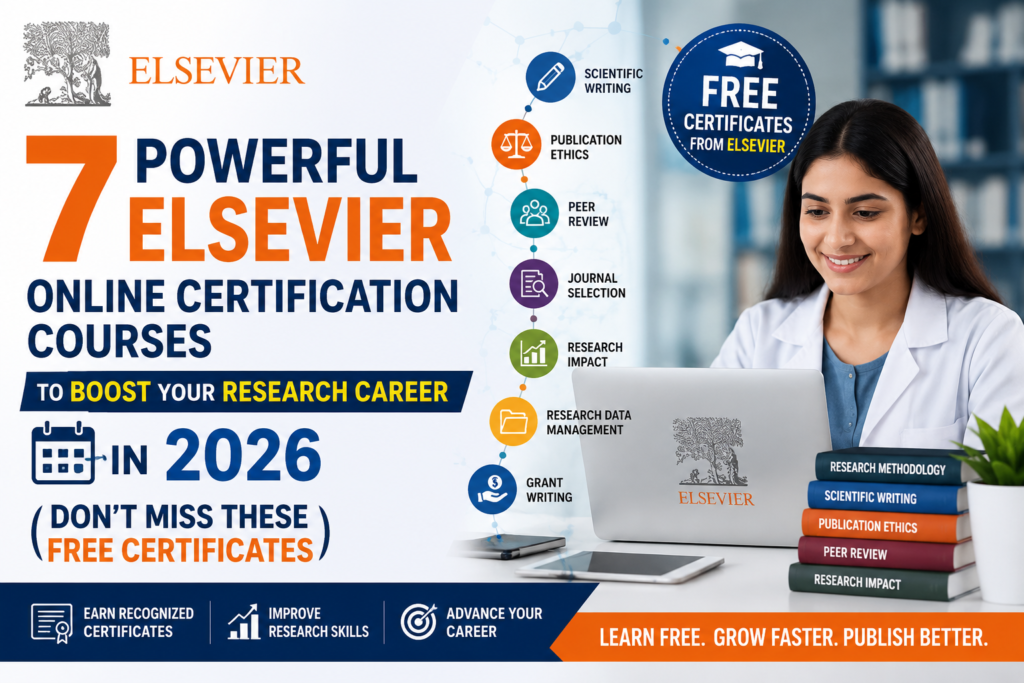
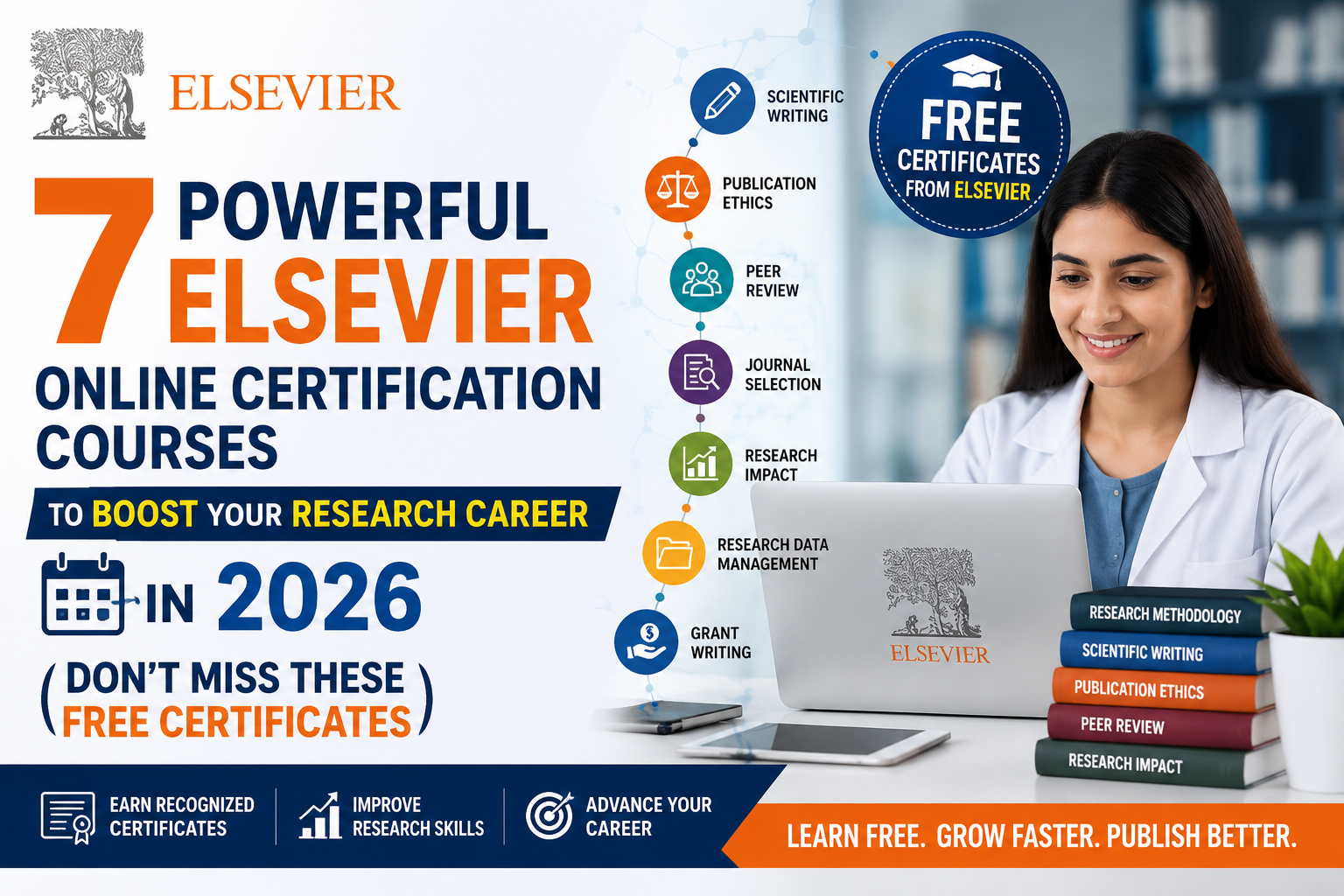
Research is no longer limited to professors working in university laboratories. Today, Pharm.D students, medical interns, postgraduate scholars, clinical researchers, nurses, pharmacists, and healthcare professionals are expected to understand scientific writing, evidence-based medicine, publication ethics, and peer review before entering academia or the pharmaceutical industry. Employers increasingly look for candidates who possess practical research knowledge in addition to their academic degrees. This shift has made Elsevier online certification courses one of the most valuable free learning resources available for aspiring researchers.
Whether your goal is to publish your first manuscript, become a peer reviewer, pursue higher education abroad, or strengthen your CV for jobs in medical writing, pharmacovigilance, clinical research, or academia, Elsevier provides structured learning paths through its Researcher Academy. The platform allows learners to study at their own pace while earning certificates that demonstrate commitment to professional development.
As a Pharm.D student, I discovered that understanding research methodology and publication standards was just as important as learning pharmacology or therapeutics. Reading textbooks builds theoretical knowledge, but research courses teach you how that knowledge is generated, evaluated, and communicated. Completing research-focused certifications improved my confidence when interpreting journal articles, conducting literature reviews, and assisting with scientific writing. If you’re planning a career in healthcare, these skills can become a significant advantage.
What is Elsevier?
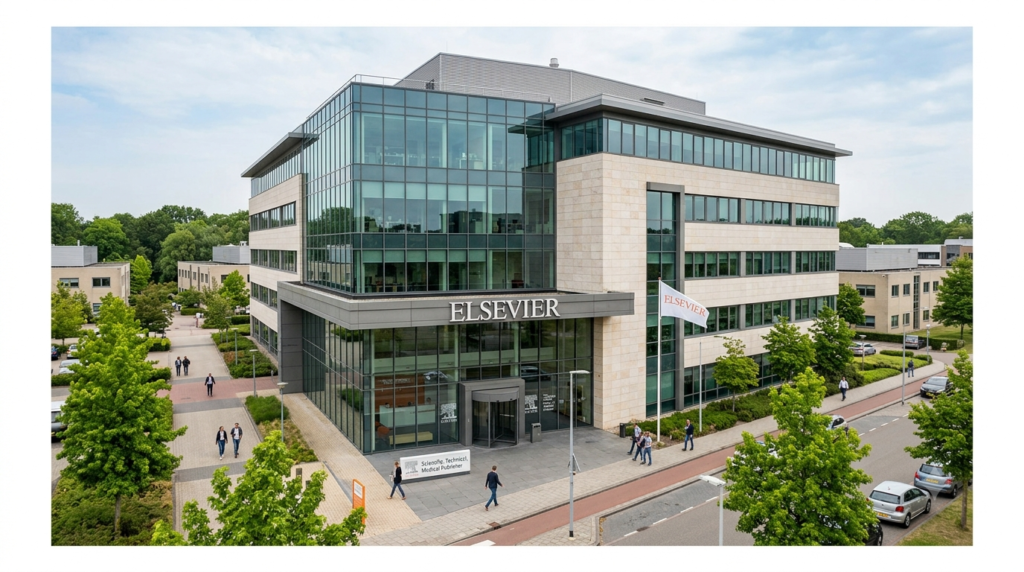
Many students searching for what is Elsevier assume it is simply a publisher of medical textbooks. In reality, Elsevier is one of the world’s largest scientific publishing and information analytics companies. It publishes thousands of peer-reviewed journals and books across medicine, pharmacy, nursing, engineering, life sciences, and numerous other disciplines. Beyond publishing, Elsevier develops digital solutions that support researchers throughout the entire research lifecycle—from literature discovery and manuscript preparation to publication , citation tracking and now Elsevier online certification courses.
Elsevier is also the organization behind widely recognized platforms such as ScienceDirect, Scopus, ClinicalKey, and the Researcher Academy. These tools are used by universities, hospitals, pharmaceutical companies, and research institutions worldwide. For students and early-career professionals, Elsevier’s educational resources provide an accessible way to learn essential research skills without enrolling in expensive certification programs.
Understanding Elsevier’s ecosystem is particularly beneficial for healthcare students because many evidence-based treatment guidelines and landmark clinical studies are published in Elsevier journals. Familiarity with these resources not only improves academic performance but also prepares learners for future roles involving literature evaluation, systematic reviews, pharmacovigilance, and clinical decision-making.
Why Elsevier Online Certification Courses Matter in 2026
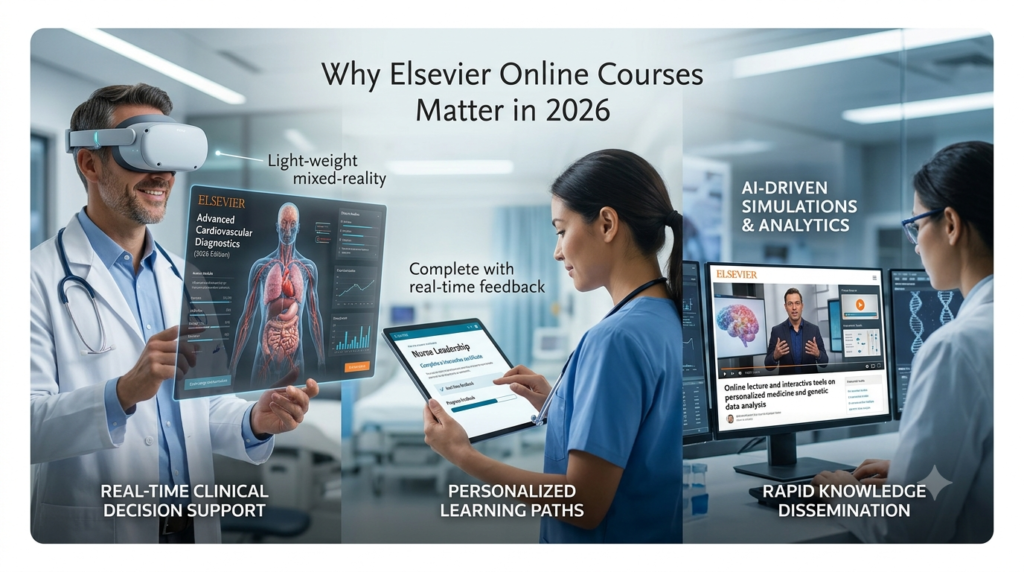
The research landscape has evolved dramatically over the last few years. Artificial intelligence, open science initiatives, data transparency, and stricter publication ethics have transformed how research is conducted and disseminated. As a result, employers increasingly expect graduates to possess practical research competencies alongside their academic qualifications. This is where Elsevier online courses provide immense value.
Unlike traditional classroom instruction, Elsevier’s online learning modules are designed by experienced editors, publishers, and researchers who understand the real challenges faced during manuscript preparation and publication. The courses cover practical topics such as selecting an appropriate journal, avoiding plagiarism, responding to peer-review comments, improving scientific writing, managing research data, and enhancing research visibility. These are skills rarely taught comprehensively during undergraduate education.
For healthcare professionals—including Pharm.D graduates, MBBS students, nurses, dentists, and life science researchers—these competencies can open doors to careers in medical writing, clinical research, regulatory affairs, pharmacovigilance, and academia. Completing Elsevier online certification courses demonstrates initiative and a willingness to invest in continuous learning, qualities that recruiters often value highly. Since many modules are available at no cost, they also represent an affordable pathway to professional development.
Growing Demand for Research Skills : Elsevier Online Certification Courses
Scientific research has become increasingly collaborative and multidisciplinary. Pharmaceutical companies, contract research organizations, hospitals, and academic institutions now seek professionals who can critically appraise literature, contribute to publications, and communicate research findings effectively. Certifications in scientific writing and publication ethics can therefore enhance employability, especially for fresh graduates competing in a competitive job market.
Importance for Healthcare Professionals : Elsevier Online Certification Courses
Healthcare decisions today rely heavily on evidence-based medicine. Whether interpreting a new clinical trial, evaluating a systematic review, or preparing a case report, professionals need strong research literacy. Elsevier’s educational modules help bridge the gap between academic learning and real-world research practice, enabling learners to apply evidence confidently in clinical and academic settings.
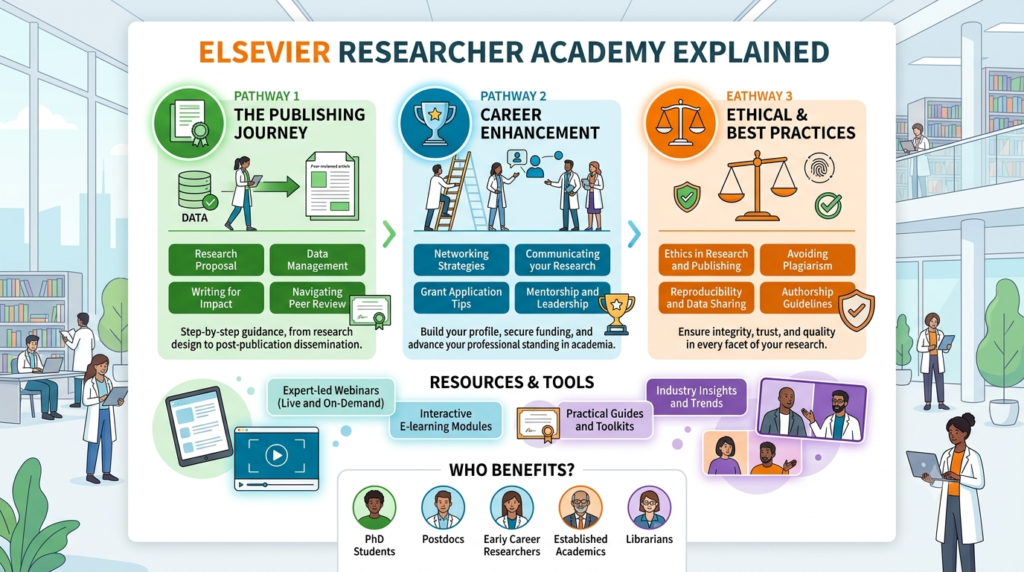
Elsevier Researcher Academy Explained : Elsevier Online Certification Courses
Among all educational initiatives offered by Elsevier, the Researcher Academy stands out as one of the most accessible and comprehensive platforms for research training. It is specifically designed to support researchers at every stage of their careers—from undergraduate students writing their first literature review to experienced investigators preparing grant applications or mentoring junior colleagues.
The platform hosts structured learning modules covering manuscript writing, publication ethics, peer review, open access publishing, data management, journal selection, citation practices, research communication, and career development. Lessons are divided into manageable segments featuring videos, quizzes, interactive exercises, and downloadable resources, making it easy to progress even with a busy schedule.
One of the platform’s greatest strengths is its practical orientation. Rather than focusing solely on theoretical concepts, the courses emphasize actionable strategies that learners can immediately apply to their own research projects. Completing eligible modules results in a Research Academy Elsevier certificate, Elsevier Online Certification Courses , which can be showcased on professional networking platforms and included in resumes or academic portfolios.
Who Can Enroll? : Elsevier Online Certification Courses
One of the biggest advantages of Elsevier Researcher Academy is its inclusivity. The platform welcomes undergraduate students, postgraduate scholars, doctoral candidates, clinicians, pharmacists, nurses, faculty members, researchers, and professionals from virtually every scientific discipline. Anyone interested in improving research skills can create an account and begin learning.
Course Categories : Elsevier Online Certification Courses
Popular categories include scientific writing, publishing ethics, peer review, grant writing, data management, research impact, collaboration, career planning, and responsible research practices. Learners can choose individual modules or follow curated learning paths tailored to their career goals, allowing them to build expertise progressively.
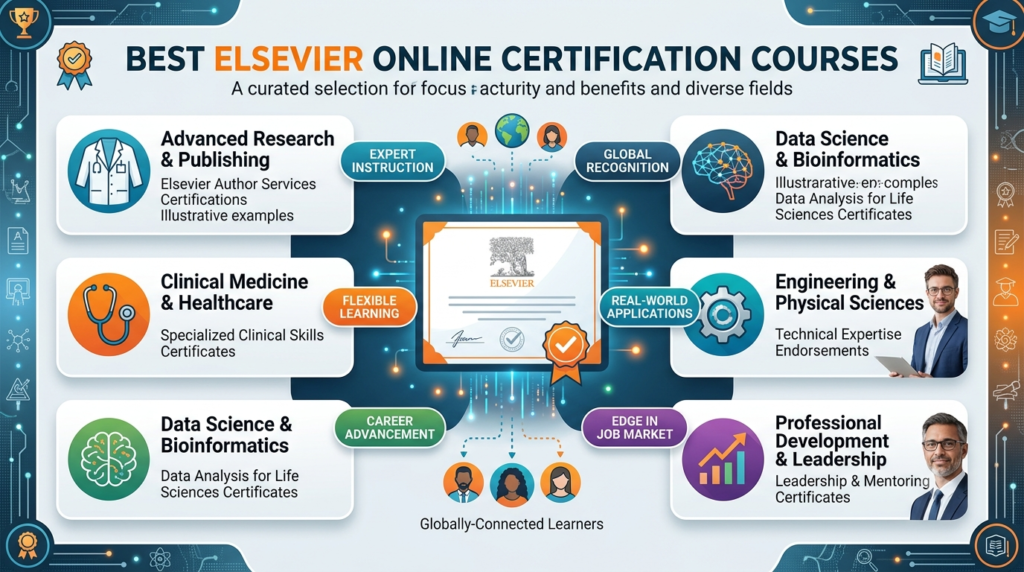
Best Elsevier Online Certification Courses
With dozens of learning modules available, choosing where to begin can feel overwhelming. Fortunately, several courses consistently stand out because they address the core competencies required by students, researchers, and healthcare professionals. These courses not only improve research knowledge but also enhance practical skills that can be applied immediately in academic and professional settings.
One of the most recommended starting points is the scientific writing course, which explains how to structure manuscripts, write clear abstracts, present data effectively, and communicate research findings with precision. Equally valuable is the publication ethics course, which introduces concepts such as plagiarism, authorship criteria, conflicts of interest, and responsible reporting. Understanding these principles is essential for maintaining integrity throughout the publication process.
Another highly regarded module focuses on peer review, helping learners understand how manuscripts are evaluated by journal reviewers and editors. Participants gain insight into reviewing techniques, constructive feedback, and editorial decision-making. Additional courses covering research data management, research visibility, collaboration, grant writing, and journal selection provide a well-rounded foundation for anyone pursuing a research-oriented career. Together, these Elsevier courses free, Elsevier Online Certification Courses equip learners with practical knowledge that extends far beyond classroom education.
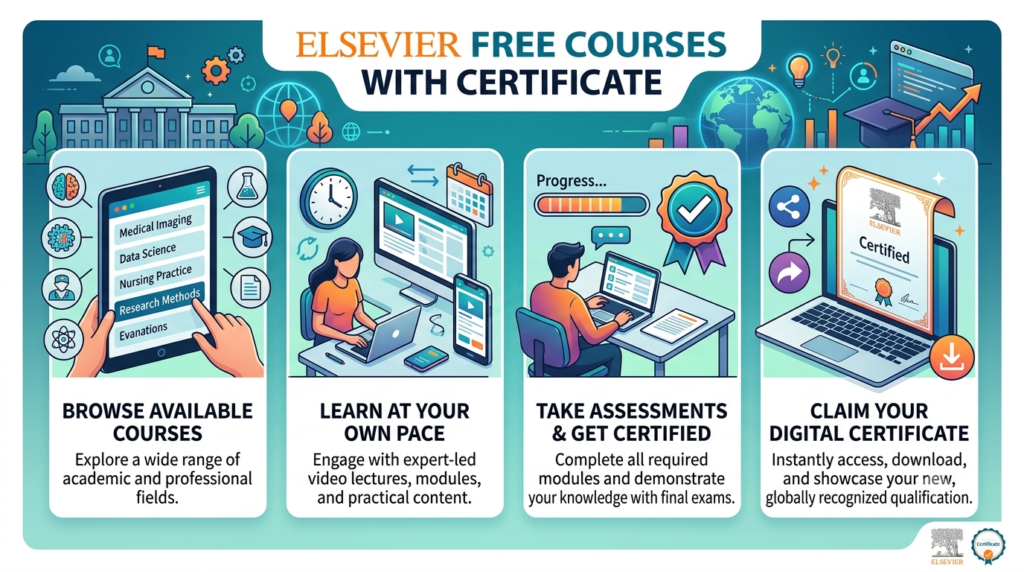
Elsevier Free Courses with Certificate with links
One of the biggest reasons behind the popularity of Elsevier free courses with certificate and Elsevier Online Certification Courses is that they remove financial barriers for students and early-career researchers. Many universities teach research methodology as part of the curriculum, but these courses often focus on theory rather than the practical aspects of publishing a manuscript, selecting journals, handling reviewers’ comments, or maintaining publication ethics. Elsevier Researcher Academy fills this gap by offering structured learning modules that are freely accessible after registration. Instead of paying hundreds of dollars for commercial certifications, learners can build credible research skills from an internationally recognized publisher.
Another advantage is flexibility. The courses are self-paced, allowing students to learn according to their schedules. Whether you are preparing for examinations, completing hospital postings, or working as a research intern, you can pause and resume lessons whenever convenient. Most modules consist of short videos, quizzes, reading materials, and practical examples that simplify complex publishing concepts. After successfully completing eligible modules and passing the assessments, participants receive a digital certificate that can be downloaded and shared professionally.
Popular Elsevier Research Academy free online courses with certificates include:
| Course | Certificate | Suitable For | Official Link |
|---|---|---|---|
| Scientific Writing | ✅ Yes | Students, Researchers | Writing for Research Learning Path |
| Publishing Ethics | ✅ Yes | Authors | Publication Process – Ethics Modules |
| Peer Review | ✅ Yes | Reviewers | Navigating Peer Review Learning Path |
| Journal Selection | ✅ Yes | First-time Authors | Finding the Right Journal (Publication Process) |
| Research Data Management | ✅ Yes | Clinical Researchers | Research Preparation – Research Data Management |
| Grant Writing (Funding Proposals) | ✅ Yes | Faculty & PhD Scholars | Research Preparation – Funding Modules |
| Research Impact | ✅ Yes | Researchers | Communicating Your Research & Research Metrics |
These certificates strengthen resumes, LinkedIn profiles, academic portfolios, and applications for internships, scholarships, higher education, and research positions.
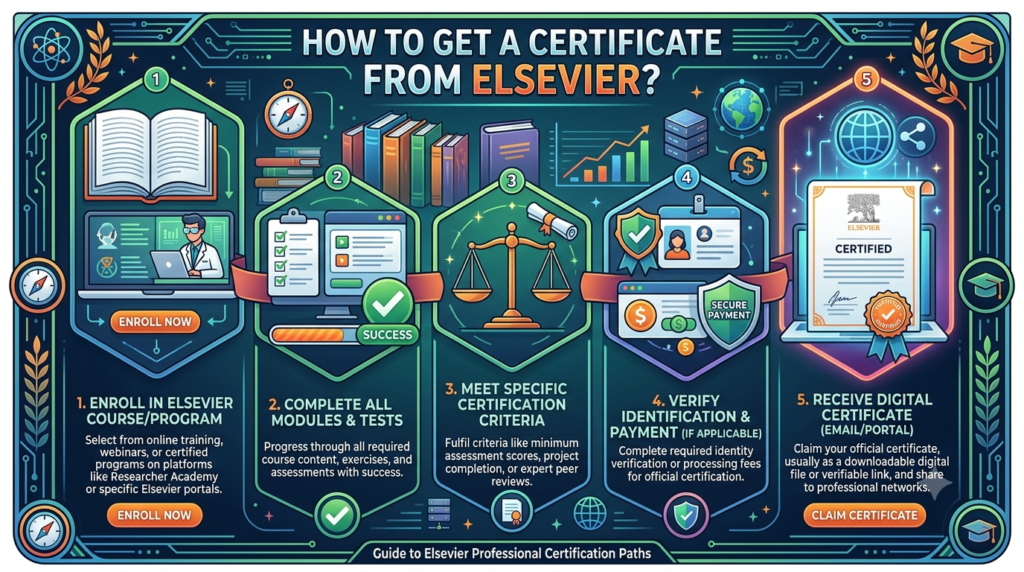
How to Get a Certificate from Elsevier? : Elsevier Online Certification Courses
Many learners ask how they can obtain an official Research Academy Elsevier certificate. The process is straightforward and takes only a few steps.
- Create an Elsevier account.
- Complete the Elsevier login process.
- Visit the Researcher Academy dashboard.
- Choose a course marked with a certificate.
- Complete every lesson.
- Pass the final assessment or quiz.
- Download your certificate from your completed courses dashboard.
The certificate usually includes your name, the course title, and the completion date. Since it is issued by Elsevier, it adds credibility to your academic profile. Although it is not equivalent to a university degree, it demonstrates continuous professional development and research competency.
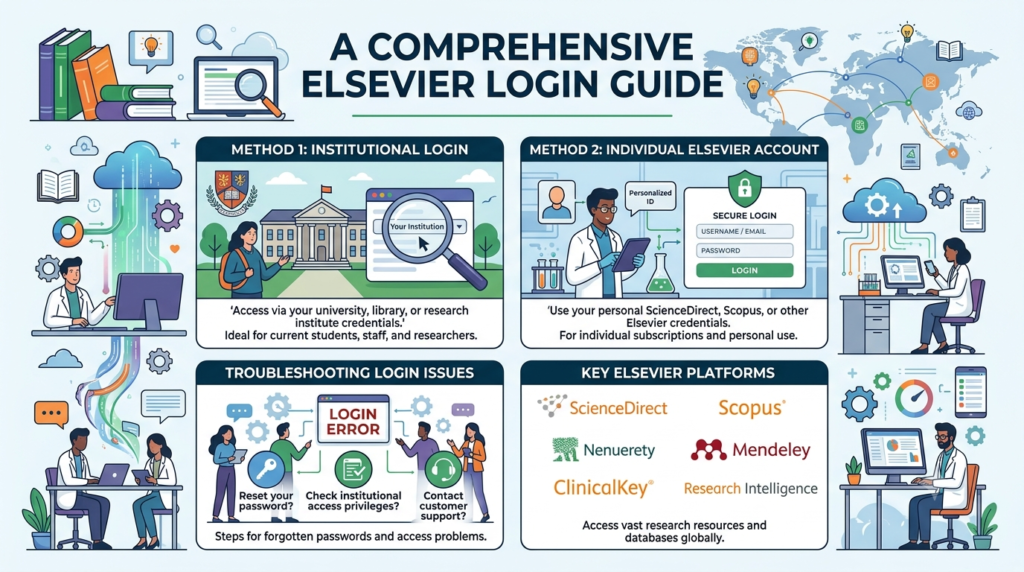
Elsevier Login Guide : Elsevier Online Certification Courses
To access Elsevier online certification courses, you first need an Elsevier account. Registration is free and requires only basic information such as your name, email address, and password. Once registered, you can use the same credentials across several Elsevier platforms, making it convenient to access educational resources, journals, and research tools.
If your university subscribes to Elsevier products such as ScienceDirect or ClinicalKey, you may also receive institutional access to additional content. However, the majority of Researcher Academy learning modules are available independently after signing in, making them accessible even to students without institutional subscriptions.
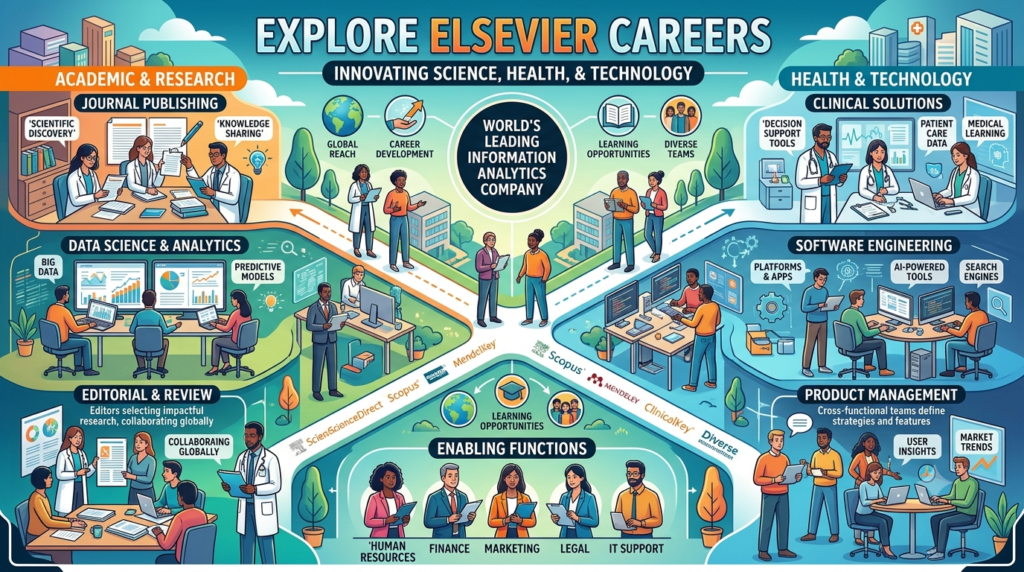
Elsevier Careers : Elsevier Online Certification Courses
When students search for Elsevier careers, they often think only of editorial positions. In reality, Elsevier offers opportunities across publishing, healthcare technology, software engineering, product management, data analytics, marketing, customer success, sales, AI, and medical content development. Individuals with pharmacy or life sciences backgrounds may find roles in medical editing, scientific communication, content quality, and research support.
For Pharm.D graduates interested in non-clinical careers, developing research skills through Elsevier courses can strengthen applications for positions in:
- Medical Writing
- Scientific Editing
- Pharmacovigilance
- Clinical Research
- Medical Information
- Regulatory Affairs
- Journal Editorial Support
Recruiters appreciate candidates who understand publication ethics, manuscript preparation, and evidence-based medicine because these skills translate well into healthcare communication roles.
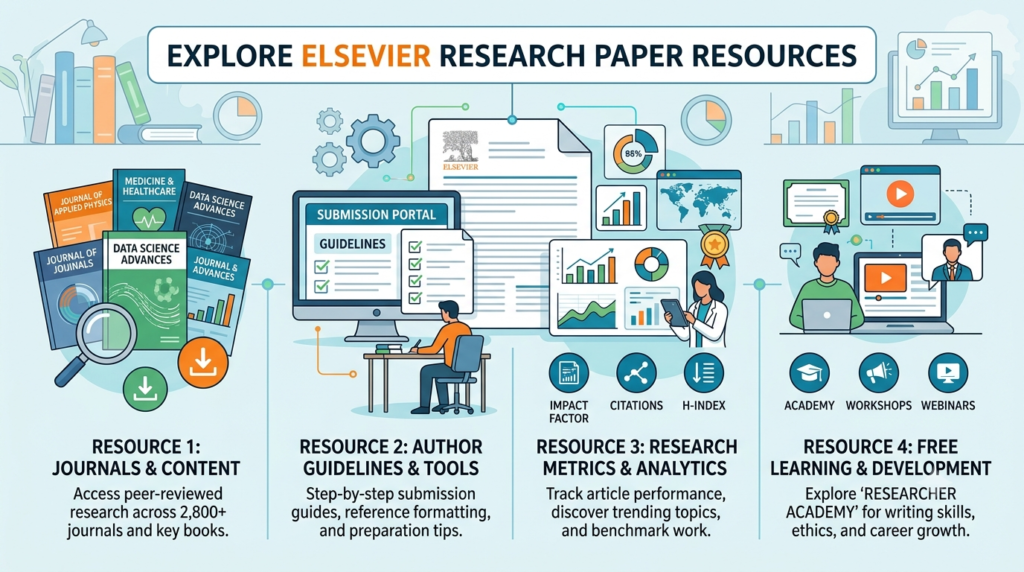
Elsevier Research Paper Resources : Elsevier Online Certification Courses
Preparing an Elsevier research paper involves much more than writing scientific content. Authors must identify an appropriate journal, follow formatting guidelines, prepare ethical declarations, cite references correctly, and respond professionally to reviewers. Elsevier Researcher Academy offers dedicated modules that explain each of these steps using real-world examples.
One of the most valuable lessons emphasizes avoiding common reasons for manuscript rejection. Many first-time authors lose publication opportunities because of poor study design, inadequate reporting, plagiarism, weak statistical presentation, or selecting the wrong journal. Learning these principles before writing your first manuscript saves considerable time and improves publication success.
Students should also remember that publishing is a gradual learning process. Every rejected manuscript provides valuable feedback that can strengthen future submissions.

Personal Experience as a Pharm.D Student
As a Pharm.D student, I initially believed that research simply involved reading journal articles for seminars and case presentations. My perspective changed during clinical postings and research internships, where I realized that understanding how evidence is created is just as important as applying it in patient care. Reading a published article is very different from knowing how authors designed the study, analyzed data, addressed ethical concerns, and responded to reviewers.
While working on literature reviews and healthcare blogs for White Coat Writes, I frequently referred to peer-reviewed publications. This experience highlighted the importance of structured scientific writing, accurate referencing, and publication ethics. Exploring Elsevier online certification courses helped me understand concepts such as selecting the right journal, writing effective abstracts, avoiding plagiarism, and interpreting reviewer comments. These practical lessons improved both my academic writing and my confidence when discussing research findings.
If you are a pharmacy student aiming for careers in clinical research, medical writing, pharmacovigilance, or higher education, these courses provide an excellent starting point. They bridge the gap between theoretical knowledge and real-world research expectations.
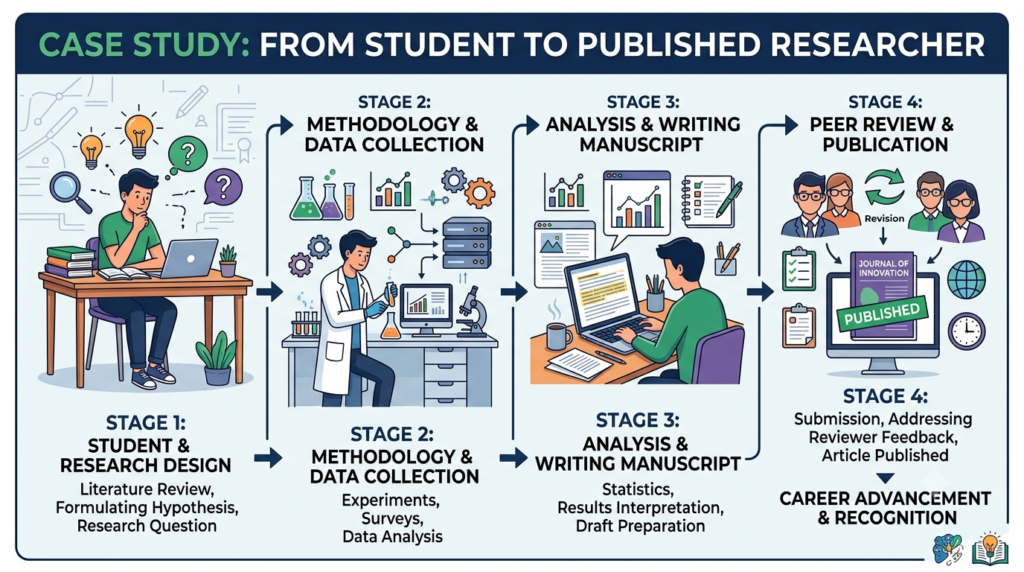
Case Study Example: From Student to Published Researcher
Consider a hypothetical Pharm.D student named Aisha who aspired to publish her first review article. Although she possessed strong clinical knowledge, she had little understanding of manuscript preparation or journal selection. After enrolling in several Elsevier online courses, she completed modules on scientific writing, publication ethics, peer review, and journal selection.
Using these newly acquired skills, Aisha revised her literature review, improved the manuscript structure, strengthened the discussion section, and formatted references correctly. She also learned how to address reviewer comments professionally after receiving revision requests from a journal. Within a few months, her manuscript was accepted for publication.
Beyond publication, these certifications strengthened her CV, helping her secure interviews for medical writing and clinical research positions. This example demonstrates that structured learning can significantly accelerate professional growth.
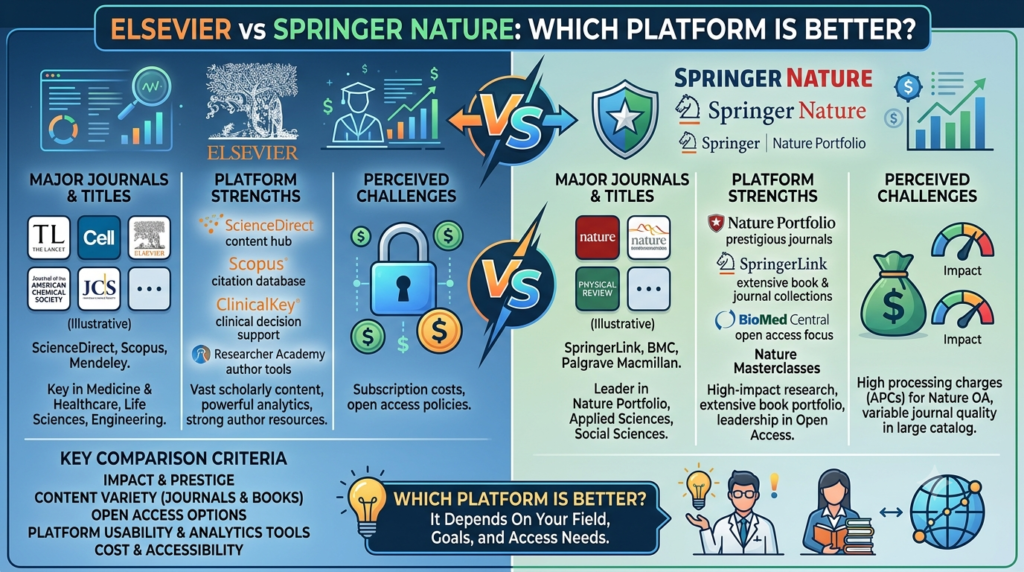
Elsevier vs Springer: Which Platform Is Better?
A common question among researchers is whether Elsevier or Springer is the better publishing platform. The answer depends on your goals.
| Feature | Elsevier | Springer |
|---|---|---|
| Research Academy | Excellent | Limited |
| Free Research Training | Extensive | Moderate |
| Publishing Guidance | Excellent | Good |
| Healthcare Journals | Very Strong | Strong |
| Engineering Journals | Strong | Very Strong |
| Scopus Integration | Yes | No |
| Learning Resources | Extensive | Moderate |
Both publishers maintain high academic standards and publish reputable journals. Rather than choosing one over the other, researchers should select journals based on scope, audience, indexing, quality, and relevance to their work.
Conclusion
Elsevier online certification courses have become one of the best free learning resources for students, healthcare professionals, researchers, and early-career authors who want to strengthen their research skills. Through the Researcher Academy, learners gain practical knowledge in scientific writing, peer review, publication ethics, journal selection, and research communication while earning certificates that enhance professional credibility.
For Pharm.D students and healthcare graduates, these certifications complement academic education by providing industry-relevant skills that are increasingly valued in medical writing, pharmacovigilance, clinical research, regulatory affairs, and academia. While certificates alone will not guarantee employment or publication, combining them with practical experience, internships, and consistent learning can significantly improve career prospects.
People Also Ask
Is Elsevier Researcher Academy free?
Yes. Most Researcher Academy courses are available free after creating an Elsevier account.
Is Elsevier free or paid?
Researcher Academy is largely free, while many journals and databases require institutional or personal subscriptions.
How to access Elsevier for free?
Create a free Elsevier account, use Researcher Academy, access open-access articles, or use institutional subscriptions provided by your university.
Which one is better, Springer or Elsevier?
Both are highly respected publishers. Elsevier offers stronger integrated research training through Researcher Academy, while Springer has an extensive multidisciplinary journal portfolio.
Can I publish in Scopus for free?
Yes. Some Scopus-indexed journals do not charge Article Processing Charges (APCs), while many open-access journals require publication fees.
Which is better, UGC or Scopus?
They serve different purposes. UGC-CARE is an Indian quality list, whereas Scopus is an international abstracting and citation database recognized globally.
Can I have a Scopus ID without publication?
Generally, a Scopus Author ID is created automatically after your first indexed publication.
What is the cost of Scopus publication in India?
There is no fixed cost. Some journals charge no fee, while others may charge APCs ranging from approximately ₹20,000 to over ₹2,00,000 depending on the journal and publication model.
Who owns Elsevier?
Elsevier is part of RELX, a global information and analytics company.
Is Elsevier the same as Scopus?
No. Elsevier is the publishing company, while Scopus is Elsevier’s bibliographic and citation database.
Is Elsevier British or American English?
Elsevier is headquartered in the Netherlands and accepts both British and American English, provided the manuscript uses one style consistently.
Frequently Asked Questions
1. Are Elsevier certificates recognized?
Yes. They are widely recognized as professional development certificates issued by a leading scientific publisher.
2. Can undergraduate students join Elsevier Researcher Academy?
Absolutely. Undergraduate, postgraduate, and doctoral students can all enroll.
3. Do Elsevier certificates expire?
No, certificates generally do not have an expiration date, though course content may be updated periodically.
4. Can I add Elsevier certificates to LinkedIn?
Yes. They can be added under the Licenses & Certifications section of your LinkedIn profile.
5. Which Elsevier course should beginners start with?
The Scientific Writing and Publishing Ethics courses are excellent starting points before progressing to peer review and journal selection.