
Table of Contents
🔍 Introduction to Literature Reviews
Why Literature Reviews Matter in Research
If research were a journey, then a literature review would be your map. Without it, you’re basically walking blindfolded in a forest full of data, hoping to stumble upon something meaningful. Whether you’re a student, researcher, or a Pharm D scholar, understanding literature reviews is absolutely critical. They help you identify gaps, avoid duplication, and build on existing knowledge.
In academic research, especially in healthcare and pharmacy, literature reviews are the backbone of evidence-based practice. From clinical trials to drug safety studies, everything begins with understanding what has already been done. That’s where systematic research and narrative literature review come into play.
Overview of Systematic vs Narrative Review
At first glance, both may look similar—they review existing studies. But dig deeper, and you’ll notice a massive difference. A systematic review is structured, methodical, and replicable, while a narrative review is more flexible, descriptive, and interpretive.
Think of it like this:
A systematic review is like a GPS navigation system, giving precise, step-by-step directions. A narrative review is more like a travel blog, sharing insights, opinions, and experiences.
📊 Systematic Review Meaning & Definition
What is a Systematic Review?
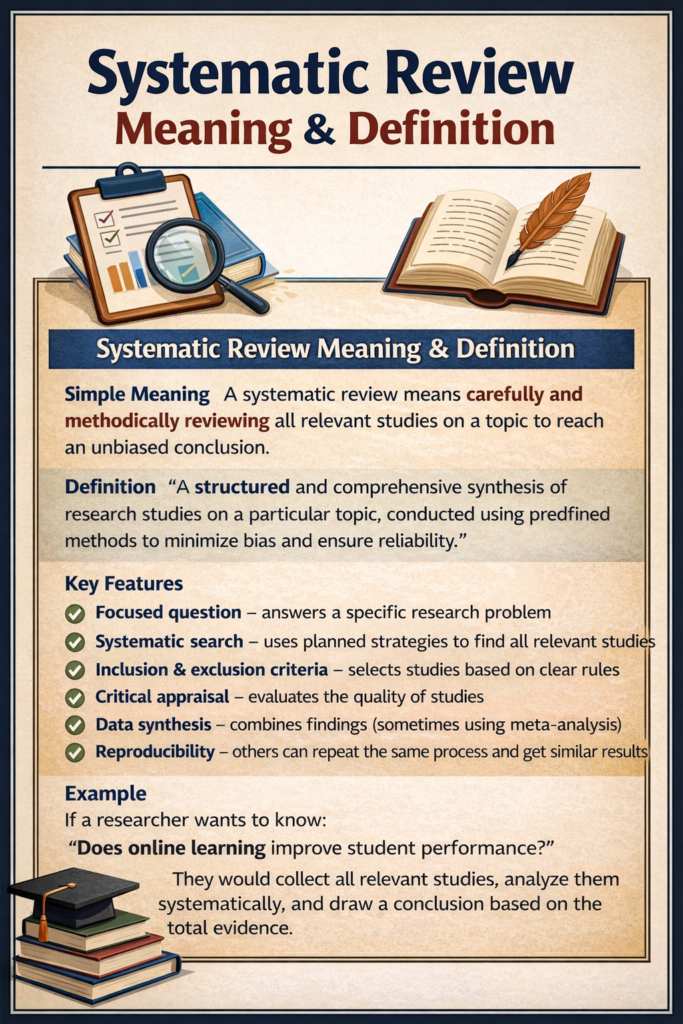
A systematic review definition can be described as a rigorous and structured method of identifying, evaluating, and synthesizing all relevant studies on a specific research question.
It follows a predefined protocol and aims to minimize bias. That’s why it is considered the gold standard in evidence-based medicine.
Key keywords:
- systematic review meaning
- systematic review definition
- systematic research
- Systematic Review vs Narrative Review
Key Characteristics of Systematic Research
- Clearly defined research question
- Predefined inclusion and exclusion criteria
- Comprehensive database search
- Critical appraisal of studies
- Data synthesis (often includes systematic review and meta analysis)
A systematic review is not just reading papers—it’s more like conducting a mini research project using already published data.
📝 Narrative Review Meaning & Definition
What is a Narrative Review?
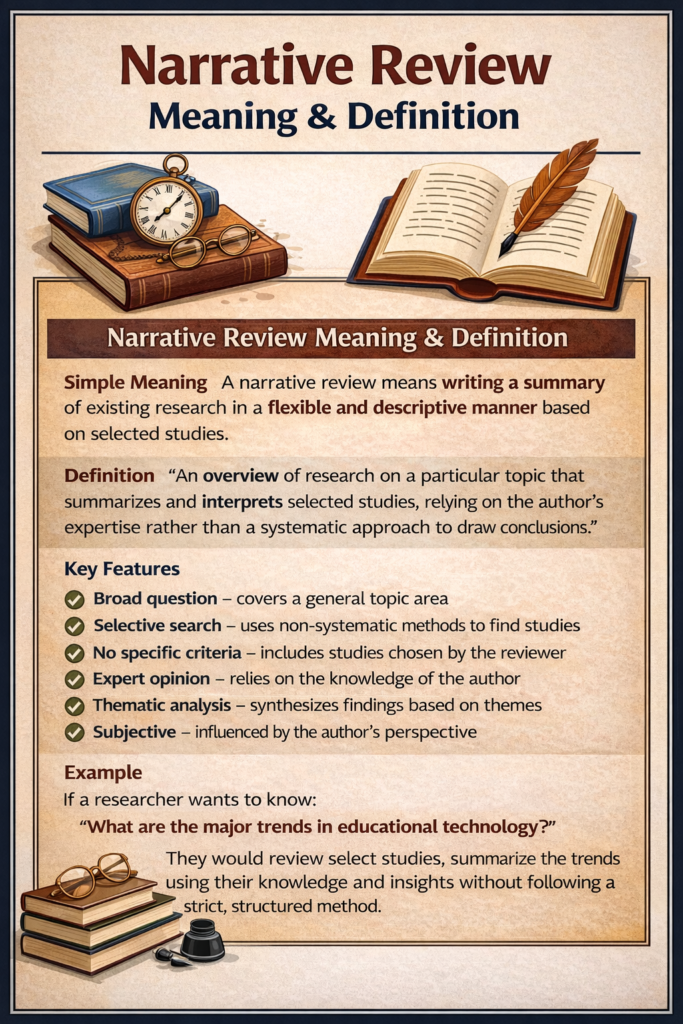
A narrative review is a type of literature review that summarizes and interprets research findings without a strict methodological framework.
Keywords covered:
- narrative review meaning
- what is a narrative review
- narrative literature review meaning
- Systematic Review vs Narrative Review
Unlike systematic reviews, narrative reviews allow more flexibility and are often used to provide a broad overview of a topic.
Types of Narrative Reviews
- Traditional narrative review
- Critical review
- Thematic review
- Conceptual review
These reviews are widely used in early research stages or when exploring new topics.
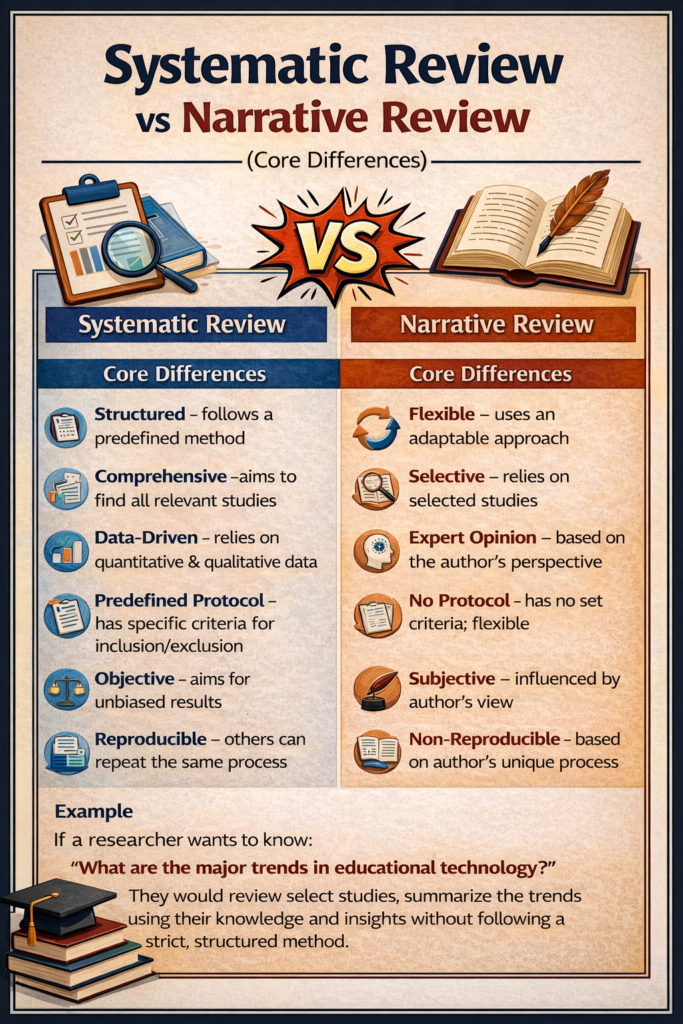
⚖️ Systematic Review vs Narrative Review (Core Differences)
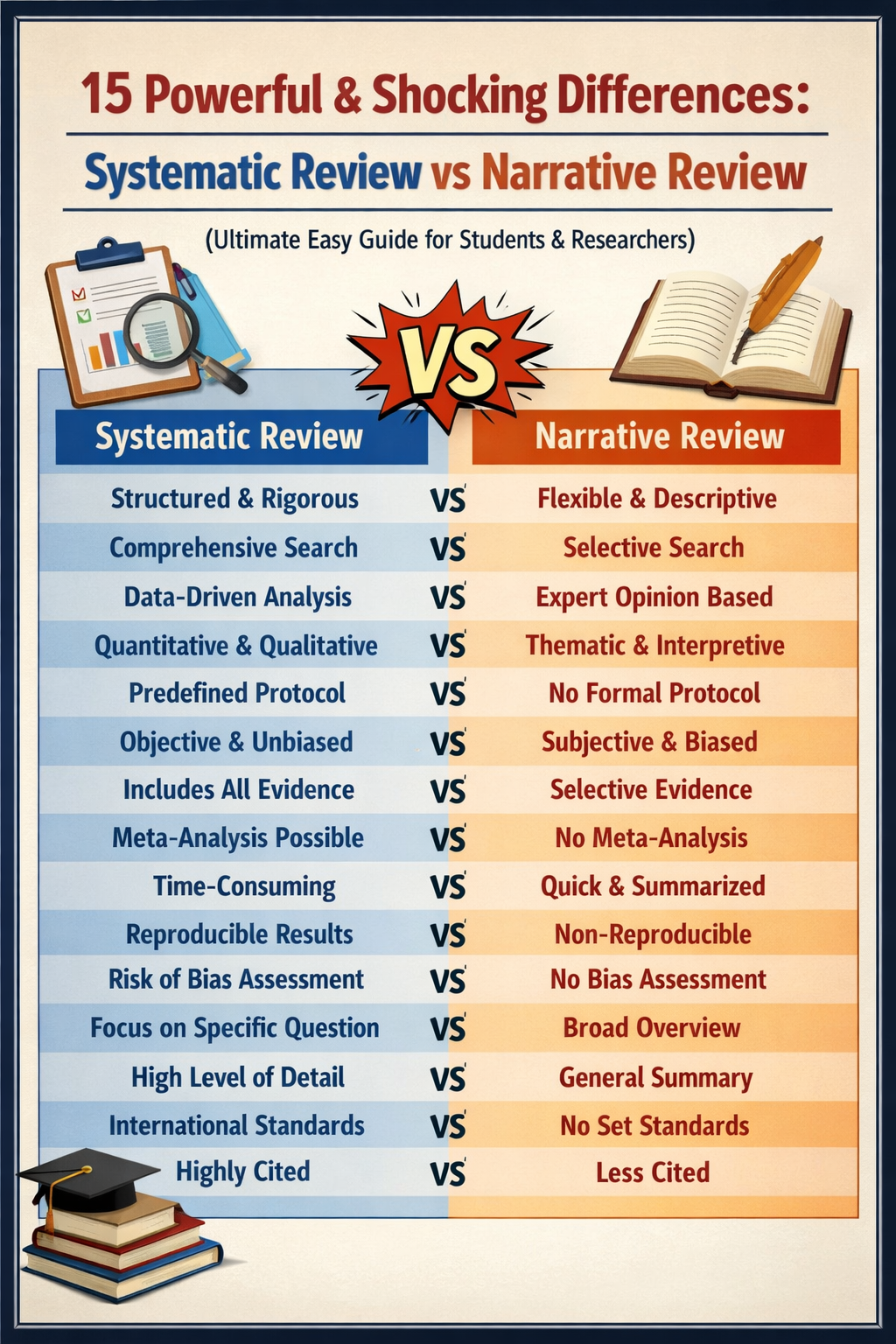
Comparison Table : Systematic Review vs Narrative Review
| Feature | Systematic Review | Narrative Review |
|---|---|---|
| Approach | Structured | Flexible |
| Bias | Low | High |
| Protocol | Predefined | Not required |
| Reproducibility | High | Low |
| Data Analysis | Quantitative/Meta-analysis | Qualitative |
| Time Required | Long | Short |
When to Use Each Review Type
Use systematic review when:
- You need evidence-based conclusions
- Working on clinical or policy research
- Publishing in high-impact journals
Use narrative review when:
- Exploring new topics
- Writing academic assignments
- Providing theoretical insights
🔬 Scoping Review vs Systematic Review
What is a Scoping Review?
A scoping review maps the existing literature on a topic and identifies key concepts, gaps, and evidence types.
Key Differences Explained
- Scoping reviews are broader
- Systematic reviews are more focused
- Scoping reviews don’t always assess quality
Keywords:
- scoping review vs systematic review
- what is a scoping review vs systematic review
- Systematic Review vs Narrative Review
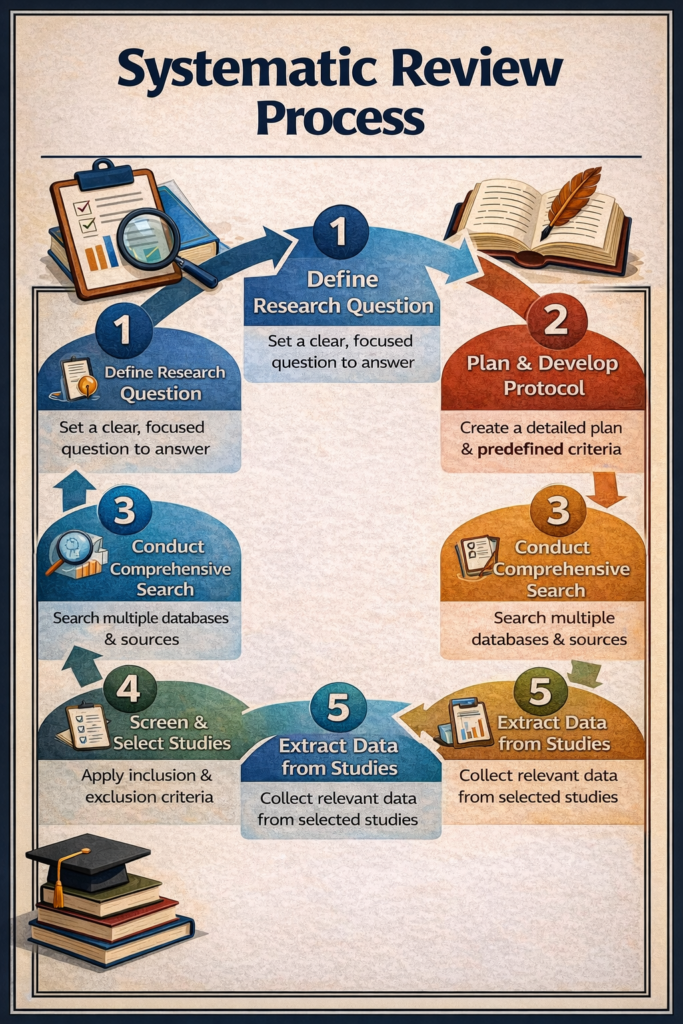
🧪 Systematic Review Process
5 Steps of Systematic Review
- Define research question
- Develop protocol
- Literature search
- Data extraction
- Analysis & synthesis
7 Steps of Systematic Review
- Formulate question
- Register protocol
- Search databases
- Screen studies
- Assess quality
- Extract data
- Report results
✍️ Narrative Review Writing Guide
How to Write a Narrative Review
- Choose a broad topic
- Collect relevant studies
- Organize them thematically
- Critically analyze findings
- Write in a storytelling format
Keywords:
- how to write a narrative review
- writing narrative literature reviews
- Systematic Review vs Narrative Review
Structure & Format
- Introduction
- Body (themes or arguments)
- Discussion
- Conclusion
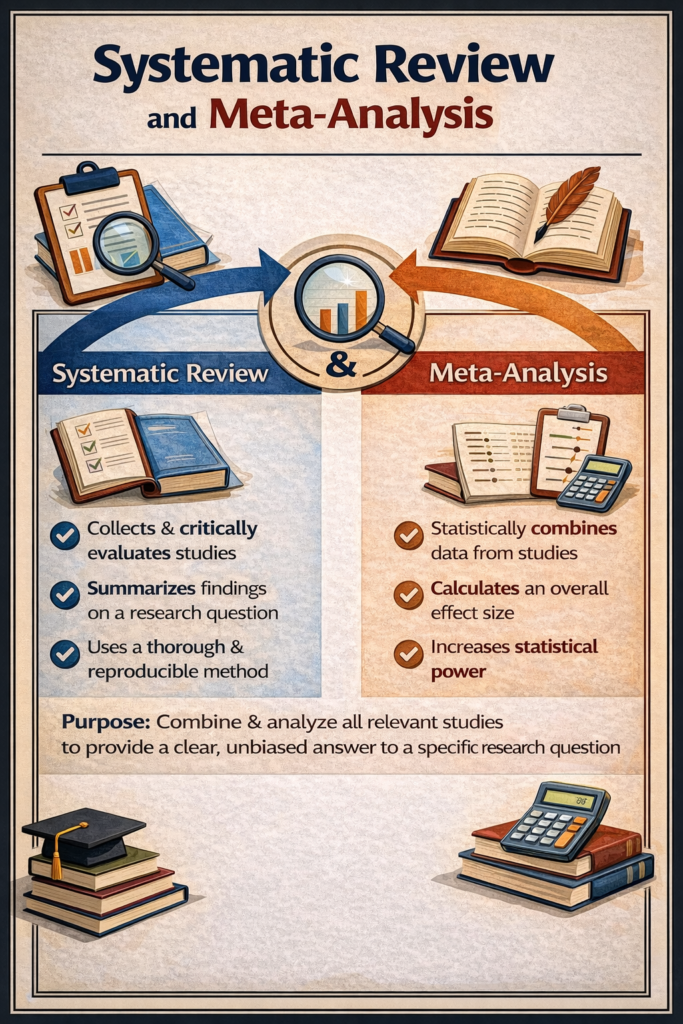
📈 Systematic Review and Meta-Analysis
Difference Between Systematic Review and Meta Analysis
- Systematic review = collects studies
- Meta-analysis = statistically combines results
Keyword focus:
- difference between systematic review and meta analysis
📚 Examples & Case Scenarios
Example of Systematic Review Paper
Example topic:
- “Effectiveness of antibiotics in treating pneumonia”
Keywords:
- example of systematic review paper
- systematic review example dissertation
- Systematic Review vs Narrative Review
Narrative Literature Review Example
Example topic:
- “Role of pharmacists in patient counseling”
Keywords:
- narrative literature review example
- narrative review examples
- Systematic Review vs Narrative Review
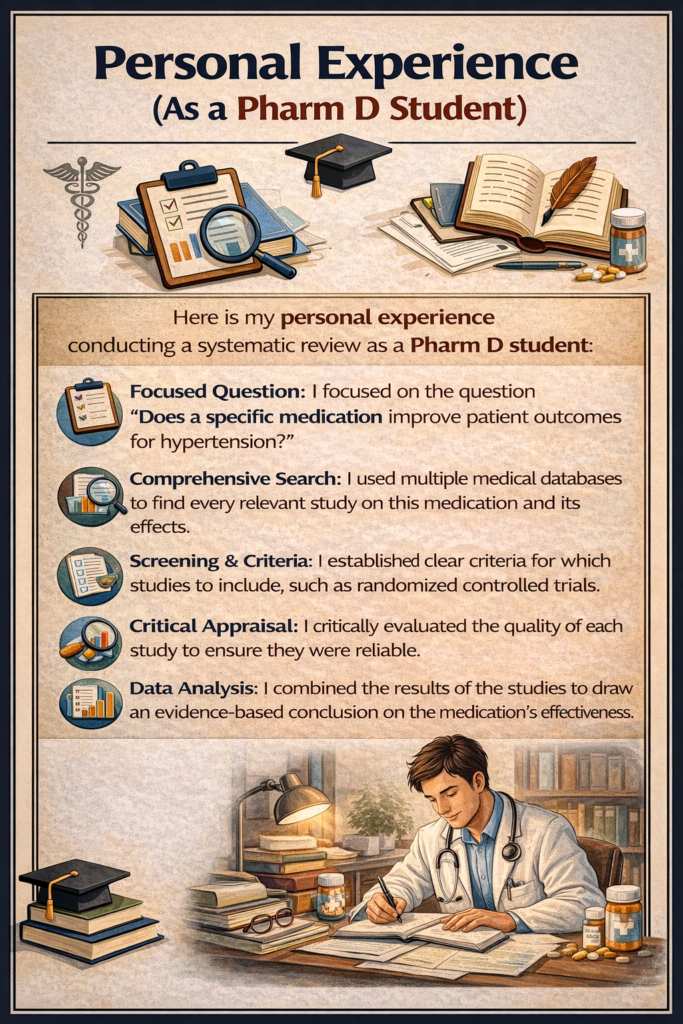
💊 Personal Experience (As a Pharm D Student)
During my Pharm D journey, I initially struggled to understand the difference between a systematic review and narrative review. I remember choosing a narrative review for my first assignment because it felt easier. I could explore topics freely without strict guidelines.
However, when I worked on a systematic review protocol example, things changed completely. It required database searching (PubMed, Scopus), screening hundreds of papers, and following PRISMA guidelines. It was time-consuming but incredibly rewarding.
A real scenario:
While researching adverse drug reactions, a systematic review helped identify statistically significant trends, whereas a narrative review helped explain clinical relevance in simple terms.
📊 Impact Factor & Publication Insights
Systematic Review Journal Impact Factor
Systematic reviews are highly valued and often published in high-impact journals because they provide strong evidence.
Keywords:
- systematic review impact factor
- systematic review journal impact factor
Examples:
- The Lancet
- BMJ
- Cochrane Reviews
🎓 Free Certification Courses: Systematic Review vs Narrative Review
| Sr.no. | Course Name | Provider | Field | Duration | Certificate |
| 1 | Good Clinical Practice (GCP) Certification | FreeGCP | Clinical Research | 20–25 hours | ✅ Free |
| 2 | Pharmacovigilance Course | Elevify | Pharmacovigilance | Flexible (Self-paced) | ✅ Yes |
| 3 | Certificate Course in Pharmacovigilance (CCP) | VigiServe Foundation | Pharmacovigilance | Self-paced | ✅ Yes |
| 4 | Free Clinical Research Courses (Multiple Modules) | ProRelix Education | Clinical Research | Varies | ✅ Available |
| 5 | Advanced Pharmacovigilance Practice Course | Elevify | Pharmacovigilance | Self-paced | ✅ Yes |
| 6 | Drug Development Product Management | Coursera | Pharma/Drug Development | ~10 hours | ⚠️ Free (Audit) |
| 7 | Understanding Clinical Research: Behind the Statistics | Coursera (University of Cape Town) | Clinical Research | ~8 hours | ⚠️ Free (Audit) |
| 8 | Introduction to Systematic Review and Meta-Analysis | Coursera (Johns Hopkins University) | Research | ~10 hours | ⚠️ Free (Audit) |
| 9 | Basics of Pharmacovigilance | Udemy | Pharmacovigilance | ~2–4 hours | ⚠️ Free (Limited offers) |
| 10 | Clinical Data Management | Great Learning | Clinical Research | ~2–3 hours | ✅ Free |

❓ People Also Ask (Quick Answers)
What is meant by systematic review?
A structured method to collect and analyze all relevant studies on a topic.
What are the 5 steps of systematic review?
Define question, protocol, search, extract data, analyze.
What are the 7 steps of a systematic review?
Question → Protocol → Search → Screening → Quality → Data → Reporting.
What are the 5 C’s of a literature review?
Context, Content, Comparison, Critique, Conclusion.
What are the ABC of systematic literature review?
Ask, Build, Compare.
What are the 4 main types of literature?
Narrative, Systematic, Scoping, Meta-analysis.
What are general guidelines for literature review?
Be objective, structured, and evidence-based.
What is a narrative review?
A descriptive summary of research without strict methodology.
Difference between systematic and narrative review?
Systematic = structured; Narrative = flexible.
What are the 4 types of literature review?
Narrative, Systematic, Scoping, Meta-analysis.
What is the format of narrative review?
Introduction → Themes → Discussion → Conclusion.
How to start a narrative review?
Begin with a broad research question.
Is a narrative review a systematic review?
No, they are fundamentally different.

🧾 Conclusion
Understanding the difference between systematic review vs narrative review is crucial for every student and researcher. One offers precision and reliability, while the other provides flexibility and insight. Choosing the right type depends on your research goals, time, and expertise.
If you’re aiming for high-impact publications or evidence-based practice, go for a systematic review. If you’re exploring ideas or writing assignments, a narrative review works perfectly.

❓ FAQs
1. What is a systematic review example?
A study analyzing multiple trials on drug effectiveness.
2. What is narrative literature review meaning?
It’s a descriptive summary of research studies.
3. Can a narrative review include meta-analysis?
No, meta-analysis is part of systematic reviews.
4. Which is easier: systematic or narrative review?
Narrative review is easier and less time-consuming.
5. Do systematic reviews have higher impact factor?
Yes, they are more likely to be published in high-impact journals.