
Table of Contents
Introduction to Pharmacovigilance
If medicines were cars, pharmacovigilance would be the traffic police, the accident investigators, and the safety engineers rolled into one. For beginners stepping into this field, pharmacovigilance can feel overwhelming—terms like ADRs, ICSR, PV reporting, and databases flying around like medical jargon confetti. But here’s the good news: once you understand the tools, everything starts to make sense.
This blog on pharmacovigilance tools is designed especially for beginners—pharmacy students, medical writers, life science graduates, and anyone curious about drug safety.
What Is Pharmacovigilance and Why Is It Important?
Pharmacovigilance is the science and activities related to detecting, assessing, understanding, and preventing adverse effects or any other drug-related problems. Sounds heavy? Let’s simplify.
Imagine a drug that works perfectly in clinical trials but causes rare side effects once used by millions. Pharmacovigilance systems catch these signals early and protect public health.
Why is pharmacovigilance important?
- Ensures patient safety
- Detects unknown ADRs
- Supports regulatory decision-making
- Improves benefit–risk balance of medicines
Without pharmacovigilance tools and software, modern healthcare would be like flying blind.
Understanding the Process of Pharmacovigilance
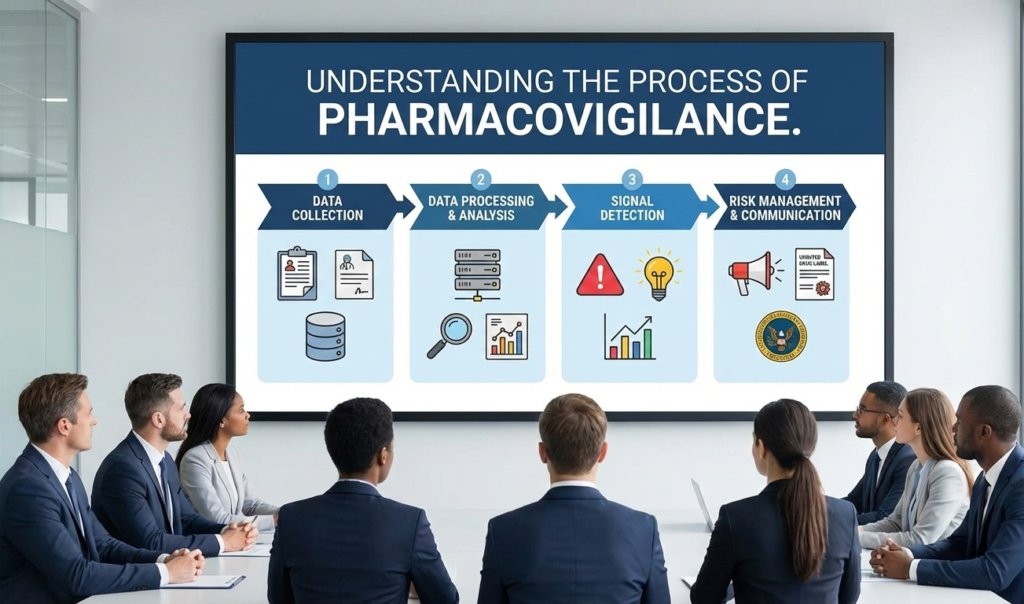
Before diving into tools, let’s understand the process of pharmacovigilance. Think of it as a loop, not a straight line.
Signal Detection
This is where pharmacovigilance databases and reporting tools come into play. Signals are patterns suggesting a possible new adverse reaction.
Risk Assessment
Here, experts analyze data using pharmacovigilance software to determine seriousness and causality.
Risk Management
Actions like label changes, warnings, or even drug withdrawal happen at this stage.
Risk Communication
Finally, information is shared with healthcare professionals, regulators, and patients.
What Are Pharmacovigilance Tools?
Pharmacovigilance tools are methods, systems, and software used to collect, manage, analyze, and report drug safety data.
Manual vs Digital Pharmacovigilance Tools
- Manual tools: Paper forms, spreadsheets (old-school but still used)
- Digital tools: Pharmacovigilance systems, databases, and PV software
Today, digital pharmacovigilance tools dominate because of speed, accuracy, and compliance.
Key Types of Pharmacovigilance Tools for ADR Reporting
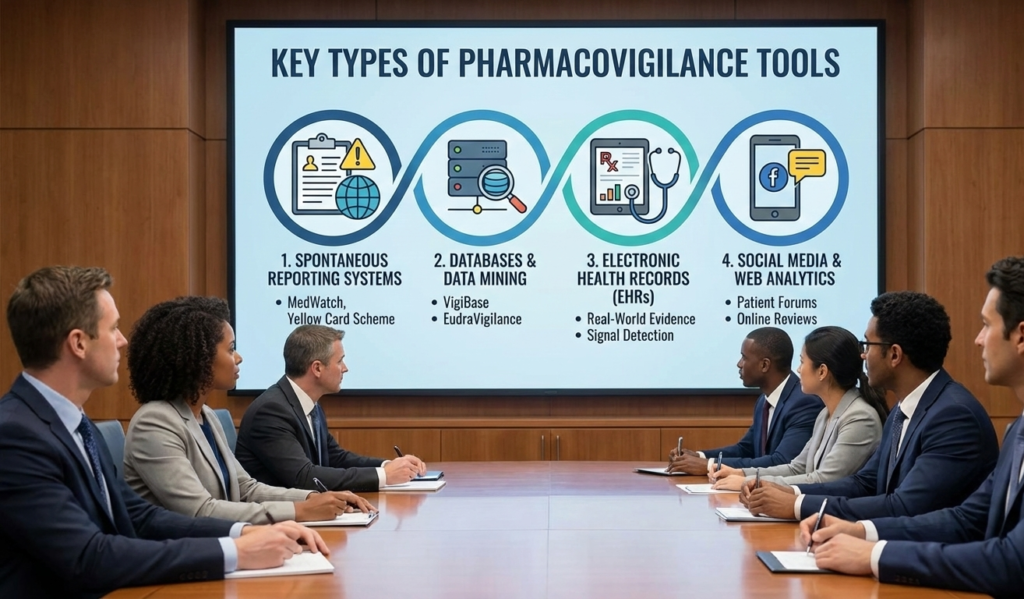
Pharmacovigilance Tools for ADR Reporting
These tools capture ADRs from healthcare professionals, patients, and clinical studies.
Pharmacovigilance Databases
They store millions of safety reports for signal detection and trend analysis.
Pharmacovigilance Systems
End-to-end platforms managing the full PV lifecycle—from case intake to regulatory submission.
Pharmacovigilance Tools for ADR Reporting
ADR reporting is the backbone of pharmacovigilance.
Methods of ADR Reporting
- Spontaneous reporting
- Active surveillance
- Literature monitoring
- Clinical trial reporting
Spontaneous Reporting
The most common method. Healthcare professionals report suspected ADRs using pharmacovigilance reporting tools.
Active Surveillance
More structured and proactive, often using registries and electronic health records.
Pharmacovigilance Software Explained
Pharmacovigilance software is designed to automate safety workflows.
Software for Pharmacovigilance Lifecycle
From case intake and data entry to narrative writing and regulatory submission, everything happens in one place.
Cloud-Based vs On-Premise Systems
- Cloud-based: Flexible, scalable, beginner-friendly
- On-premise: Secure but costly and complex

Free Courses on Pharmacovigilance Tools and Drug Safety Basics suitable for Beginners
| Course Title | Provider / Platform | What You’ll Learn |
| Free GVP Training (Good Pharmacovigilance Practice) | PharmaLessons | Basics of pharmacovigilance, pharmacovigilance system, reporting & risk management |
| Basic Good Pharmacovigilance Practices | Pharma Digests | Intro to PV, safety signals, risk minimization |
| Self-Paced PV Courses (WHO-UMC) | Uppsala Monitoring Centre (WHO) | Online lessons on drug safety, ADR reporting, signal detection |
| Free Pharmacovigilance Course (Impodays) | Impodays | PV fundamentals including safety assessment & ADR reporting |
Popular Pharmacovigilance Softwares Used Globally
Oracle Argus Safety
The industry gold standard. Widely used by pharma companies worldwide.
ArisG
Known for its user-friendly interface and modular design.
VigiFlow
Developed by WHO for national pharmacovigilance centers.
Empirica
Focused on signal detection and data analysis.
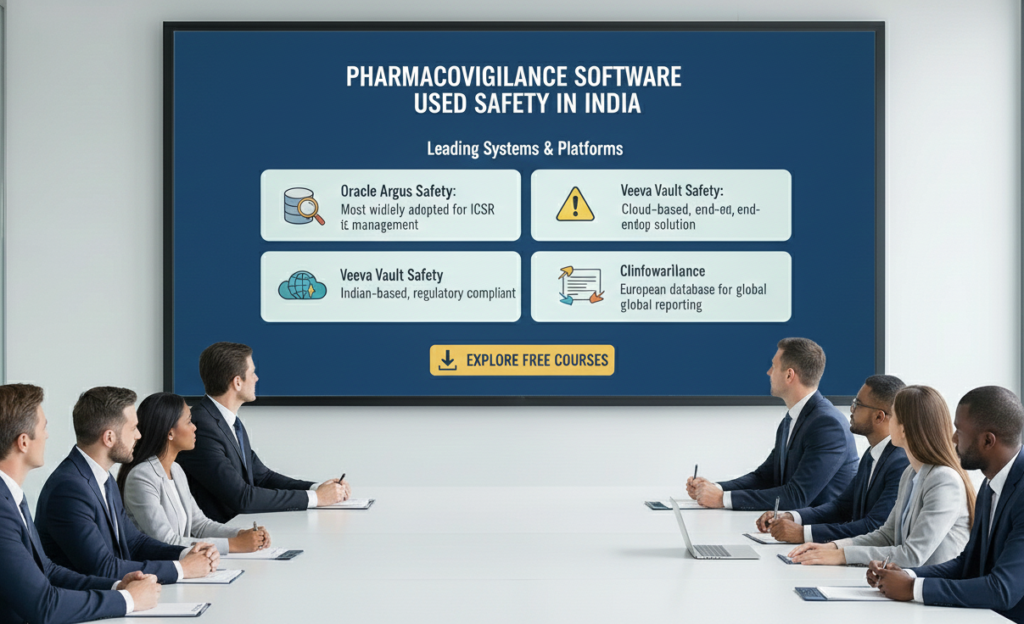
Pharmacovigilance Software Used in India
India has a strong pharmacovigilance ecosystem.
PvPI Tools
The Pharmacovigilance Programme of India uses tools integrated with WHO systems.
CDSCO Reporting Systems
ADR reporting portals connected to national regulatory authorities.
These pharmacovigilance tools for ADR reporting play a crucial role in India’s drug safety monitoring.
Pharmacovigilance Databases You Should Know
WHO VigiBase
The world’s largest pharmacovigilance database with reports from over 130 countries.
FAERS
The US FDA’s Adverse Event Reporting System.
EudraVigilance
European database for monitoring medicinal product safety.
For beginners, understanding how these pharmacovigilance databases work is a big career advantage.
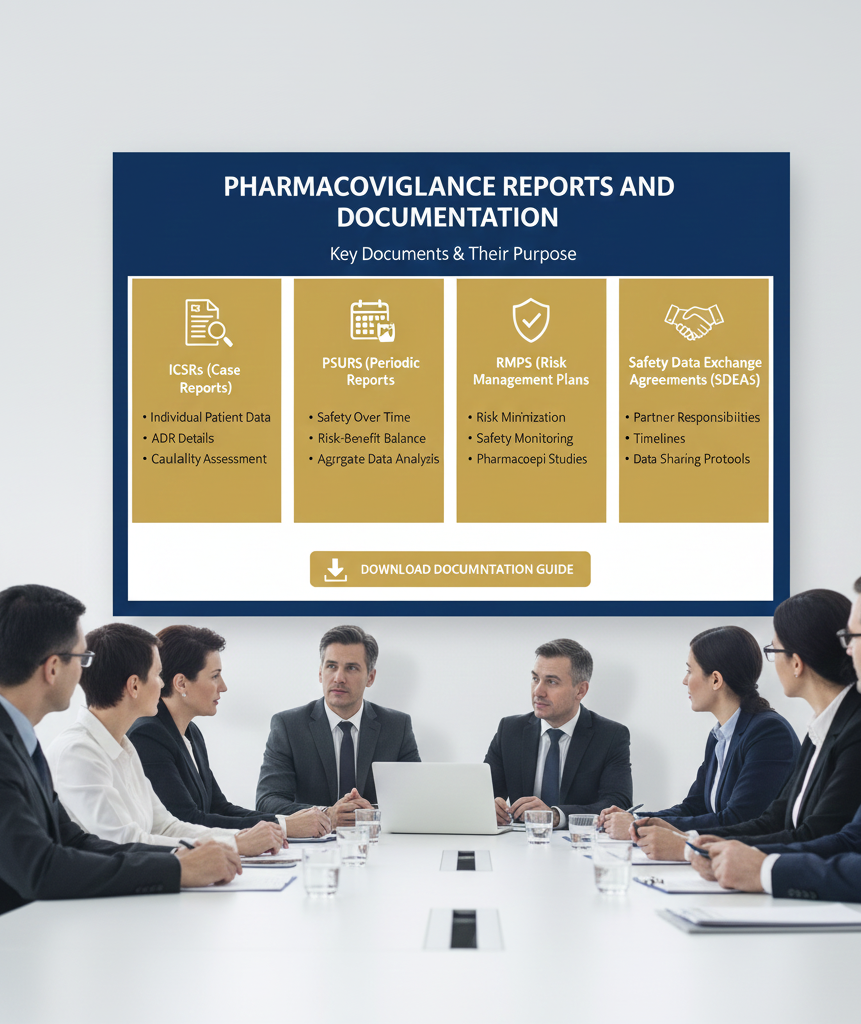
Pharmacovigilance Reports and Documentation
Individual Case Safety Reports (ICSRs)
Detailed reports of suspected ADRs—core output of PV reporting tools.
Periodic Safety Update Reports (PSURs)
Summarize worldwide safety data at defined intervals.
Pharmacovigilance Examples in Real Life
Remember when certain painkillers were restricted due to heart risks? Or when warning labels changed for common antibiotics? These are classic pharmacovigilance examples where tools and systems saved lives.
Choosing the Right Pharmacovigilance Tools for Beginners
If you’re just starting:
- Learn basic ADR reporting tools first
- Get hands-on exposure to at least one PV software
- Understand databases before advanced signal detection
Start small, then scale.
Future of Pharmacovigilance Tools and PV Software
AI, machine learning, and real-world evidence are shaping the future. Tomorrow’s pharmacovigilance systems will predict risks before they happen—like a weather forecast for drug safety.

Conclusion
Pharmacovigilance tools are the silent guardians of patient safety. For beginners, understanding pharmacovigilance tools and software isn’t just about learning systems—it’s about understanding responsibility. Whether you aim to work in pharma, regulatory affairs, or medical writing, mastering pharmacovigilance systems opens doors to a future-proof career.

FAQs
1. What are pharmacovigilance tools?
They are systems, software, and methods used to monitor drug safety and report ADRs.
2. Which pharmacovigilance software is best for beginners?
Oracle Argus Safety and VigiFlow are commonly recommended.
3. What is PV reporting?
PV reporting involves documenting and submitting adverse drug reactions to authorities.
4. Are pharmacovigilance tools used in India different?
India uses global tools along with PvPI and CDSCO systems.
5. Can non-pharmacists work with pharmacovigilance tools?
Yes, life science graduates and medical writers can build strong PV careers.