
Table of Contents
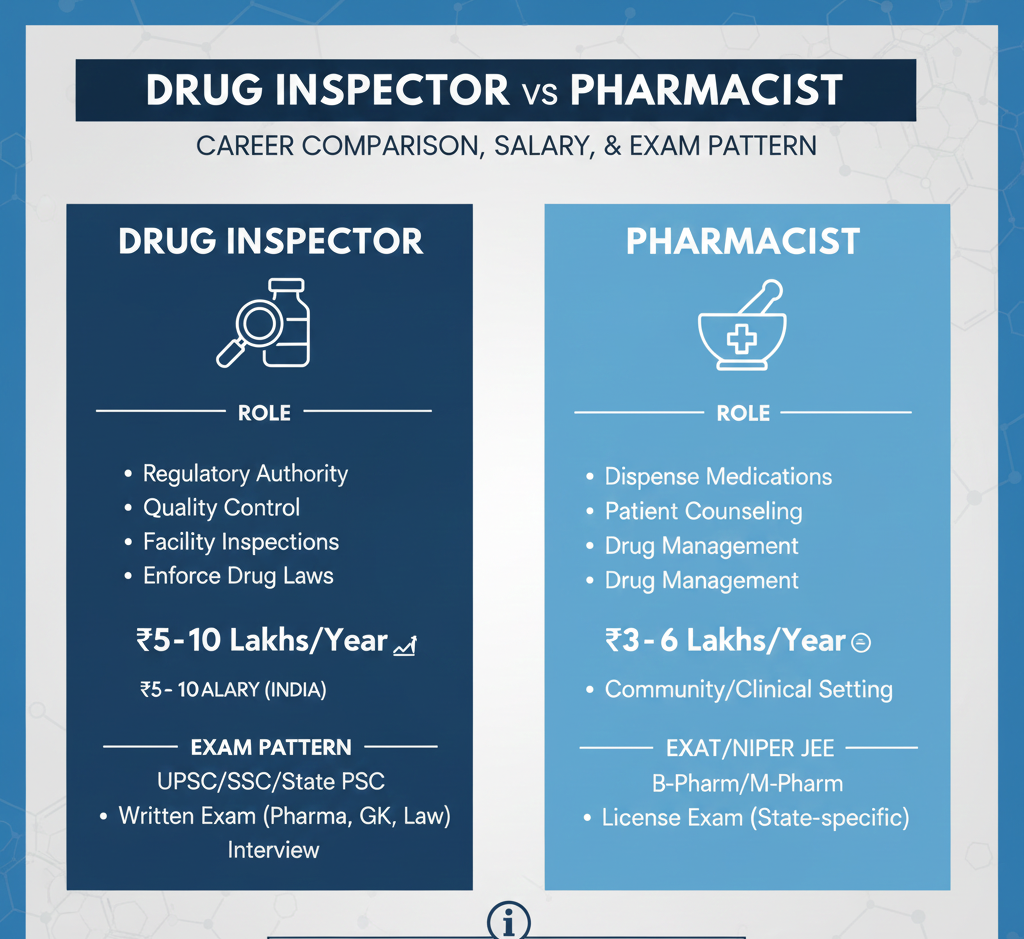
The pharmaceutical world in India isn’t just about making and selling medicines — it’s also about protecting public health, regulating quality, and ensuring medicines are safe. As India’s pharma sector grows, roles like Drug Inspector and Pharmacist play a pivotal role. While both interact with medicines, their purposes, responsibilities, and career paths differ significantly. In this article, we’ll dive deep into what sets these two professions apart, whether you’re thinking about pursuing a career in regulation or patient-facing pharmacy work.
Who is a Drug Inspector?
Definition and Purpose
A Drug Inspector is a regulatory officer — typically a government-appointed official — entrusted with ensuring that drugs, medicines, and medical devices available in the market meet safety, quality, and legal standards. Their work is vital to enforce the norms laid down by law and to prevent unsafe or counterfeit medicines from harming the public.
Typical Role and Mandate
The primary duty of a Drug Inspector is inspection and oversight. That means checking manufacturing units, wholesale or retail pharmacies, distribution centers — anywhere where medicines or medical devices are made, stored, or sold. They sample products, ensure compliance with the Drugs and Cosmetics Act, 1940 and associated regulations, and take action if there are violations.
They can revoke licenses, seize unsafe or expired drugs, order recalls, and even initiate legal proceedings when required.
Types of Workplaces
Drug Inspectors may work under central agencies like the Central Drugs Standard Control Organisation (CDSCO) or various State Drug Control Departments.
Their role can involve field inspections, lab testing oversight, regulatory compliance, and sometimes, litigation or administrative duties.
Who is a Pharmacist?
Definition and Role Overview
A Pharmacist is a healthcare professional specially trained to handle medicines. Their core responsibilities revolve around ensuring that patients receive the correct medicines, understand usage, and are made aware of potential side effects or drug interactions. In short — they are the bridge between medicines and patients, or between doctors’ prescriptions and safe consumption.
Typical Responsibilities
Pharmacists dispense prescription medicines, advise patients on dosage, usage, and side effects. They maintain inventory, manage stock in pharmacies or hospitals, ensure expiry checks, and sometimes provide additional services like counselling on medicines, checking drug interactions, and guiding patients on proper medication usage.
In some settings — hospitals, clinics, clinical trials or pharmaceutical companies — pharmacists may also work in quality control, regulatory affairs, or even research supporting drug safety and compliance.
Where They Usually Work
Pharmacists find roles in retail pharmacies (local medical shops), hospitals, clinics, pharmaceutical companies, manufacturing units, quality-control labs, or even in research and regulatory sectors.
Educational Requirements
For Drug Inspector
To be eligible for a Drug Inspector post one typically needs a degree in Pharmacy — usually a B.Pharm (Bachelor of Pharmacy), or relevant specialization in pharmaceutical sciences.
Some state or central body notifications may also list qualifications such as Pharmacology, Microbiology or related fields depending on regulatory needs.
For Pharmacist
A standard path is completing either a Diploma in Pharmacy (D.Pharm) or B.Pharm. After completing education, one often needs to register with the relevant state pharmacy council (or meet licensing requirements) to practice as a pharmacist.
Exam Patterns and Selection Process
Drug Inspector — Competitive Exam Route
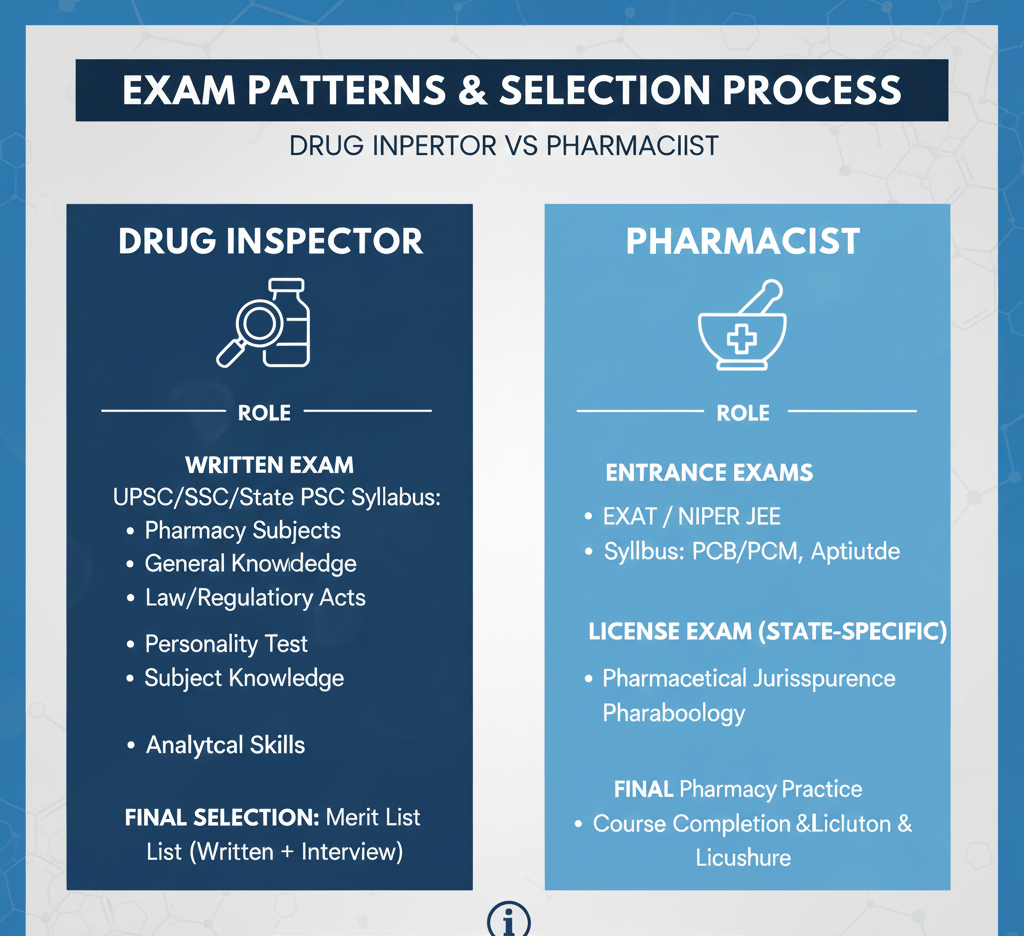
Becoming a Drug Inspector usually involves clearing a competitive examination conducted by central authorities (like UPSC) or state agencies (State PSCs).
The exam assesses knowledge in pharmacy, pharmaceutical laws (including Drugs and Cosmetics Act), quality control, microbiology or pharmacology, depending on the state syllabus. After the written test, there may be interviews or document verifications before final selection.
Pharmacist — Licensing / Registration
For pharmacists — after D.Pharm or B.Pharm, one must often register with the relevant regulatory council or authority to legally practice.
If applying for government or hospital roles, there may be additional selection criteria (depending on institution), but generally no competitive regulatory exam like for Drug Inspector — unless you’re going for a specialized or regulatory post.
Skills Required for Both
To succeed as a Drug Inspector or Pharmacist, certain skills and attributes are essential — though their emphasis differs with role:
- Analytical skills — to evaluate drug quality, legal compliance (for inspector) or dosage correctness (for pharmacist).
- Attention to detail — spotting discrepancies in documentation, labels, storage conditions, prescription errors.
- Communication skills — for pharmacists, explaining prescriptions/side-effects to patients; for inspectors, interacting with manufacturers, retailers, officials.
- Regulatory awareness & ethics — especially for Drug Inspectors, to ensure compliance with laws and ethical public-health practices.
- Problem-solving & decision-making — handling unexpected inspections or patient concerns; making calls on drug safety or prescriptions.
Roles and Responsibilities in Detail
Drug Inspector
- Inspect manufacturing units, distribution centers, pharmacies — from production to retail.
- Take samples of medicines or medical devices for lab testing to confirm quality and compliance.
- Enforce regulations under the Drugs and Cosmetics Act, revoke licenses or initiate actions when standards are violated.
- Record reports of inspections, maintain documentation of compliance or violations, and coordinate recalls if needed.
- Monitor storage and distribution — ensure conditions such as proper storage (temperature, labeling, expiry) are met.
Pharmacist
- Dispense medicines accurately as per prescription.
- Counsel patients on dosage, possible side-effects, interactions, and correct usage.
- Maintain pharmacy inventory, ensuring stock is managed, expired medicines removed, and supplies updated.
- Collaborate with doctors or healthcare staff (in hospitals/clinics) to support patient treatment — especially in clinical pharmacy or pharmacovigilance settings.
- In some instances — especially in larger hospitals or pharma companies — may be involved in quality control, drug safety monitoring, regulatory documentation, or research support.
Career Growth and Opportunities
Career Path for Drug Inspector
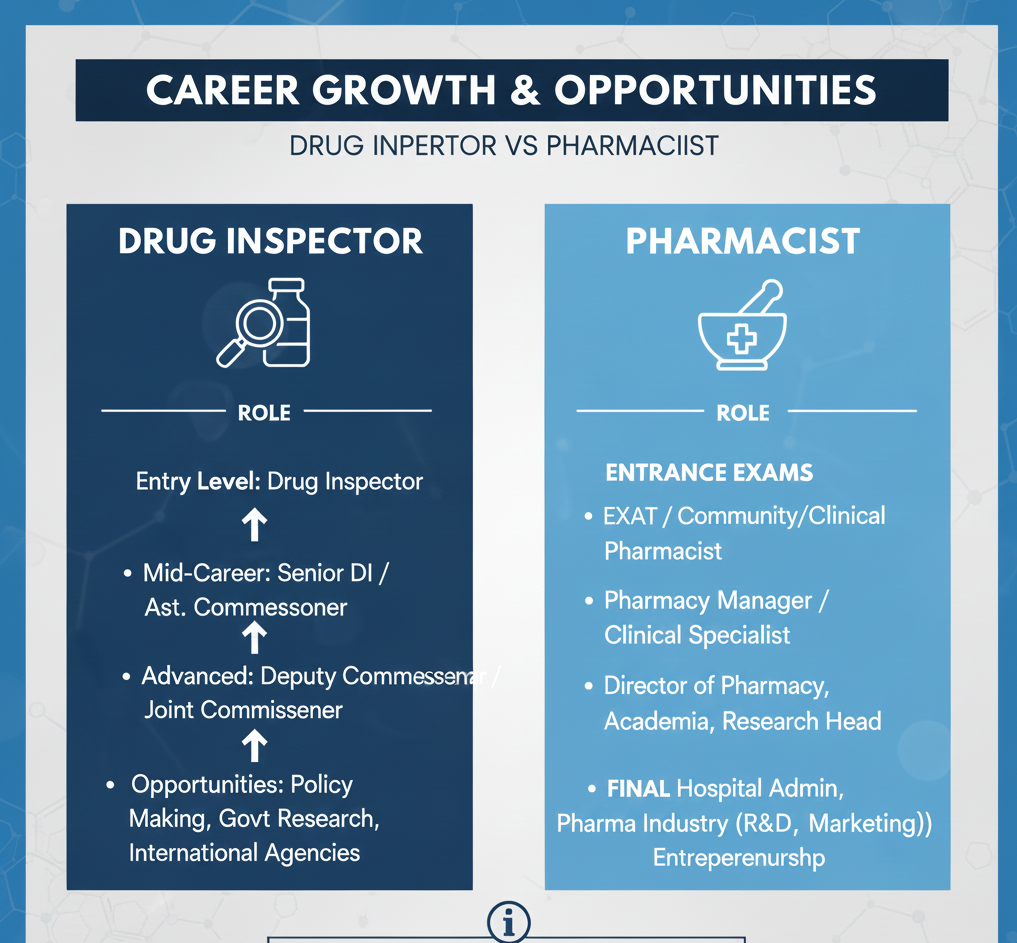
Once appointed, Drug Inspectors have structured progression: from entry-level inspector to Senior Drug Inspector, then perhaps to Assistant Drug Controller, Deputy Drug Controller, or even regulatory head roles (central or state) depending on experience and performance.
They may also work with central agencies like CDSCO, or state drug control departments, giving them exposure to national-level regulatory work.
Career Options for Pharmacists
Pharmacists have a more varied set of options: retail pharmacy, hospital pharmacy, clinical pharmacy, research, quality-control labs, pharmaceutical companies, regulatory support, even academia or teaching.
In hospital or clinical settings — especially with further specialization — pharmacists can evolve into clinical pharmacists, medication therapy experts, or work in pharmacovigilance and drug safety units.
Salary Comparison and Perks
Drug Inspector
- For central government posts under the 7th Pay Commission, pay scale is ₹47,600 – ₹1,51,100 depending on grade and seniority.
- Gross starting salary may typically be around ₹55,000–₹65,000/month.
- Considering additional allowances — Dearness Allowance (DA), House Rent Allowance (HRA), Transport/Travel Allowance (TA), medical benefits — in-hand salary can be significantly higher.
- With experience and promotions, salary rises, and senior roles may have quite comfortable compensation.
Pharmacist
- In private setups or retail pharmacies, starting salaries may be modest (varies widely by employer, region, demand). According to some trends, private-sector pharmacists may earn lower — ~ ₹15,000–₹60,000/month depending on experience and location.
- For government or hospital-based pharmacists, pay scales may be better — depending on hospital/organization pay levels (less than inspectors but stable).
- Since many pharmacists also work in private retail, variability is high; career growth may depend on individual skill, additional training, and workplace.
Job Security and Stability
- Drug Inspector — as a government regulatory position, this offers high job security, regulated pay structure, pension (in many cases), and perks like allowances, medical benefits, job stability.
- Pharmacist — job stability depends heavily on employer and sector (private vs public). Hospital or institutional pharmacists may have stable roles, while retail or private sector pharmacists may face pay or demand fluctuations.
Work-Life Balance
- Drug Inspectors — the role often includes inspections, field visits, licensing checks, compliance audits. This can involve travel, unpredictable schedules depending on inspections or regulatory duties, which may make work-life balance challenging.
- Pharmacists — depending on workplace. Retail pharmacies may have shift-based work; hospitals may have structured shifts; clinical or industry roles may have more regular hours. Workload can vary, but generally offers more predictable timing compared to inspector duties.
Pros and Cons: Drug Inspector
Advantages
- Prestigious government/regulatory role with respect and authority over drug safety oversight.
- Good salary with allowances, pension/benefits, and job security.
- Clear career progression path via seniority and regulatory promotions.
- Opportunity to contribute directly to public health and drug safety at national/state level.
Challenges
- High responsibility — mistakes or negligence can have serious public health consequences.
- Frequent inspections, travel, possibly irregular hours depending on tasks.
- Pressure to maintain regulatory compliance; possible legal/administrative burden.
- Limited private-sector options compared to pharmacists — mostly government/regulatory domain.
Pros and Cons: Pharmacist
Advantages
- Direct interaction with patients — ability to help people understand medicines, improve health outcomes.
- Flexibility: choose retail, hospital, clinic, industry, research, or pharma company roles.
- Demand in many sectors — hospitals, retail pharmacies, pharma industry — so easier to find jobs depending on location.
- Varied career paths: clinical pharmacy, research, quality control, pharma sales, regulatory support — opportunity to specialize.
Challenges
- Private sector remuneration may be modest, especially at entry-level.
- Shift work or long hours (in hospitals/retail) — possibly less stable than typical day-job.
- Depending on employer, benefits may be limited compared to a government role.
- Need for continuous learning — drug formulations, regulations, patient counselling, new medicines — to stay relevant.
Industry Demand and Future Scope
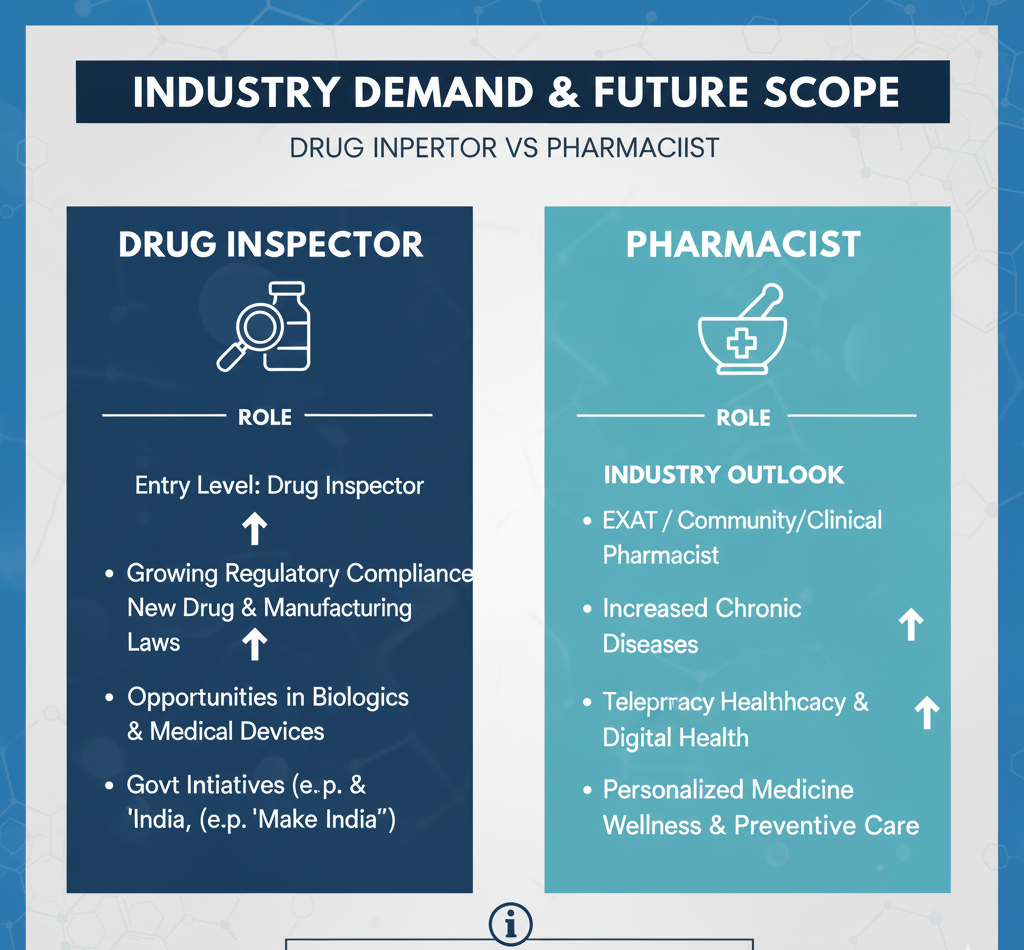
With the pharmaceutical sector in India expanding rapidly — more manufacturing, stricter regulation, increased emphasis on drug safety and quality — demand for regulatory officers like Drug Inspectors is likely to remain strong. Regulatory scrutiny is tightening, which means more roles for inspectors, compliance officers, and quality assurance professionals.
At the same time, the demand for pharmacists is also rising: hospitals are expanding, retail pharmacies are growing, and pharmaceutical companies need qualified personnel for dispensing, supply-chain, quality, research, and compliance. Clinical pharmacy, pharmacovigilance, and regulatory support roles are emerging as specialized career paths.
If you enjoy regulatory work, law-compliance, and inspection — Drug Inspector is a strong choice. If you prefer patient care, medicine usage, dispensing, or have interest in pharma-industry work — being a Pharmacist offers variety and flexibility.
Conclusion
Both Drug Inspector and Pharmacist roles are essential for the healthcare and pharmaceutical ecosystem. A Drug Inspector ensures that medicines are safe, compliant, and legally distributed — a guardian of public health and regulatory ethics. A Pharmacist connects patients with the right medicines, advises on usage and safety, manages stock, and often serves as the face of medicine-dispensing.
If you value stability, regulatory authority, and a defined government career path — the role of Drug Inspector may suit you best. But if you prefer working closer to patients, enjoy variety, or want flexibility in workplace and specialization — Pharmacist could give you more options. Both paths have strong demand; it ultimately depends on where your interest lies — oversight and regulation, or patient care and pharmacy services.
FAQs
1. What is the starting salary of a Drug Inspector?
Depending on central or state appointment, the starting in-hand or gross salary for a Drug Inspector can range around ₹55,000–₹65,000/month, along with allowances.
2. Can a Pharmacist become a Drug Inspector?
Yes — if a pharmacist has a B.Pharm (or equivalent degree recognized by the recruiting body), they can apply for Drug Inspector posts when eligible, provided they meet other selection criteria.
3. Which job offers better growth?
Drug Inspector offers structured growth within government regulatory framework, with potential promotions into senior regulatory roles. Pharmacist offers diverse paths — hospital, retail, industry, research, clinical pharmacy — giving flexibility. Both have good growth, depending on what you value: stability or variety.
4. Is a government job preferable for job security?
Generally yes — as a Drug Inspector under government service, you get regulated pay, allowances, pension or retirement benefits, job stability, and defined career ladder. Pharmacist job security depends on employer and sector, which can vary.
5. Do pharmacists need to appear for exams regularly?
Once a pharmacist completes required education (D.Pharm or B.Pharm) and registers/licences under relevant pharmacy council (if applicable), they usually do not need to appear for frequent exams — unless pursuing further specialization or government/hospital recruitment.
1 thought on “Drug Inspector vs Pharmacist: The Ultimate Breakdown of Advantages, Drawbacks & Exam Patterns”