
Table of Contents
Meta-analysis is the superhero of modern medical research 🦸♂️. When individual studies disagree, give mixed signals, or are too small to be convincing, meta-analysis steps in and brings clarity. It combines data from multiple studies and delivers one powerful, statistically solid conclusion.
If you have ever wondered how to do a meta-analysis,How to Analyze a Meta-Analysis , or even how researchers publish a meta-analysis research paper, this guide is written just for you.
Let’s break it down in simple, practical, and human terms.
What Is Meta-Analysis in Research?
Meta-analysis is a statistical technique that combines results from multiple independent studies on the same topic to calculate a single, more precise estimate of effect.
In simple words, it’s like asking ten doctors instead of one — and then mathematically combining their answers to get the most reliable truth.
In medical research, meta-analysis is used to:
- Compare treatments
- Evaluate drug safety
- Assess clinical outcomes
- Support guideline development
That’s why meta-analysis is considered the highest level of evidence in evidence-based medicine.
How to Analyze a Meta-Analysis and Why it Matters in Medical Research
A single clinical trial might show that Drug A works better than Drug B. Another trial may show the opposite. So which one should doctors trust?
Meta-analysis solves this confusion by:
- Increasing statistical power
- Reducing random error
- Improving confidence in conclusions
- Detecting small but important effects
This makes meta-analysis essential in clinical decision-making, pharmacovigilance, and regulatory science.
Meta-Analysis vs Systematic Review
Many people confuse these two, so let’s clear it up.
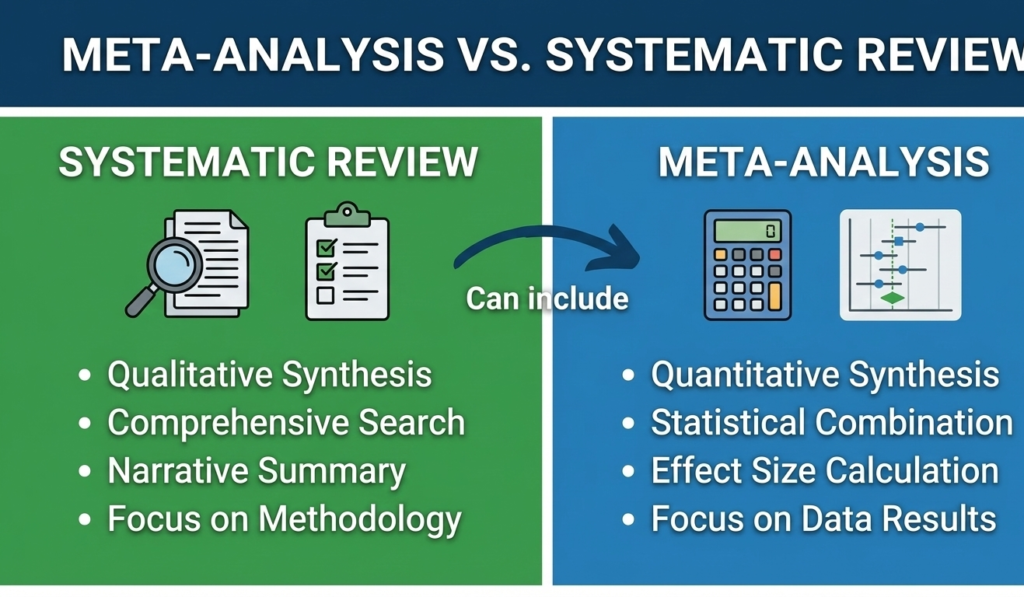
A systematic review is a structured way of collecting and critically analyzing all relevant studies on a topic.
A meta-analysis is the statistical part that may come after the systematic review.
How Meta-Analysis Builds on Systematic Reviews
You can do a systematic review without a meta-analysis.
But you cannot do a meta-analysis without a systematic review.
Think of it like cooking:
- Systematic review = gathering and preparing ingredients
- Meta-analysis = actually cooking the dish 🍳
When to Use Meta-Analysis
Meta-analysis is used when:
- Studies measure similar outcomes
- Data is quantitative
- Results can be pooled statistically
Types of Meta-Analysis
Not all meta-analyses are the same. Depending on the research question and data, different models are used.
Fixed-Effect Meta-Analysis
Assumes all studies are estimating the same true effect.
Random-Effects Meta-Analysis
Assumes that real differences exist between studies — this is more common in medical research.
Network Meta-Analysis
Compares multiple treatments simultaneously, even if they were not compared directly.
Individual Participant Data Meta-Analysis
Uses raw patient-level data instead of published summary data.
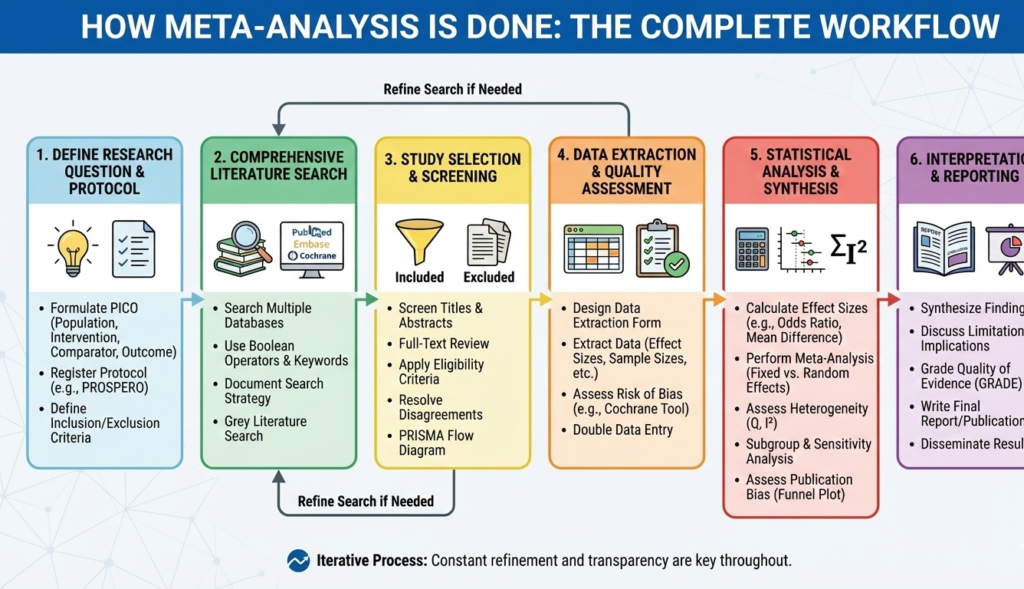
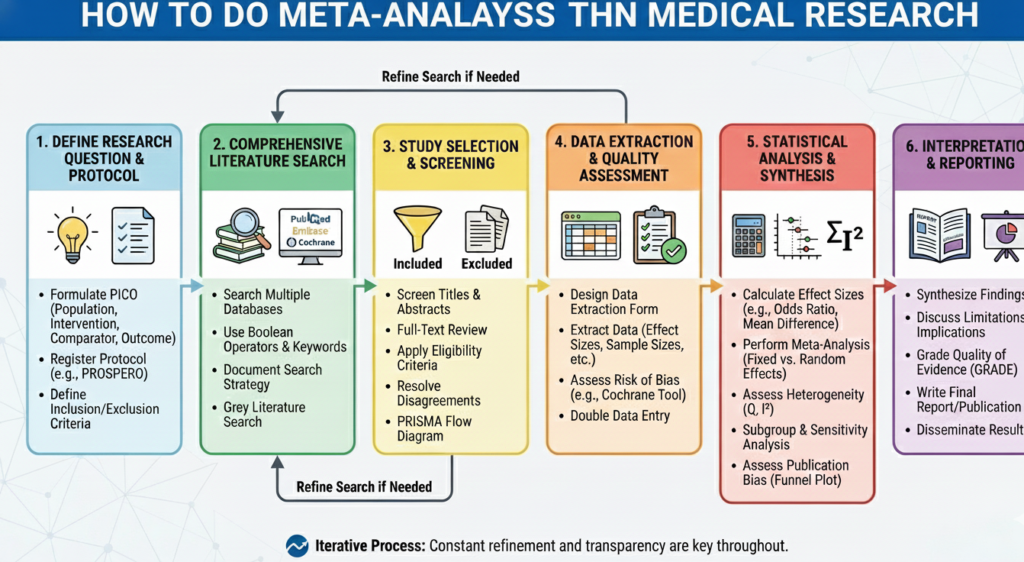
How to Analyze a Meta-Analysis: The Complete Workflow
This is where the magic happens.
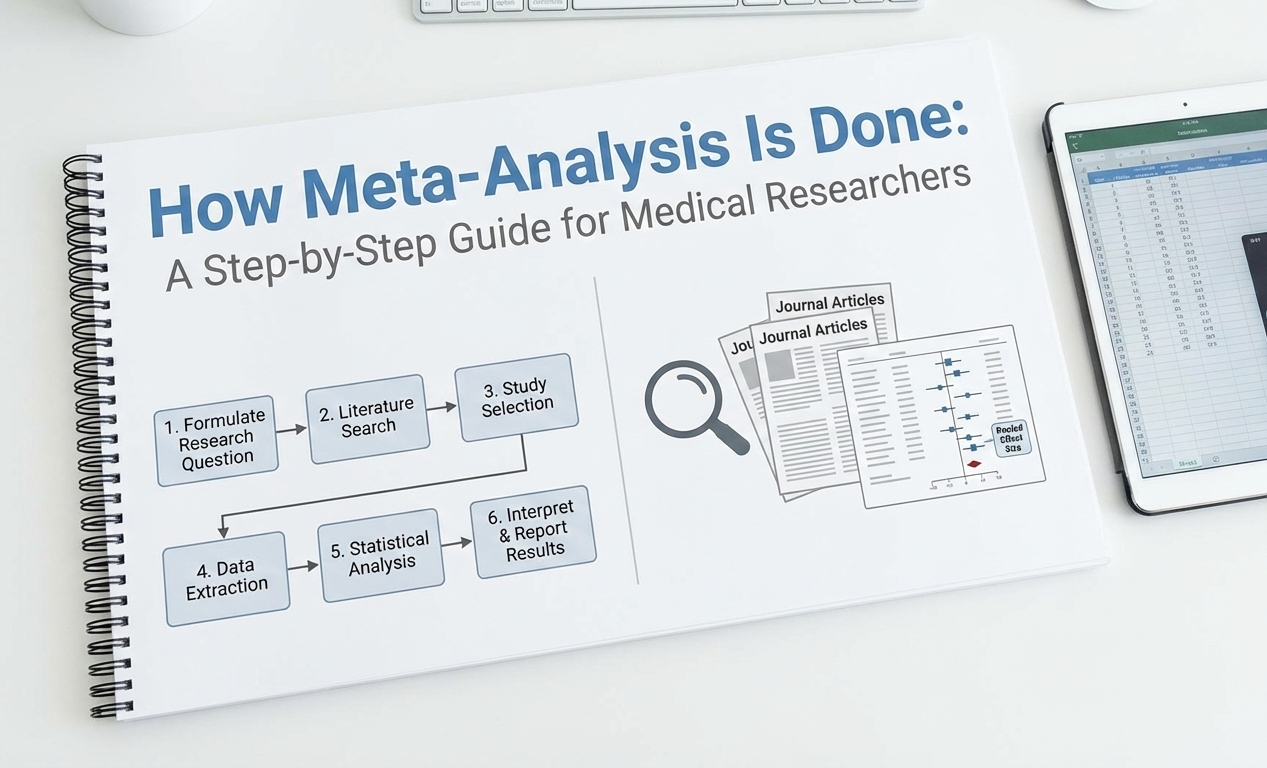
Step 1 – Framing a Research Question
Every meta-analysis begins with a clear, structured question, usually using PICO:
- Population
- Intervention
- Comparison
- Outcome
Example:
“Does Drug A reduce blood pressure more than placebo in adults?”
Step 2 – Conducting a Systematic Literature Search
Researchers search databases like:
- PubMed
- Scopus
- Cochrane Library
- Embase
Using carefully designed keywords to capture every relevant study.
Step 3 – Study Selection and Eligibility
Not every study qualifies. Researchers apply inclusion and exclusion criteria such as:
- Study design
- Population
- Outcome reporting
Only the best-fit studies are included.
Step 4 – Data Extraction
Important data are pulled from each study:
- Sample size
- Effect sizes
- Outcomes
- Standard deviations
This forms the backbone of the meta-analysis.
Step 5 – Assessing Risk of Bias
Each study is evaluated for:
- Selection bias
- Performance bias
- Reporting bias
Low-quality studies can distort results.
Step 6 – Choosing the Statistical Model
Fixed or random-effects models are selected based on heterogeneity.
Step 7 – Performing the Meta-Analysis
Now data is entered into meta-analysis software and pooled.
This generates:
- Combined effect size
- Confidence intervals
- P-values
Step 8 – Checking Heterogeneity
Heterogeneity tells us how different the studies are.
It is measured using I² statistics.
High I² = studies differ a lot
Low I² = studies are similar
Step 9 – Publication Bias Assessment
Researchers use funnel plots and statistical tests to see whether only positive studies were published.
Step 10 – Interpreting the Results
Now comes the most important part — understanding what the numbers actually mean for real patients.
How to Analyze a Meta-Analysisin Medical Research
Medical meta-analysis focuses on:
- Mortality
- Disease progression
- Adverse events
- Treatment response
Clinical Outcomes and Effect Sizes
Outcomes are expressed as:
- Risk ratios
- Odds ratios
- Mean differences
These tell us how much better or worse a treatment is.
Common Pitfalls in Medical Meta-Analysis
- Mixing poor-quality studies
- Ignoring heterogeneity
- Overinterpreting small effects
Good meta-analysis requires both statistical skill and clinical sense.
How to Analyze a Meta-Analysis
Reading a meta-analysis can feel intimidating. Here’s how to decode it.
Understanding Forest Plots
Each line represents a study.
The diamond at the bottom shows the pooled result.
If the diamond crosses the line of no effect → not significant.
Reading Funnel Plots
These show whether small negative studies are missing — a sign of publication bias.
Interpreting P-Values and Confidence Intervals
- P < 0.05 = statistically significant
- Narrow CI = precise estimate
- Wide CI = uncertainty

Meta-Analysis Software
Doing this manually would be a nightmare. That’s why we use software.
Best Meta-Analysis Software
- RevMan
- Stata
- Comprehensive Meta-Analysis
- R (meta, metafor packages)
Meta-Analysis Software Free Options
If you’re on a budget:
- RevMan (from Cochrane)
- R
- JASP
These are powerful and widely accepted.
How to Write a Meta-Analysis Research Paper
A meta-analysis paper includes:
- Abstract
- Introduction
- Methods
- Results
- Discussion
- Forest plots and tables
Transparency and reproducibility are everything.

How to Analyze a Meta-Analysis–Courses Online
Want to learn this skill properly? There are excellent options available.
Meta-Analysis Course Free with Certificate
| Course Name | Platform | Free to Access? | Certificate Available? | Useful For |
| Introduction to Systematic Review and Meta-Analysis | Coursera (Johns Hopkins University) | ✅ Free to enroll in course materials | ⚠️ Certificate requires purchase or financial aid | How to do meta-analysis & systematic review, research methods |
| Systematic Reviews and Meta-Analysis | Open Learning Initiative (OLI) & Campbell Collaboration | ✅ Free to access learning materials | ❌ No official certificate | Concepts and workflow of systematic reviews + meta-analysis |
| Introduction to Systematic Review and Meta-Analysis (alternative access) | Coursesity listing of Coursera course | ✅ Free course overview materials | ⚠️ Certificate via Coursera pathway | Core meta-analysis methodology |
Tips on Earning Certificates for Free
- Coursera Financial Aid: You can apply for financial aid on Coursera’s Introduction to Systematic Review and Meta-Analysis course to get a certificate for free or at reduced cost.
- Audit vs. Certificate: Many platforms allow you to audit courses for free (access lectures and quizzes). Certificates often require payment unless aided by a scholarship.
Future of Meta-Analysis in Evidence-Based Medicine
With AI, big data, and global collaboration, meta-analysis is becoming faster, smarter, and more powerful. It will continue to shape clinical guidelines and patient care for decades.

Conclusion
Meta-analysis is not just a statistical tool — it is the backbone of evidence-based medicine. Whether you want to know how meta-analysis is done, how to analyze a meta-analysis, or how to publish one, the principles remain the same: structured search, careful selection, sound statistics, and thoughtful interpretation.
Master this skill, and you unlock the ability to influence clinical practice worldwide 🌍.

FAQs
1. What is the difference between meta-analysis and systematic review?
A systematic review collects and evaluates studies, while meta-analysis statistically combines their results.
2. Can beginners do meta-analysis?
Yes, with proper training and software, even beginners can perform meta-analysis.
3. Which software is best for meta-analysis?
RevMan and R are the most popular free options.
4. How long does a meta-analysis take?
From weeks to months, depending on topic and number of studies.
5. Are online meta-analysis courses worth it?
Absolutely. Many free and paid courses provide practical, job-ready skills.