

Table of Contents

Introduction to HEOR
Ever wondered how governments, hospitals, and pharma companies decide whether a drug is worth its price? That’s where HEOR steps in. Think of HEOR as the bridge between medicine and money, ensuring patients get effective treatments without breaking the healthcare system.
Why HEOR Matters in Modern Healthcare
Healthcare budgets are limited, but patient needs are unlimited. HEOR helps decision-makers answer tough questions like: Is this new drug better than the old one? Is it cost-effective? Does it really improve quality of life?
The Growing Demand for Value-Based Healthcare
With rising healthcare costs, the world is shifting from “how much” to “how much value.” HEOR is the backbone of this value-based approach.
HEOR Meaning and Full Form
HEOR Full Form
HEOR stands for Health Economics and Outcomes Research.
What Is HEOR in Healthcare?
In healthcare, HEOR evaluates clinical outcomes, quality of life, and economic impact of treatments, devices, and health programs.
What Is HEOR in Pharma?
In pharma, HEOR supports drug pricing, reimbursement, market access, and health technology assessment (HTA). Without HEOR, many drugs wouldn’t make it to patients.

Health Economics and Outcomes Research (HEOR) Explained
HEOR is like a healthcare compass—it tells us where to invest resources for maximum benefit.
Core Components of HEOR
Health Economics
Focuses on:
- Cost-effectiveness analysis (CEA)
- Cost-utility analysis (CUA)
- Budget impact analysis (BIA)
Outcomes Research
Looks at:
- Clinical outcomes
- Patient-reported outcomes (PROs)
- Health-related quality of life (HRQoL)
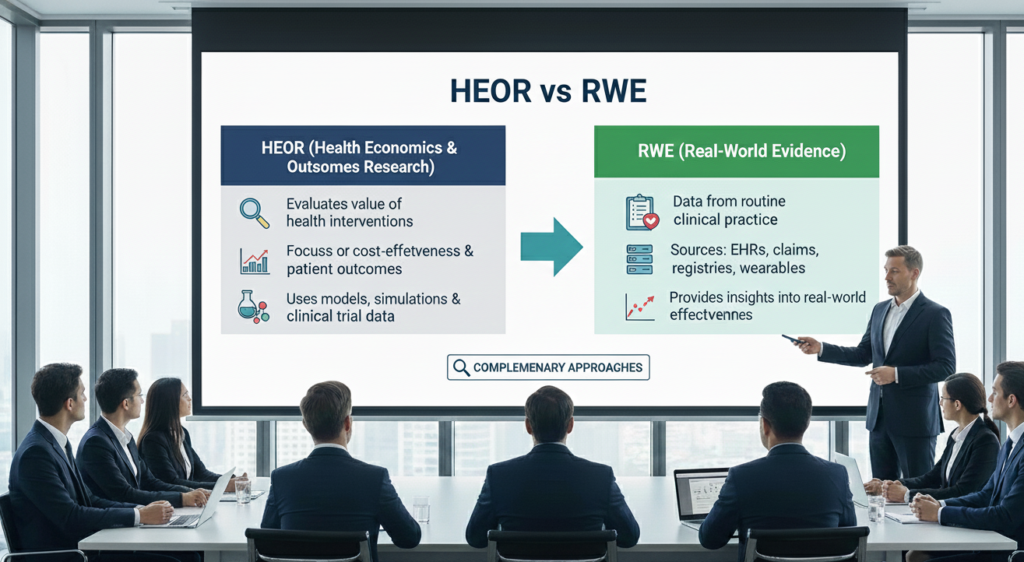
HEOR vs RWE
What Is RWE?
Real-World Evidence (RWE) comes from real-life data such as electronic health records, claims data, and registries.
Difference Between RWE and HEOR
- RWE is the data
- HEOR is the analysis and interpretation
RWE often feeds into HEOR studies, but HEOR goes beyond just data—it answers economic and policy questions.
HEOR Services and Their Role
HEOR Services in Pharma Companies
HEOR services include:
- Cost-effectiveness modeling
- Value dossiers
- HTA submissions
- Reimbursement strategy
HEOR Consulting and CROs
Many pharma companies outsource HEOR to consulting firms and CROs specializing in health economics.

HEOR Certification ,Jobs and Career Opportunities
Common HEOR Job Roles
- HEOR Analyst
- Health Economist
- Market Access Manager
- Outcomes Research Scientist
- HTA Consultant
HEOR Jobs in India
HEOR jobs in India are growing fast, especially in:
- Global pharma companies
- CROs
- Consulting firms
- Academic research organizations
Salary of a Health Economist in India
On average:
- Entry-level: ₹6–10 LPA
- Mid-level: ₹12–20 LPA
- Senior roles: ₹25+ LPA
How to Become an HEOR Professional
Educational Background Required
Ideal degrees include:
- Pharmacy (BPharm/MPharm)
- Medicine
- Life Sciences
- Economics
- Public Health
Skills Needed for HEOR Careers
- Health economics modeling
- Statistics and data analysis
- Critical thinking
- Scientific writing
- Knowledge of HTA guidelines

HEOR Certifications and Courses
Importance of HEOR Certification
HEOR certification boosts credibility and helps you break into this niche field faster.
HEOR Courses Online Free
Many platforms offer free health economics courses with certificates, perfect for beginners.
| Course Name | Platform | Certificate | Cost |
| Health Economics and Health Technology Assessment | Alison | Yes (Alison certificate) | Free |
| HEOR Foundation & Advanced Courses (Health Economics & Outcomes Research) | iMTA e-Learning | Certificate (paid) | Free access to learning |
| Health Economics Course (Elevify) | Elevify | Yes | Free to start (certificate included) |
NPTEL Health Economics Course | NPTEL | Free audit, optional paid certification | Free (certificate fee applies) |
Who Should Study Health Economics?
Backgrounds Suitable for HEOR
- Pharmacy students
- Medical professionals
- Life science graduates
- Public health aspirants
- Data and policy enthusiasts
If you enjoy both numbers and narratives, HEOR is for you.
Founder of Health Economics
Brief History of Health Economics
Health economics as a discipline is largely attributed to Kenneth Arrow, whose work laid the foundation for economic analysis in healthcare.

HEOR in Pharma and Healthcare Decision-Making
Role in Pricing and Reimbursement
HEOR determines whether a drug gets reimbursed by payers and governments.
Role in Policy and HTA
Health Technology Assessment bodies rely heavily on HEOR evidence.
Goals of a Healthy Economy
Three Goals Explained Simply
- Efficient use of resources
- Equitable access to healthcare
- Sustainable economic growth
Future Scope of HEOR
HEOR Trends and Digital Health
With AI, real-world data, and personalized medicine, HEOR is becoming more data-driven and impactful than ever.
Conclusion
HEOR is no longer optional—it’s essential. Whether you’re a pharmacy student, healthcare professional, or researcher, understanding health economics and outcomes research opens doors to global careers, impactful work, and better healthcare decisions. If healthcare were a story, HEOR would be the editor making sure every chapter truly matters.

FAQs
1. What is the difference between RWE and HEOR?
RWE provides real-world data, while HEOR analyzes that data to assess value, cost, and outcomes.
2. How to become HEOR professional?
Start with a healthcare or economics background, learn HEOR fundamentals, and complete relevant certifications.
3. Who should study health economics?
Anyone interested in healthcare decision-making, policy, or pharma strategy.
4. What is the salary of a health economist in India?
It ranges from ₹6 LPA for beginners to ₹25+ LPA for senior professionals.
5. What are the three goals of a healthy economy?
Efficiency, equity, and sustainability.